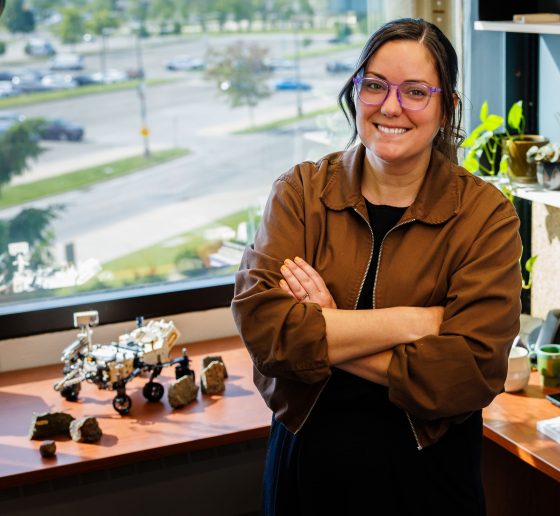
Specialties: Meteorite Petrology, Shock Metamorphism, Planetary Geoscience
Assistant Professor (Teaching Stream), Brock University 2025 – Present
Associate Curator of Mineralogy, Royal Ontario Museum 2024 – 2025
Research Associate & Course Instructor, Brock University 2021 – 2024
Environmental Consultant/E.I.T., WSP Canada 2013 to 2016
Ph.D. Earth Sciences, University of Toronto
B.Sc. Eng., Geological Engineering, Queen’s University
Do you think you found a meteorite and need help with identification and/or classification? Please don’t hesitate to reach out to me at [email protected]
Meteorite Features to look for:
- Dark fusion crust – a thin, dark coating that forms as the meteorite’s outer surface melts during atmospheric entry. Fresh fusion crust is commonly black and may become brown or rusty with weathering.
- Magnetism – many meteorites contain iron-bearing minerals and are attracted to a magnet, although not all meteorites are strongly magnetic.
- High density – meteorites often feel unusually heavy for their size because they commonly contain metal-rich minerals.
- Metallic grains – freshly cut or broken surfaces may contain small, shiny grains of iron-nickel metal.
- Chondrules – if the specimen can be safely cut with a rock or tile saw, look for small, rounded or spherical features in the interior. These may be chondrules, which are characteristic of chondritic meteorites (the most common type).
- Regmaglypts – some meteorites have shallow, thumbprint-like depressions on their surfaces produced during atmospheric entry.
- Rounded or smoothed edges – atmospheric heating can soften sharp corners and produce a somewhat rounded exterior.
- Little or no vesicles – most meteorites do not contain abundant holes or bubbles. Highly vesicular rocks are usually terrestrial volcanic rocks or industrial slag.
- No obvious quartz crystals – visible quartz is uncommon in meteorites and usually suggests a terrestrial rock.
Teaching
- ERSC 1P01 Planet Earth: Solid Earth
- ERSC 2P93 Mineralogy I: Minerals, Rocks, and their Geologic Context
- ERSC 2P24 Mineralogy II: Crystallography and Optics
- ERSC 3P21 Igneous & Metamorphic Petrology
- ERSC 3P99 Field Camp
- ERSC 4P05 Meteorite Petrology
- ERSC 3P96 Special Topics in Earth Sciences
- ERSC 4F91 BSc. Thesis
I am a scientific researcher passionate about learning about the origins of water and life in our Solar System, especially on Mars. I am currently a member of the PIXL Instrument Team on the Perseverance Rover, using X-ray Fluorescence data to unravel the geologic history of Jezero Crater, Mars.
My Earth-bound work includes the petrographic study and classification of meteorites, with a focus on shock metamorphism, endogenous metamorphism, and hydrous phases (specifically phosphate minerals and aqueous alteration products).
Current Projects:
- Groundtruthing data from the Mars 2020 PIXL instrument using terrestrial analogues
- Investigating endogenous metamorphism on Mars through analyses of meteorites and Mars 2020 data
- Analyzing minor phases with the Mars 2020 PIXL instrument
- Evaluating shock metamorphism in meteorites and Mars 2020 targets
- Mars and lunar regolith analogue science
- Developing a meteorite teaching collection at Brock University
- Developing accessible geological field methods
Analytical Techniques Focus: Optical Petrography, XRF, Raman Spectroscopy, and Electron Microscopy (SEM, EPMA, TEM, EBSD).
Kizovski, T. V., White, L. F., Černok, A., Tait, K. T., Di Cecco, V. E., Chu, X., Tomacic, J. M., Nicklin, R. I., and Darling, J. R (2026). Expanding Mars’ lithologic diversity: discovery of a garnet-bearing clast in NWA 8171. Geochemical Perspectives Letters, 40, 30–37. doi:10.7185/geochemlet.2619
Christian, J. R., VanBommel, S. J., Kizovski, T. V., Liu, Y., and Schmidt, M. E. (2026) Characterization of compositional endmembers in PIXL scans. Icarus, 453, 117060. doi:10.1016/j.icarus.2026.117060
Kizovski, T. V., Schmidt, M. E., O’Neil, L., Jones, M. W. M., Tosca, N. J., et al. (2025) Fe-phosphates in Jezero Crater as evidence for an ancient habitable environment on Mars. Nature Communications, 16, 6470. doi:10.1038/s41467-025-60026-7
Schmidt, M. E., Kizovski, T. V., Liu, Y., Hernandez-Montenegro, J. D., Tice, M. M., et al. (2025) Diverse and highly differentiated lava suite in Jezero crater, Mars: Constraints on intracrustal magmatism revealed by Mars 2020 PIXL. Science Advances, 11, eadr2613(2025). doi:10.1126/sciadv.adr2613
Shumway, A. O., Kizovski, T. V., Catling, D. C., VanBommel, S. J., Jones, M. W. M., et al. (2025) Mineralogically diverse and salt-rich regolith in Jezero Crater characterized using X-ray spectroscopy. Journal of Geophysical Research: Planets, 130, e2024JE008912. doi:10.1029/2024JE008912
Hernández-Montenegro, J. D., Kizovski, T. V., Treiman, A. H., Li, A. Y., Asimow, P. D., et al. (2025) Petrogenesis of the olivine cumulate outcrop Issole – The missing link between the Séítah and Máaz formations in Jezero crater, Mars. Icarus, 437, 116620. doi:10.1016/j.icarus.2025.116620
Lawson, P., Kizovski, T.V., Tice M., Clark,B., VanBommel, S., Thompson, D., Wade., L., Denise, R., Heirweigh, C., Elam T., Schmidt, M.E., Bornstein, B. (2025) Adaptive Sampling with PIXL on the Mars Perseverance Rover. Icarus, 429, 116433, ISSN 0019-1035, https://doi.org/10.1016/j.icarus.2024.116433.
Hurowitz, J. A., et al., including Kizovski, T.V. (2025) Redox-driven mineral and organic associations in Jezero Crater, Mars. Nature, 645, 332–340. doi:10.1038/s41586-025-09413-0
VanBommel, S.J., Sharma, S., Kizovski, T.V., Heirwegh, C. M., Christian, J. R., et al. (2025). Rare earth element assessment in Jezero crater using the Planetary Instrument for X-ray Lithochemistry on the Mars 2020 rover Perseverance: A case study of cerium. Icarus, 425, 116355.
Mansbach E.N., Kizovski, T.V., Scheller, E.L., Bosak, T., Mandon, L., et al. (2024) Likely Ferromagnetic Minerals Identified by the Perseverance Rover and Implications for Future Paleomagnetic Analyses of Returned Martian Samples (2024). Journal of Geophysical Research: Planets, 129, e2024JE008505.
https://doi.org/10.1016/j.icarus.2024.116355
Hausrath, E.M., Adcock, C.T., Berger, J.A., Cycil, L.M., Kizovski, T.V., McCubbin, F.M., Schmidt, M.E., Tu, V.M., VanBommel, S.J., Treiman, A.H., and Clark, B.C. (2024). Phosphates on Mars and Their Importance as Igneous, Aqueous, and Astrobiological Indicators. Minerals, 14, 591. https://doi.org/10.3390/ min14060591
Christian, J.R., VanBommel, S.J., Elam, W.T., Ganly, B., Hurowitz, J.A., Heirwegh, C.M., Allwood, A.C., Clark, B.C., Kizovski, T.V., Knight, A.L. (2023). Statistical characterization of PIXL trace element detection limits, Acta Astronautica, 212, 534-540, ISSN 0094-5765, https://doi.org/10.1016/j.actaastro.2023.08.032.
Liu, Y., Tice, M. M., Schmidt, M. E., Treiman, A. H., Kizovski, T. V., et al. (2022). An olivine cumulate outcrop on the floor of Jezero crater, Mars. Science., 377(6614), 1513–1519. https://doi.org/10.1126/science.abo2756
Farley, K. A., Stack, K. M., Shuster, D. L., Horgan, B. H. N., Hurowitz, J. A., Tarnas, J. D., Simon, J. I., Sun, V. Z., Scheller, E. L., Moore, K. R., McLennan, S. M., Vasconcelos, P. M., Wiens, R. C., Treiman, A. H., Mayhew, L. E., Beyssac, O., Kizovski, T. V., Tosca, N. J., Williford, K. H., Crumpler, L. S. … & M.P. Zorzano (2022). Aqueously altered igneous rocks sampled on the floor of Jezero crater, Mars. Science, 377(6614).
Kizovski, T.V., Izawa, M.R.M., Tait, K.T., Moser, D.E., Day, J.M.D., Hyde, B.C., White, L.F., Kovarik, L., Taylor, S.D., Perea, D.E., Barker, I.R., & Joy, B.R. (2020). Petrogenesis, alteration, and shock history of intermediate shergottite Northwest Africa 7042: Evidence for hydrous magmatism on Mars? Geochimica et Cosmochimica Acta, 283, 103–123. https://doi.org/10.1016/j.gca.2020.05.030
Darling, J.R., White, L.F., Kizovski, T.V., Černok, A., Moser, D.E., Tait, K.T., Dunlop, J., Langelier, B., Douglas, J.O., Zhao, X., Franchi, I.A., & Anand, M. (2020). The shocking state of apatite and merrillite in shergottite Northwest Africa 5298 and extreme nanoscale chlorine isotope variability revealed by atom probe tomography. Geochimica et Cosmochimica Acta. https://doi.org/10.1016/j.gca.2020. 11.007
White, L.F., Tait, K.T., Langelier, B., Lymer, E.A., Černok, A., Kizovski, T.V., Ma, C., Tschauner, O., & Nicklin, R.I. (2020). Evidence for sodium-rich alkaline water in the Tagish Lake parent body and implications for amino acid synthesis and racemization. Proceedings of the National Academy of Sciences of the United States of America, 117(21), 11217–11219. https://doi.org/10.1073/pnas.2003276117
Kizovski, T.V., Tait K.T., Di Cecco, V. E., White, L.F., & Moser, D. (2019). Detailed mineralogy and petrology of highly shocked poikilitic shergottite Northwest Africa 6342. Meteoritics & Planetary Science, 17, 1-17. https://doi.org/10.1111/maps.13255
White, L.F., Kizovski, T.V., Tait, K.T., Langelier, B., Gordon, L.M., Harlov, D., & Norberg, N. (2018). Nanoscale chemical characterisation of phase separation, solid state transformation, and recrystallization in feldspar and maskelynite using atom probe tomography. Contributions to Mineralogy and Petrology, 173(10), 87. https://doi.org/10.1007/s00410-018-1516-8
Tosca, N. J., et al., including Kizovski, T.V. (2025) In situ evidence for serpentinization within the Máaz formation, Jezero crater, Mars. Science Advances, 11, eadr8793. doi:10.1126/sciadv.adr8793
Treiman, A. H., et al., including Kizovski, T.V. (2025) The Brac/Dourbes olivine-cumulate rock, Séítah Formation, Jezero Crater floor, Mars: Its parent magma, and relation to basalts of the Máaz Formation (2025). Journal of Geophysical Research: Planets, 130, e2024JE008539. doi:10.1029/2024JE008539
Scheller, E.L., et al, including Kizovski, T.V. (2024). Inorganic interpretation of luminescent materials encountered by the Perseverance rover on Mars. Science Advances, 10, eadm8241. doi:10.1126/sciadv.adm8241
Udry, A., et al., including Kizovski, T.V. (2023). A Mars 2020 Perseverance SuperCam Perspective on the Igneous Nature of the Máaz formation at Jezero crater and link with Séítah, Mars. Journal of Geophysical Research. Planets, 128 (7), pp.e2022JE007440. doi:10.1029/2022JE007440
Sun, V. Z., et al., including Kizovski, T.V. (2023). Overview and results from the Mars 2020 Perseverance rover’s first science campaign on the Jezero crater floor. Journal of Geophysical Research: Planets, 128, e2022JE007613. https://doi. org/10.1029/2022JE007613
Scheller, E.L., et al, including Kizovski, T.V. (2022). Aqueous alteration processes in Jezero crater, Mars—implications for organic geochemistry. Science 378,1105-1110. doi:10.1126/science.abo5204
Tice, M.M., et al., including Kizovski, T.V. (2022). Alteration history of Séítah formation rocks inferred by PIXL x-ray fluorescence, x-ray diffraction, and multispectral imaging on Mars. Science Advances, 8, eabp9084. doi:10.1126/sciadv.abp9084