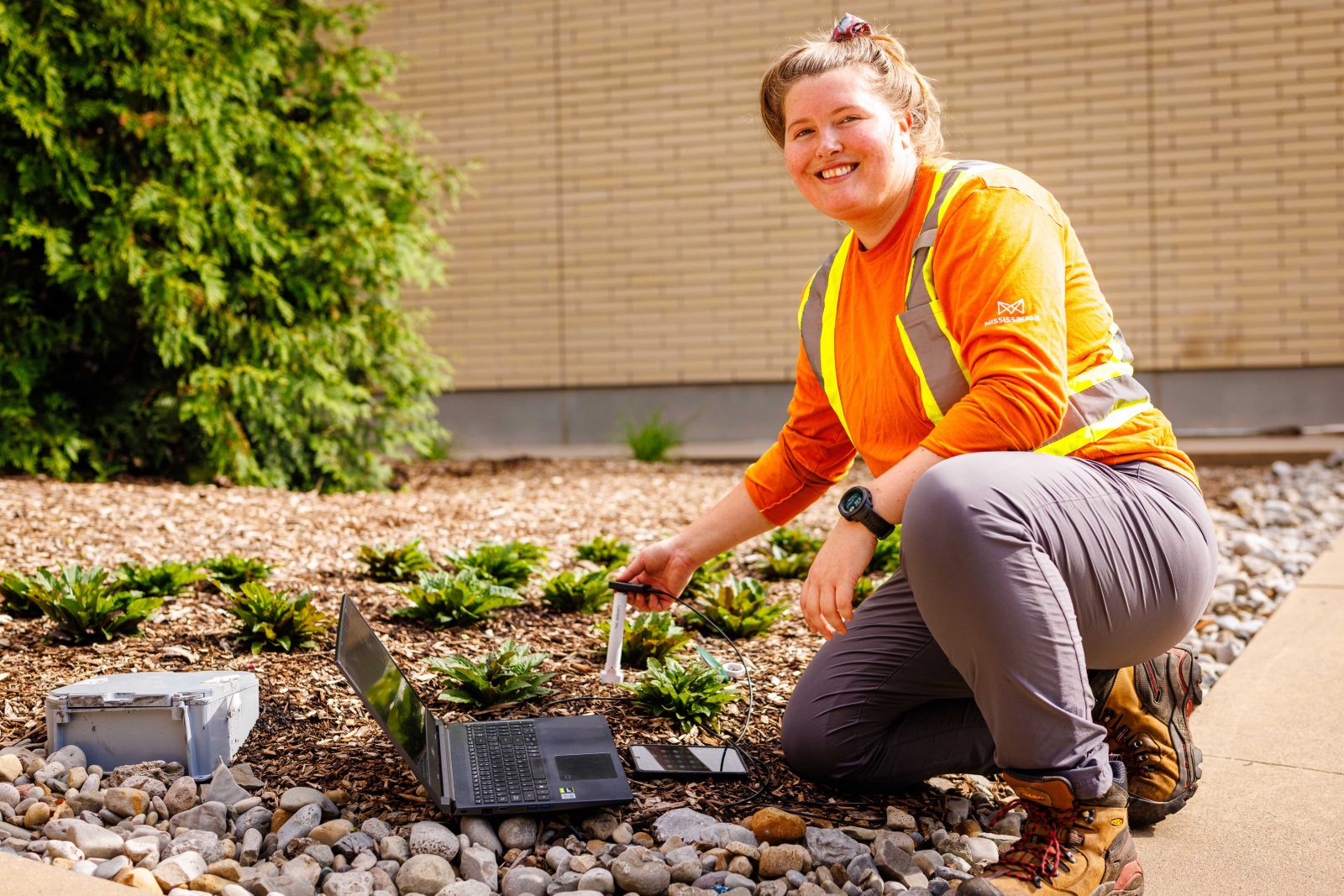
 Brock University graduate student Lindsay Taylor (BA '19) is conducting community-based research on rain gardens as a sustainable approach to urban stormwater management.
 Long before Lindsay Taylor (BA ’19) began her master’s in Earth Sciences at Brock University, she was already planting the seeds for a community-based research project exploring green infrastructure and sustainable flood mitigation strategies.
After studying Labour Studies and Psychology at the University and completing an Environmental Technician diploma and postgraduate studies in Ecosystem Restoration at Niagara College, Taylor spent several years working in sustainability roles across the region.
While serving as Sustainability Director for the St. Catharines Downtown Association (SCDA), she noticed the downspout of Silver Spire Church on St. Paul Street drained stormwater onto a patch of grass, making it an ideal location for a rain garden.
“A rain garden is a shallow, vegetated depression designed to capture stormwater runoff and give it more time and space to infiltrate into the soil rather than immediately entering the storm sewer system,” she says. “At the site scale, that can help reduce the volume and rate of runoff reaching municipal drainage infrastructure.”
While looking for ways the SCDA could explore sustainable urban drainage, Taylor reached out to Faculty of Mathematics and Science Experiential Education Co-ordinator Jason Causarano to see whether there might be an opportunity to collaborate.
Causarano connected Taylor with Assistant Professor of Earth Sciences Kelly Biagi. Students from Biagi’s Surface Hydrology course later worked with the SCDA on an urban hydrology modelling project examining flooding near St. Paul Street during high-intensity rainfall events.
“That was my first opportunity to work with Kelly,” Taylor says. “Later in my career, when I was ready to pursue a research project of my own, I reached out to ask if she would supervise it. That eventually grew into my master’s research on rain gardens and urban stormwater management.”
Taylor is monitoring how the rain gardens manage water under real-world conditions, including rainfall, infiltration, soil moisture and water movement, alongside changes in soil and water chemistry and vegetation establishment. Those observations will also inform hydrologic modelling to explore how rain gardens may perform under different conditions and designs.
“Lindsay has put an incredible amount of work, care and dedication into this project. She has taken an idea that began as a community need and turned it into a rigorous research project, while also building partnerships, co-ordinating field activities and taking on the many practical challenges that come with research in urban environments,” says Biagi. “Her commitment has been absolutely instrumental to the project’s success, and I’m incredibly proud of what she has accomplished.”
With help from partners across the region, Taylor has established research sites on City of St. Catharines property, including at the FirstOntario Performing Arts Centre, as well as at Silver Spire Church.
“I wanted community involvement and applied science to be at the heart of the project,” she says, adding that her work was inspired by the ways research, community knowledge and practical solutions could be intertwined to create greener, more resilient neighbourhoods.
Funding from TD Friends of the Environment Foundation and the Niagara Community Foundation (NCF) supported installation of the rain gardens.
“NCF is honoured to partner with Brock University, especially when we can support their efforts to increase community engagement, to be stewards of our natural environment and to champion a cause. This rain garden project is a fantastic example of that. Brock was able to bring together some strong partners to make this project happen, and we are so pleased to be able to help through our Environmental Grant program,” says Bryan Rose, NCF’s Executive Director.
“TD Friends of the Environment Foundation supports local projects that help protect and enhance the environment,” says Hannah Bradshaw, Regional Manager, Metro Ontario and Atlantic, TD Friends of the Environment Foundation. “Rain gardens are a simple way to help manage stormwater, bring more plants into urban spaces and show how small changes can make a difference in local communities. We’re pleased to support this research and the insights it may offer to other communities.”
Brock’s Facilities Management team also provided access to water and secure storage for hundreds of plants, while Walker Industries donated compost, the Niagara Artists Centre hosted rainfall monitoring equipment, City of St. Catharines staff provided access to municipal research sites and Niagara College provided access to its environmental laboratories to analyse the soil. Volunteers from the Brock Department of Earth Sciences’ Landscape Hydrology and Restoration Group, Niagara Green Herons environmental education program and First St. Catharines Girl Guides helped install the gardens.
“The greatest surprise has been seeing so many people rally around a shared goal,” Taylor says. “Kelly gave me the opportunity of a lifetime; to take an idea that started in the community and develop it into rigorous applied research. I’m incredibly grateful for her mentorship and for the partners who made that possible.”
Taylor hopes her research, which is scheduled to wrap up in late 2027, will provide evidence that municipalities and residents can use when considering where and how rain gardens fit into broader stormwater management strategies. Alongside the scientific findings, the project will produce practical tools to make rain gardens more accessible to residents, including a toolkit for assessing sites, selecting plants and designing gardens on private property.
A ceremony marking the official opening of the Downtown St. Catharines Rain Garden Project is scheduled for Tuesday, Sept. 22 from 10 to 11 a.m. at the FirstOntario Performing Arts Centre, located at 250 St. Paul St. in downtown St. Catharines.