 Brock University Earth Sciences master’s student Lindsay Taylor (BA '19) will officially open community rain gardens and unveil a community-created art installation on Tuesday, Sept. 22 from 10 to 11 a.m. at the FirstOntario Performing Arts Centre in downtown St. Catharines. The rain gardens and artwork have been created as part of Taylor’s master’s research.
When people walk through the heart of downtown St. Catharines, Lindsay Taylor (BA ’19) hopes they’ll see potential for a more sustainable future.
Next week, the Brock University Earth Sciences master’s student will host a public event to officially open rain gardens developed through a community-based research project and unveil an art installation meant to continue community conversations.
The outdoor ribbon-cutting ceremony will take place Tuesday, Sept. 22 from 10 to 11 a.m. on the west side of the FirstOntario Performing Arts Centre (PAC), 250 St. Paul St.
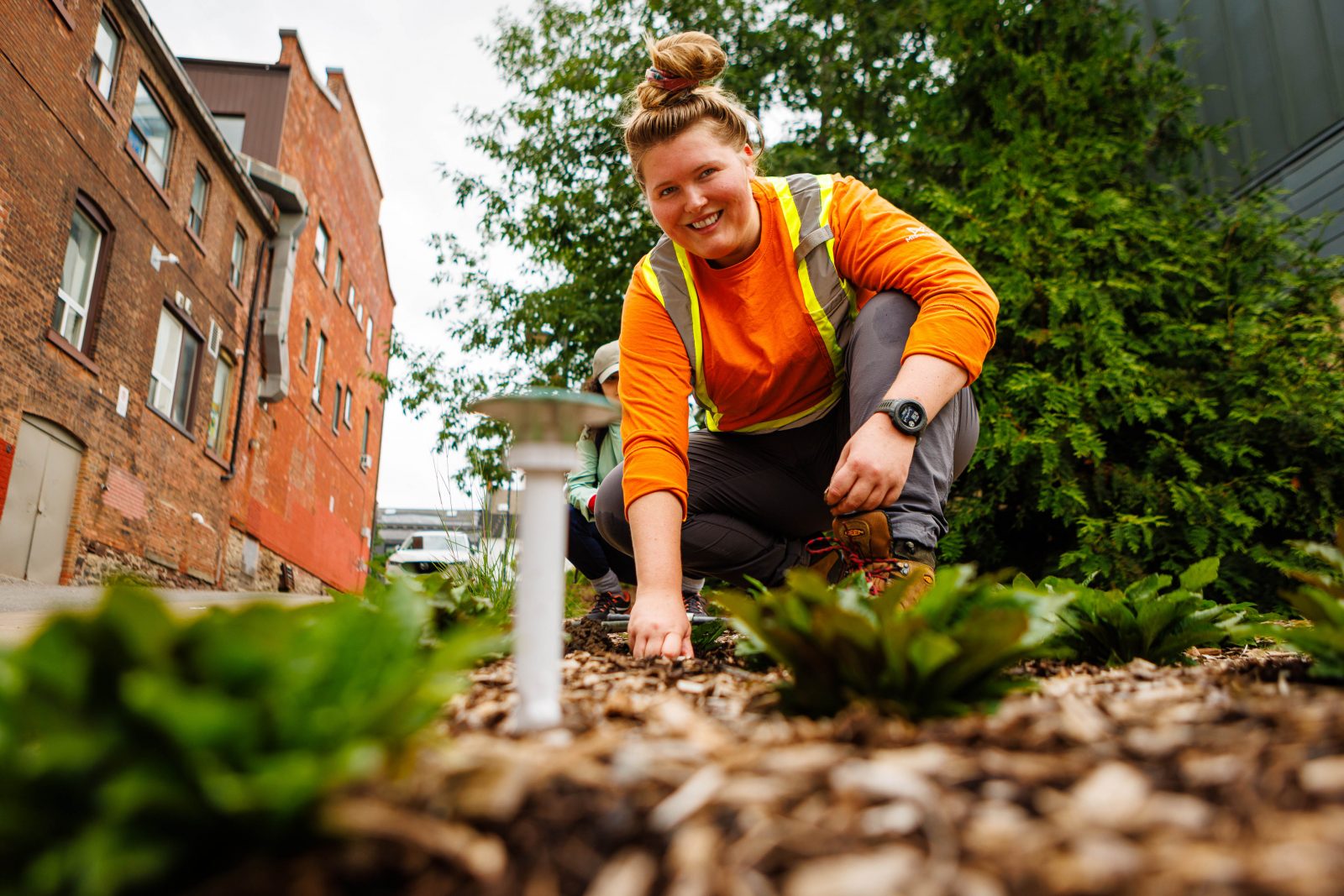
Rain gardens offer a green approach to reducing urban flooding issues — a challenge Niagara knows all too well in recent years. The shallow, vegetated depressions are designed to capture stormwater runoff, giving water more time and space to infiltrate into the soil rather than immediately entering the storm sewer system.
Through Taylor’s master’s research and a wealth of community support, rain gardens have been developed on City of St. Catharines property, including the PAC, as well as at Silver Spire Church, also downtown.
Paired with the PAC rain garden will be Potential, an outdoor art installation created by Taylor in collaboration with volunteers from Brock’s Department of Earth Sciences Landscape Hydrology and Restoration Group, Niagara Green Herons and Taylor’s husband, Dorian Cannon. The art installation uses a recovered root ball and a painted soil profile to uncover the hidden layers beneath the surface of a rain garden.
“The artwork is more than a visual addition to the project,” Taylor says. “It is an important component, a public touchpoint, for us.”
A QR code on the installation will direct visitors to information about the rain garden project and a short survey intended to help the research team understand public awareness and perceptions of rain gardens.
The public-facing element reflects the broader approach Taylor has taken to her Earth Sciences master’s research, which grew from her work at the St. Catharines Downtown Association (SCDA) and was fuelled by a desire to connect community priorities with applied science.
She’s examining how different soil conditions affect water movement using rain gardens.
“This project is a fantastic example of how academic research can directly support municipal and community goals,” says Assistant Professor of Earth Sciences Kelly Biagi, Taylor’s research supervisor. “By combining environmental science with public engagement, Lindsay’s work shows how hands-on green infrastructure initiatives can help our cities better understand and manage urban stormwater while connecting people to the science right in their own downtown.”
Taylor says the project has reinforced the value of taking research beyond the University and applying it to questions communities are already asking about stormwater, flooding and urban green space.
“There are big infrastructure and policy conversations happening around how our cities manage water, but there are also opportunities to ask what we can learn by working at the scale of a garden, a building or a downtown block,” she says. “For me, that connection between research and the community is really important.”
In addition to Brock researchers, students and the University’s Facilities Management and the Machine Shop teams, the project has also been supported by the City of St. Catharines, 1st St. Catharines Girl Guides, Meridian Centre, Niagara Artists Centre, Niagara College, Niagara Community Foundation, Niagara Green Herons, Off Campus Niagara, Silver Spire Church, SCDA, TD Friends of the Environment Foundation and Walker Industries.