Articles from:October 2021

  • Trail Management through Collaboration: Reflections and Aspirations

    Blog Contributor: John Foster
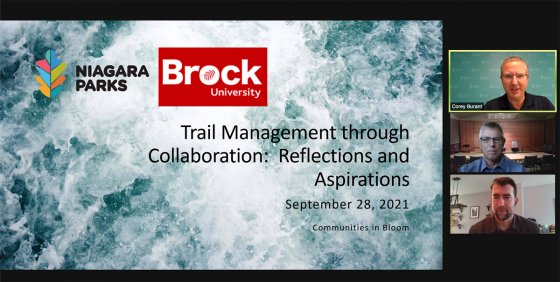
    The Trail Assets and Tourism Initiative (TATI) is an innovative partnership between Brock’s Environmental Sustainability Research Centre, the Niagara Parks Commission (NPC), and the Ontario Trails Council (OTC). The purpose of the partnership is to develop and enhance the parks and trails network operated by the NPC through research and collaboration. To date, the partnership team has developed strategies that support the NPC’s ability to manage park and trail assets to provide safe, enjoyable, and sustainable recreation opportunities for all. Most recently, two members of the TATI team, Garrett Hutson (Project Chair, Brock University) and Corey Burant (Program Manager of Forest Health, Niagara Parks Commission) were invited to discuss their experiences working on the partnership to Communities in Bloom, a Canadian non-profit dedicated to the improvement of civic spaces. I had an opportunity to catch up with both Hutson and Burant to further discuss the partnership and their joint presentation to Communities in Bloom.

    When asked about the significance of presenting the work of the TATI partnership to a larger audience, both Hutson and Burant acknowledged the utility and endless impacts of collaboration between agencies. Burant specifically acknowledged the challenges that are facing many parks and trails operators, including those at Communities in Bloom, as a result of increased visitor pressure from COVID-19, and discussed how important it is to share resources to commonly faced challenges for these agencies. Further, Hutson commented on the power of partnerships such as the TATI, musing that participants in similar partnerships are likely to benefit from the insight he and Burant shared about collaborative work during their presentation.

    Switching gears to focus on the TATI partnership itself, I asked both Hutson and Burant about their experiences working together, and what aspect of the partnership they found to be most valuable. For Hutson, the opportunity to work with other agencies such as the NPC and OTC was fulfilling, as was the ability to witness graduate students gain invaluable networking and professional opportunities outside of the traditional graduate program format. For Burant, the opportunity to collaborate with researchers from Brock is highly valuable for the NPC, stating that the quality and professionalism of the Brock contingent has been most impressive to him.

    When asked about which partnership projects have been most impactful, Hutson expressed his excitement for the recent Trail Re-Alignment project, which focussed on visitor wayfinding and experience in the Niagara Glen Nature Reserve. Due to the work of the partnership team, the NPC was able to receive significant grant funding from the TD Friends of the Environment program, and the TATI-recommended work is currently underway.

    Looking forwards to future partnership achievements, Burant indicated he was most excited about the next project for the TATI team, which is to create a Management Strategy for the Niagara Glen Nature Reserve. This strategy will help guide Niagara Parks in ensuring that the environmentally sensitive attributes of the Niagara Glen are protected for generations to come while also providing high quality recreation opportunities for the people of Niagara and beyond.

    As for the future of the partnership? Hutson says: “We have all the right people at the table to continue to get valuable work completed, which will both add recreation vibrancy to Niagara Parks as well as protect trail environments for future generations.”

    Interested in learning more about the Trail Assets and Tourism Initiative? Visit the ESRC’s website here.

    Categories: Blog, Collaborations, Innovative Partnership, Trail Assets and Tourism Initiative

  • Case Studies: A Step Towards Solving the Climate Crisis

    Blog Contributor: Erica Harper

    Christine Janzen is an instructor within the Environmental Sustainability Research Centre who teaches the Introduction to Environmental Sustainability (ENSU 2P01) and Environmental Sustainability in Practice (ENSU 2P02) courses at Brock University. Despite the challenges of teaching students in an online format during a global pandemic, she got creative and designed a case study for students focused on developing a sustainable community hub in the Town of Lincoln. A Community Hub is a place that offers various integrated services such as social, health, education, business development, and municipal services.

    For context, the Town of Lincoln is in the heart of the Niagara Region on Lake Ontario and includes smaller communities such as Beamsville, Jordan, and Vineland. It is home to nearly 24,000 residents and to over 50 wineries, farms, and heritage sites. The Town of Lincoln has long been committed to creating a sustainable community for all, and their overarching vision to be a place where all residents grow, prosper, and belong. To continue to fulfill this vision, the Town has set to develop a sustainable Community Hub, which represents “Project 1” within the Brock-Lincoln Living Lab Sustainability Action Plan.

    Students were challenged with the task of creating a planning process for the sustainable Community Hub while taking many other factors  into account, such as:

    • Determining who is involved in the planning process
    • Assessing who should be consulted during the planning process
    • Securing a building in an accessible location
    • Creating a framework for the project
    • Return on investment
    • The services that will be offered to residents
    • Implementing sustainable initiatives and making sustainability a priority
    • Ensuring that all residents are informed and buy into the idea of a Community Hub since taxpayer money will help to fund this project

    To help inform their responses to the case study for the Town of Lincoln, students were presented with fictional quotes from various key stakeholders that were “asked whether or not they would support the implementation of a Community Hub in their town”. Some fictional stakeholders included the Mayor, the Manager of Infrastructure and Development, citizens, council members, business owners, and social service providers.

    According to Janzen, the students approached this project and their chosen topics with a variety of interesting ideas. For example, a group of students were tasked with focusing on green infrastructure and low impact design on the community hub property. Their ideas ranged from a green roof, rain gardens, and permeable pavement to allotment of land for community gardens. Another group was asked to propose a communication strategy to promote the Hub to a group of stakeholders who may be hesitant about its implementation where they could apply what they’d learned about best practices in Environmental Communications. This group of students considered what messages would resonate best with the stakeholders they’d chosen based on their values and concerns, and considered best methods of dissemination of messages from in-person group discussions, public participation through social media, local broadcast media to forming a local community hub committee including some of the Town’s citizens.

    Overall, Janzen said that while the steps of this project were new to many students and that the project was challenging, the students rose to the occasion. Janzen also said that she was “pleased to see students using what they had learned about the Town’s values, goals, and objectives to help them determine what voices would be important in the Hub discussion”, adding that “one student even mentioned that she drove through the Town of Lincoln for the first time to get a better idea of the context of the case study”. She also focused on the importance of experiential education, as it “gives students opportunities to see how theory is applied in the “real” world and deepens their understanding of the course material”.

    Experiential education also helps students make connections between theory and practice at a local level. “For example”, said Janzen, “ENSU 2P02 explores how environmental sustainability practices are being implemented in several fields and provides examples from across the globe. Having students work through one of the projects the ESRC is engaged in allows them to see and participate in a project that is happening locally  – what sustainability looks like in Niagara Region”.


    Categories: Blog, Brock Lincoln Living Lab, Experiential Education, Town of Lincoln

  • NPC Speaker Series Underway: A Bright Future for Stewardship in Niagara

    Blog Contributor: Lauren Patterson

    The first session of the Environmental Speaker Series was a success! On September 23, the Niagara Parks Commission in partnership with the Environmental Sustainability Research Centre at Brock University hosted their first of 3 lectures. The speakers delivered an inspiring discussion on the importance of Environmental Stewardship within the Niagara Region, and answered pressing questions from the audience.

    Brooke Kapeller, a Brock University Masters student, opened the session with an informative Story Map of her thesis “Exploring environmental stewardship in the Niagara Region of Canada: How do elements of environmental stewardship relate to success?”. Brooke’s research explores what drives success within environmental stewardships initiatives, with a specific focus on the Niagara Region. Her research will be made available to the public sometime in October.

    Following Brooke’s presentation, Dr. Ryan Plummer moderated an enlightening discussion with keynote speakers Ellen Savoia and Corey Burant of the Niagara Parks Commission. The session highlighted the vibrant history of stewardship in Niagara region and gave a glimpse into what the future holds.

    Ellen, the lead of the Environmental Planning team with NPC, oversees 1,325 hectares of Niagara Parks land. Ellen emphasized the honour and tremendous responsibility the NPC holds in preserving the natural environment of the Region and outlined how planning and policy sets the framework in which stewardship works. She shared with us the organizations focus on preservation and promotion of natural and cultural heritage, as well as the unique habitats that make prosperity and restoration in Niagara so important.

    Corey, the Program Manager of Forest Health with NPC, described the balancing act of simultaneously showcasing and preserving Niagara’s natural beauty. Corey expressed NPC’s commitment to being leaders in stewardship, and ensuring the lands are sustainably managed. According to Corey, stewardship at Niagara means being resilient and keeping the parks intact as they face threats such as climate change and invasive species. He highlighted the significance of restoration and rehabilitation, and the important role collaboration plays in making projects successful.

    The lecture left both the speakers and the audience feeling excited about NPC’s ongoing and future projects, including an Urban Forestry Management Plan, Climate Change Adaptation Plan, and the continued commitment to the recently approved Environmental Stewardship Action Plan.

    Mark your calendars for Thursday, October 28, at 7pm. Our next lecture “Ecosystem restoration challenges faced by Parks Canada”, will feature keynote speakers Tammie Dobbie and Andrew Leforet from Parks Canada.

    If you missed this session, do not fret! All Environmental Speaker Series sessions are being recorded, and you can click here to watch right now. To make sure you do not miss out on future lectures, click here to register for free and a link will be emailed to you directly.

    Categories: Blog, Collaborations, Environmental Stewardship Initiative, SSAS Student Contributor