Blog Contributor: Meredith DeCock
Once you’ve been to one or two conferences, you’ve been to them all, right? I have been to leadership, industry, and academic conferences, and until recently, I would have said that I went into each with the same mindset: networking. The goal was to make connections with people. The more connections the better. Until recently, I would say I fell into the habit of blindly treating all networking opportunities the same.
As a graduate student in the Sustainability Science and Society master’s program, I have been very fortunate to attend and present at a few conferences in the last year. Each conference experience was unique in the type of conference, the audience in my presentation sessions, and the type of connections I made.
The first conference I presented at was Mapping New Knowledges (MNK) at Brock University last fall. I presented a poster in a spot that was hard to access – behind a door, on the inside row of posters, and right by the window. There were not many people who attended my poster, which I don’t think had much to do with the non-ideal location. Poster sessions are awkward. People don’t want to come straight up to your poster until they are certain they want to engage in a conversation. The strange and beautiful thing about the MNK conference is that it is open to all Brock gradate students, regardless of faculty. Walking through the poster session, there may be an ecology poster beside a humanities poster, across from a linguistics poster – it’s what makes the MNK conference so interesting and allowed me to gain a deeper appreciation for the range of research being conducted on campus. The other fantastic part of MNK is the professional development element. Each day there were sessions to select from that were dedicated to student’s professional development, either within academia or outside of the academy. I may not have made any career-benefiting connections, but I went away from the conference with a feeling of deep support from the University for my personal and professional development.
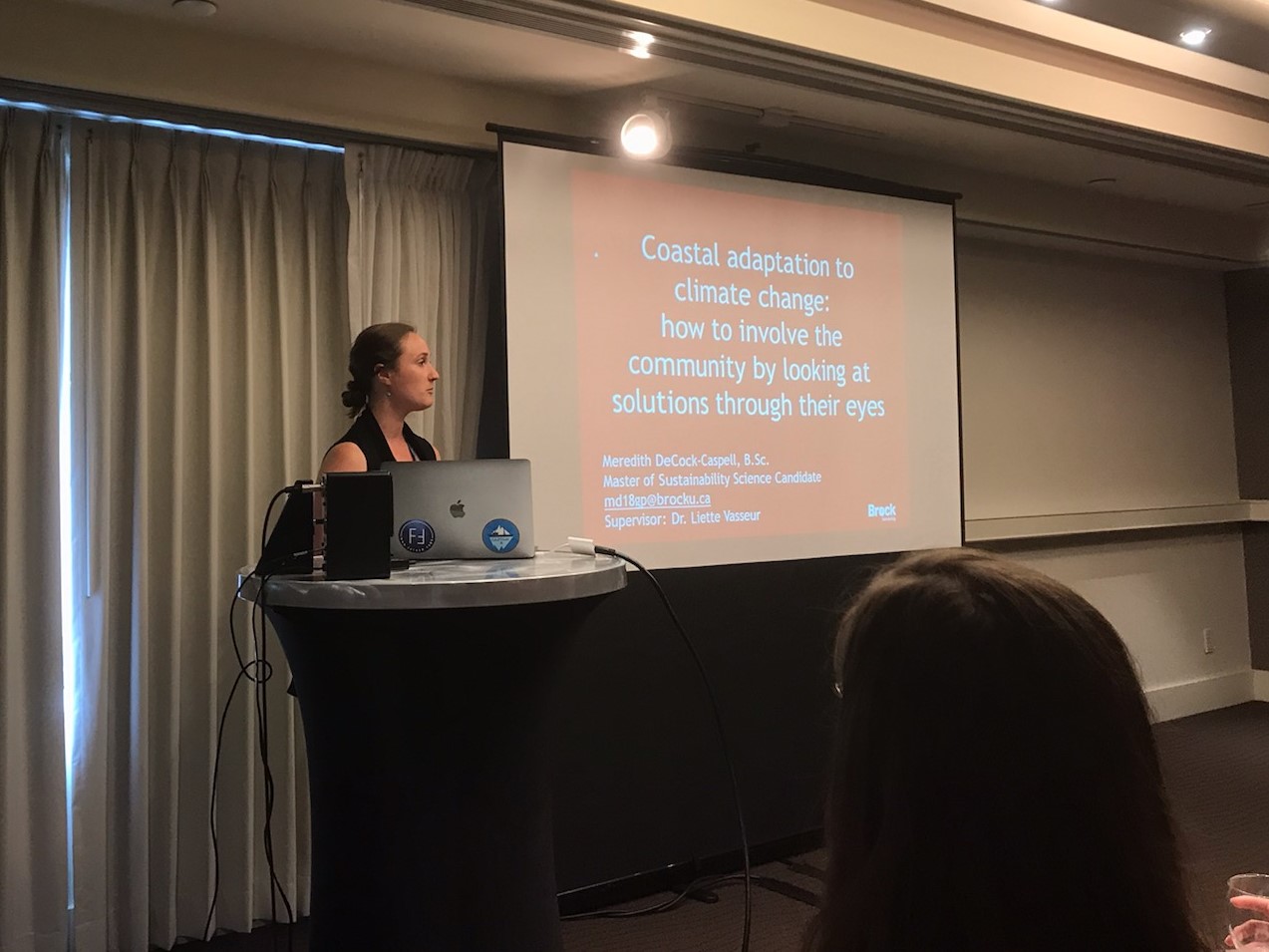
The second conference I attended was the Marine Environment Observation, Prediction and Response Network (MEOPAR) conference in Victoria this past June. This conference was different as it was primarily organized for people working on MEOPAR-funded research projects. Being surrounded and engaging with peers working within the same discipline almost made it feel like you were amongst family. Networking felt easy. Everyone was overwhelmingly supportive of each other’s work. I was placed in a session to present my work in what seemed like the only social science related break-out session of the conference. And although there were only two of us presenting it was still very well attended. My presentation title, which included the term “community engagement”, attracted certain attendees and led me to connect with an employee working for the City of Surrey, BC who was interested in our process due to his extensive work with public engagement.
I recently came back from the inaugural Sustainability: Transdisciplinary Theory, Practice, and Action (STTPA) conference hosted by University of Toronto Mississauga (UTM). What I noticed immediately upon arrival at the conference was that most people seemed to know each other, and it was obvious who wasn’t affiliated with UTM. Networking felt like much more of a challenge than at the MEOPAR conference. As sustainability science is inherently inter and transdisciplinary, the research projects are as complex as the problems they are trying to help solve. This makes it challenging to group projects into themed sessions. I ended up in a geospatial group, presenting alongside researchers working on machine learning and remote sensing to identify tree species and track ecosystem health over time. My presentation certainly included geospatial data, but it also included a social science aspect that made me feel as though I didn’t quite fit with the others. I was nervous about this leading up to the session. But each of the presenter’s research was unique and stood out in its own way. Being in this particular session led me to making a connection afterwards with a peer at UTM wanting to cite our upcoming papers.
A key lesson I have learned from these conferences over the past year is which sessions you choose to attend is important. Do you attend ones that sound the most interesting, or do attend one because the presenter could potentially be a great contact to make? Sometimes I choose not to go to the ones that most interest me, but the one I think may benefit myself or my research team the most. I also keep my future possible career options in mind when selecting which sessions to attend. Being intentional about which ones you choose may lead to connections or ideas that benefit you in ways you never could have seen coming. Not looking at the program in detail before the day of the conference can result in you ending up in the wrong room, in a session that you have no interest in attending, but you feel awkward leaving once you realize the mistake you made. Compare that to when I went to a session specifically because there was a researcher whose bio sparked my interest as she was doing similar work to my team at Brock. This led to us having an extended conversation after the session about different strategies that we are using for focus groups in our case studies and will hopefully lead to a mutually beneficial relationship between our teams.
My experiences in the last couple of years have made me realize how important it is to be intentional about which conferences you are choosing to go to, which sessions you attend, and who you are trying to connect with. You don’t always get it right, but when you do, it is a rewarding experience.