Articles from:February 2018

  • Looking back on the SSAS program: Tyler Prince discusses his fiery thesis

    Interview conducted by: Lydia Collas

    Interviewee: Tyler Prince

    Lake in southwest Yukon

    Photo: Tyler’s study lake in southwest Yukon from which samples were taken to reconstruct the region’s fire history.

    Tyler Prince has become the latest Sustainability Science & Society student to successfully defend his thesis. On the 19th December, Tyler presented his thesis “Postglacial reconstruction of fire history from a small lake in southwest Yukon using sedimentary charcoal and pollen,” to a packed audience. It didn’t take long for the examiners to reach their decision and to deliver those words that instantly lift a boulder-sized weight off any students’ shoulders: “Congratulations, you’ve passed”.

    A few weeks after the defense, I met up with Tyler to find out more about his time working towards his Master of Sustainability over the last two years.

    Firstly, can you tell me a bit about your research?

    The aim of my research was to reconstruct the fire history of southwest Yukon over the entire Holocene, which began approximately 12,000 years ago. I completed this record by using charcoal and pollen preserved within lake sediments. Our current fire records are relatively short, especially in these Northern areas, therefore long-term records are necessary to understand how frequent fires were on the landscape in the past and how the fire regime may change in the future as a result of climate change.

    That sounds like a lot of exciting fieldwork, how was that?

    The fieldwork was definitely one of the highlights of my masters. I was fortunate to have two field seasons, travelling to the Yukon in 2016 and 2017 where I collected samples in Whitehorse, Dawson and Old Crow. These are memories I will never forget.

    Do you have a favourite moment from your time in the SSAS program?

    I don’t think I have a single favourite moment. The fieldwork is up there, as well as travelling to Boston to present my research at an international geography conference (AAG). My entire lab group traveled to Boston together as we all were presenting our Master’s research, so that was a great experience.

    Over the last two years, Tyler’s talent has been recognised with a staggering number of awards and scholarships. Tyler was awarded the Northern Scientific Training Program Grant, the Ontario Graduate Scholarship, the Dean of Graduate Studies Spring Research Fellowship, the Dean of Graduate Studies Entrance Scholarship and the Faculty of Social Sciences Student Travel Award.

    Tyler also has an exceptional record at conferences having been awarded the Best Master’s Presentation at the Annual Meeting of the American Association of Geographers (2017) in both the Biogeography category and in the Paleoenvironmental Change category. Tyler also won Best Master’s Poster at the Ontario-Quebec Paleolimnology Symposium.

    The SSAS program, established by Brock’s Environmental Sustainability Research Centre (ESRC) provides exceptional students with a transdisciplinary education of environmental sustainability. In the 24-month thesis stream, students pursue an in-depth, novel research project – as Tyler did with such great success. Alternatively, students can opt for an alternative, 16-month route, where they complete a Major Research Paper and a four-month coop. The equal consideration deadline for 2018 entry has now passed, but for more information on applying please visit https://brocku.ca/esrc/apply-today/.

    On behalf of the ESRC, I would like to once again congratulate Tyler for a stunningly successful time in the SSAS program and wish him the greatest success in the future.
    Categories: Blog, SSAS Student Contributor

  • Master of Sustainability student needs your help

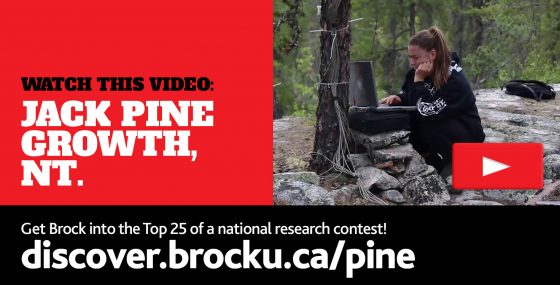
    Help our Master of Sustainability student, Dana Harris, move on to the next round of NSERC’s Science Action video competition! The 25 videos with the most views on March 2, 2018 will proceed to the judges’ panel, where they will compete for one of 15 cash prizes. Take a minute and click the photo below to view Dana’s video and learn more about Jack Pine growth.

    Jack Pine Video
    Categories: Blog, SSAS Student Contributor

  • Outdoor Research Symposium

    Blog Contributor: Dr. Garrett Hutson

    Liz Peredun

    Brock alumna Liz Peredun (pictured above) and participating ESRC faculty member, Dr. Garrett Hutson, presented findings from the first comprehensive NOLS sense-of-place outcomes study at the Coalition for Education in the Outdoors Research Symposium in Martinsville, Indiana on January 13, 2018. The NOLS mission is to be the leading source and teacher of wilderness skills and leadership that serve people and the environment. NOLS leads wilderness expeditions for a variety of age groups worldwide with a focus on teaching leadership, outdoor skills, environmental studies, and risk management. One of the core environmental studies learning objectives at NOLS is for students to develop a “sense of place” by experiencing wilderness and exploring relationships with their surroundings. In the NOLS context, sense of place is defined as the personal relationship students develop with areas travelled during NOLS experiences. Sense of place is important to NOLS because articulating an environmental ethic and supporting students’ abilities in connecting with the natural world beyond NOLS is a goal of every course.

    The purpose of this study was to explore how NOLS course participants report developing a sense of place after completing a course at NOLS Rocky Mountain in Lander, Wyoming. Data were analyzed from 511 NOLS students who answered the open-ended question: Did NOLS help you develop a personal relationship to the places you visited? If so, how? Overall, 72% responded affirmatively and responses ranged from general feelings of nature appreciation to specific curriculum-driven learning mechanisms. Learning mechanisms included the chance to engage in environmental studies, developing familiar rituals, participating in authentic experiences, time for reflection, and discussions on natural history and indigenous awareness.

    Additional analysis is underway to explore links between sense-of-place development and other aspects of the NOLS environmental studies curriculum such as foundations in ecology, Leave No Trace environmental ethics, climate change, and transfer of learning. NOLS was a participating member of this study and plans to utilize these findings both to better understand the impacts of its programs and to improve the environmental studies curriculum.

    Liz Peredun is a graduate of the Department of Recreation and Leisure Studies undergraduate program with the Outdoor Recreation concentration. Liz currently works as an instructor for NOLS in the Yukon Territory, Wyoming, and Utah and as a Program Director for Outward Bound Canada. Additionally, Liz works as a research assistant for this ongoing ESRC funded study.

    Categories: Applied Research, Blog, Conferences, Faculty Contributor