Articles from:October 2016

  • Politics and Film: Brace yourself for US Election 2016 by reliving the first time a Clinton won the presidency

    The War Room (Dir. DA Pennebaker and Chris Hegedus)
    1993, Oscar nomination, Best Documentary, 93 mins
    Followed by Q&A and audience discussion

    As the most improbable and high-stakes US presidential election in modern times careens to an unpredictable close, the Brock University Department of Political Science invites you to join us for a screening and discussion of The War Room, the influential 1993 documentary of the first time a Clinton ran for President.

    The War Room, the third film in the department’s Politics and Film Series,offers a behind-the-scenes account of Bill Clinton’s insurgent and (at the time) improbable campaign for the presidency, and offers an illuminating contrast to the 2016 campaign between Democratic candidate Hillary Clinton and Republican candidate Donald Trump.

    This special screening of The War Room will be followed by a discussion of the film and of the current presidential race with Brock political scientists Stefan Dolgert and Blayne Haggart. “The stakes for the current election couldn’t be higher, for Americans, Canadians and the whole world,” says Politics and Film series coordinator Blayne Haggart. “It’s also been a really, really unusual election. Tonight’s event will give us and audience members a chance to talk about the state of the most bizarre election in recent memory, and to see what’s changed and what’s stayed the same since Bill Clinton ran in 1992.”

    The War Room is presented in conjunction with the PAC Film House. Tickets are $9 (general admission) and $7 for Film House members. Tickets can be bought online at https://firstontariopac.ca/Online/article/FilmHouse or by calling the box office at 905-688-0722. Tickets are also available the day of show.

    For further information, please contact Blayne Haggart.
    Categories: Events

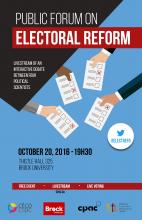
  • An Interactive Forum on Electoral Reform in Canada

    Thursday, October, 20, 2016
    7:00 pm
    Thistle Hall 325

    This event will be hosted by the Centre for the Study of Democratic Citizenship at McGill University, but will be live-streamed into Thistle Hall 325 and will allow both in-room and remote attendees to ask questions and vote on their preferred electoral system via a mobile platform.
    The forum itself will feature commentary by Canada’s Minster of Democratic Institutions, the Honourable Maryam Monsef, as well as four political scientists, each making the case for a particular electoral system: Peter Loewen (University of Toronto), Laura Stephenson (University of Western Ontario), Marc André Bodet (Université Laval) and Sven-Oliver Proksch (McGill University).

    Political scientists from Brock will also be on hand to answer questions/offer commentary to audience members whose online questions are not addressed via the Mobile Platform.

    For further information, please contact Zachary Spicer.

    Categories: Events

  • Advocacy Coalitions in Ontario Land Use Policy Development

    Thursday, October 20, 2016
    2:00pm – 4:00pm
    GL 164

    In 2005, the Ontario government passed the Places to Grow Act and the Greenbelt Act, both major changes in land use policy designed to preserve greenspaces and combat urban sprawl in the Greater Golden Horseshoe, Canada’s largest conurbation. This research presentation examines the actors, actor beliefs, and inter-actor alliances in the southern Ontario land use policy subsystem from the perspective of the Advocacy Coalition Framework (ACF). Specifically, it shows the results of an empirical examination of the ACF’s Belief Homophily Hypothesis, which holds that inter-actor alliances form on the basis of shared policy-relevant beliefs, creating advocacy coalitions. The analysis finds strong evidence of three advocacy coalitions in the policy subsystem – an agricultural coalition, an environmentalist coalition, and a developers’ coalition – as predicted by the hypothesis. However, it also finds equally strong evidence of a cross-coalition coordination network of peak organizations, something not predicted by the Belief Homophily Hypothesis, and in need of explanation within the ACF.

    Tim Heinmiller is an Associate Professor in the Department of Political Science. Profesor Heinmiller came to Brock’s Department of Political Science in 2005, after completing a Ph.D. in Comparative Public Policy at McMaster University, and a post-doctoral fellowship at the University of Western Ontario. His research focuses on Canadian and comparative public policy, investigating why governments choose some policies over others. Much of his research has focused on water policy development in Canada and elsewhere, but his more recent work has expanded into other environmental policy areas and even into health and criminal justice policy. A common strain in all of his research is the application and development public policy process theories, and he has published work using most of the mainstream theories of the policy process.

    For further information, please contact Zachary Spicer.

    Categories: Events