Uncategorised

  • Brock expert studies public memory of Terry Fox via Instagram

    This story originally appeared in The Brock News
    By Amanda Bishop
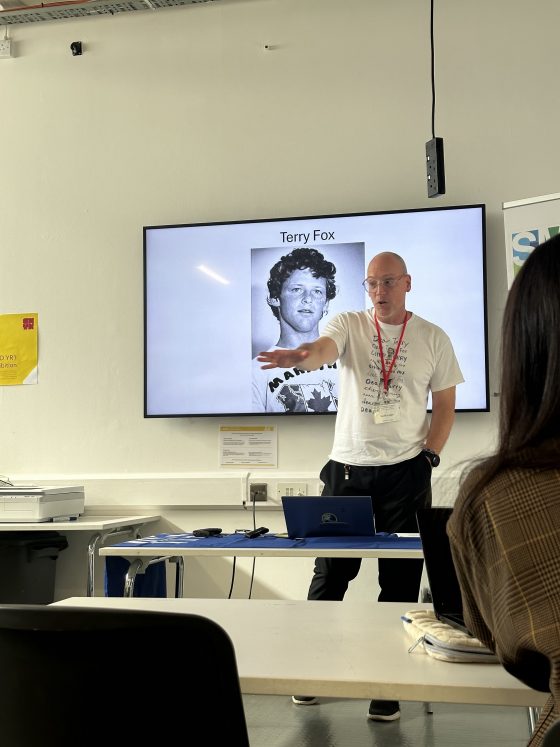

    Professor Foster presenting at the International Association for Media and Communication Research this summer.

    Forty-four years ago, Terry Fox captured the hearts of the nation by running across Canada on one leg to raise funds for cancer research. Although the beloved Canadian is no longer here to personally continue his Marathon of Hope, his legacy lives on through annual memorial runs and, according to Brock’s Derek Foster, through Instagram.

    Fox, who succumbed to his battle with cancer in 1981, is at the centre of Foster’s recent research involving public memory, social media and well-being.

    As part of his ongoing research into how the celebrated Canadian is remembered in popular culture, the Brock Associate Professor in the Department of Communication, Popular Culture and Film analyzed hundreds of Instagram posts created by people who visited Fox memorial sites.

    In the lead-up to this year’s Terry Fox Run, held annually in September, Foster says he wanted to see how user-generated content creates and shapes the public memory of Fox compared to the Terry Fox Foundation’s official messaging about runs and fundraising.

    “The public memory of Terry Fox is very much forward looking, in the sense that what he was pursuing in 1980 is still a collective endeavour for people motivated by finding a cure for cancer,” says Foster. “So, the memory isn’t just tied to the past through a lens of nostalgia, but rather, connected to our present and also a dream of a future.”

    Foster’s review showed about one third of his sample made clear references not only to emotional experiences, such as visitors being moved to tears, but also to what he calls “self-transcendent emotions” such as awe and gratitude.

    He also notes the posts don’t appear to be driven by a desire for engagement, as social media posts often are. In fact, only a small number of people liked or commented on the posts he reviewed. Foster says it’s significant that “the hashtag isn’t driving the discourse” because it shows a level of sincerity from the creators.

    “What we see is the vernacular memory — everyday people as they are deciding to create, produce and circulate these thoughts and experiences on their own, not organized in any way,” he says.

    Foster also says the way individuals are using social media to share their personal experiences with Fox memorials is an excellent case study on the legacies of public figures.

    “Most public memory involves looking back to build a sense of community or reinforce certain values that we can then use as we move forward,” says Foster. “That is far more explicit in the public memory around Terry Fox than other figures — the aim is not just to maintain him in memory but to continue to strive for the goal that he wasn’t able to reach.”


  • Brock’s 2024 Indigenous Leader finds magic in doing what’s difficult


    Jon Davey, Chief of Staff to the President and CEO of Scotiabank.Jon Davey, Chief of Staff to the President and CEO of Scotiabank, is the honouree for Brock’s 2024 Indigenous Leaders Speaker Series.

    This article written by Sarah Ackles, it originally appeared in The Brock News

    There are seminal moments in life that determine the impact someone will have on the world.

    When proud Haudenosaunee man Jonathan (Jon) Davey (BA ’05) was presented with those monumental calls to action throughout his career, he knew his overarching goal was to honour his ancestors and “make things better for future generations.”

    Davey often reflected on the refrain of his father when faced with decisions about how to best serve his community and become a person of substance.

    “What’s the more difficult thing to do?” his father would ask.

    As Davey told the attendees of the fourth annual Indigenous Leader Speaker Series on June 20, “That’s where the magic is — where you don’t want to go and what you don’t want to do.”

    A man sits in front of books and gives a virtual presentation.

    Jon Davey (BA ’05), Chief of Staff to the President and CEO of Scotiabank, was the selected speaker for Brock’s 2024 Indigenous Leaders Speaker Series, which took place online on June 20.

    The community webinar took place in the lead up to National Indigenous People’s Day, which recognizes the heritage and diversity of First Nations, Inuit and Métis people across Canada.

    Hosted by Vice-Provost, Indigenous Engagement Robyn Bourgeois, the speaker series is a partnership between the Office of the Vice-Provost, Indigenous Engagement and the Goodman School of Business.

    “I didn’t want us just to focus on the hard things Indigenous people go through —which we have to — I also wanted to celebrate indigenous excellence,” Bourgeois said. “Jon embodies the spirit of Indigenous excellence.”

    Davey is a proud member of the Lower Cayuga of Six Nations of the Grand River. A lawyer by trade, the Brock graduate and Board of Trustees member is currently the Chief of Staff to the President and CEO of Scotiabank. He also spent a decade working with the Federal Crown counsel in the Aboriginal Law Division of the Department of Justice Canada.

    As a young person beginning his academic journey, however, Davey admits he was nervous to leave the comforts of his home in Hamilton, Ont., where he felt acceptance of his culture and heritage as the son of a Haudenosaunee father and non-Indigenous mother.

    When he arrived on campus, however, he said he found a community where he could “stand tall and be proud” of who he was while completing a Bachelor of Arts in Business Communication in an environment that both supported and challenged him.

    “Brock’s probably had the most integral impact on me becoming a person, becoming a young adult, and taking responsibility, and I’m very grateful for the support I received throughout my time here,” he said. “When my four years was up, I didn’t want to leave; I was comfortable again, like I had been before I left home.”

    Along with that strong sense of community, Davey has also looked to the traditional teachings of his ancestors to guide his career decisions, noting that he approaches challenges and opportunities with a “good mind and good heart.”

    He ties this back to the messages of the Two Row Wampum belt, the symbolic record of an agreement made in 1613 between the Haudenosaunee Confederacy and Dutch settlers. It features two parallel beaded rows that represent two boats, reflecting two entities that progress side-by-side in mutual respect.

    “When you think about the Two Row Wampum there is this idea of harmony and peace and I want to see that more and I want to be that change,” he said. “There is harmony, but there still needs to be shared understanding, there still needs to be a bridge from time to time.”

    He said the common thread woven through his work — whether with the federal government, in the financial sector or directly with the community — is understanding and sharing “that value of partnership and working together, and, at the same time, exemplifying it.”

    He also stressed that it is crucial to thank those who supported and charted a path forward before him, and that he hopes to do the same for future generations who will continue to do the work after him — including his two young children.

    Although he joked that lawyers are often taught to give “recommendations” rather than “advice,” he also left new and future graduates with some parting words from his father, which he said have always served him well.

    “If you have something of substance to say, you’re always going to have an audience,” he said.

    A recording of the event will be shared on the Indigenous Leader Speaker Series web page.

  • Canadian newscaster’s journey began with Brock internship

    This article written by Amanda Bishop, it originally appeared in The Brock News

    When Alessandra Carneiro (BA ’16) first began dreaming of a career in broadcasting back in high school, she couldn’t have guessed that she would be sitting behind an anchor desk a few years later.

    Today, the Brock Media and Communications alumna is an anchor and reporter for CTV News Barrie and has anchored nationally for CTV News Channel.

    She advises students approaching graduation to keep lessons learned in the classroom fresh in their minds as they may need that information sooner than they think.

    “I remember learning about the Canadian Radio-television and Telecommunications Commission (CRTC) and thinking at the time, you know, will I ever really need this?” she says. “Now, every single day, the CRTC and its regulations are vital to my work.”

    Carneiro frequently returns to campus to speak with students in the Department of Communication, Popular Culture and Film (CPCF) about how her experience in the fourth-year internship course enabled her to achieve her career goals.

    “My internship at the local cable station taught me every aspect of the business, from what to look for when shooting a story to how to make sure that your writing matches the visuals to editing,” she says. “My supervisor knew my goals and helped me get the right stories to create a good demo, and that ultimately got me my first job on camera.”

    But Carneiro didn’t have a chance to use the demo right away. While still in her fourth year at Brock, she took the first job she could find with a major media company, handing out swag at events. After graduation, she worked in radio marketing and promotion before moving into media sales.

    When an opening finally came up for an anchor in Yorkton, Sask., Carneiro had her demo ready. She landed the role at age 25.

    She soon moved to Saskatoon, where she spent two years as a weekend anchor and reporter. The news stories she filed sometimes attracted national attention, and she was able to return to Ontario three years ago for her current role at CTV Barrie.

    Carneiro says that in a changing media landscape, her Brock degree has provided her with the context and agility to take on roles in various parts of the industry.

    “When I came into the business, I wasn’t solely coming from a journalism program or a broadcasting program,” she says. “My program included a variety of different ways to approach media and to learn about different sectors, which gave me skills and knowledge that have really helped me on my career journey.”

    Kate Cassidy (MEd’01, PhD’13) regularly invites Carneiro to speak to current CPCF interns and says that she is “a shining testament to the value of our media program’s comprehensive foundation, enriched by experiential learning.”

    “I truly appreciate Alessandra’s willingness to return to the classroom and mentor our students,” says Cassidy. “Her journey serves as a powerful reminder that with diligence and passion, they too can become trailblazers, just as she has done.”

    Carneiro always reminds students that openness can make all the difference to a career path.

    “Be open to every opportunity, even if it’s not the opportunity that you initially had in mind, and be willing to learn every aspect of a field because you will find your way,” she says. “ And network fearlessly — the careers of friends and mentors grow with yours, and they become voices in leadership who can vouch for what a hard worker you are and how passionate you are.”

  • Chair’s Welcome Message


    Greetings Incoming and Returning CPCF Students –

    I would like to start the 2023-2024 academic year with a very warm welcome. You are joining – or perhaps returning to – a unique department. Communication, Popular Culture and Film brings together a wide range of topics and approaches to the study, research and general critical exploration of these three intertwined disciplines. And what could be timelier in the era of unprecedented realities such as artificial intelligence, fake news and climate change?

    I often think and talk about the fact that it is communication, in all its forms, that underlies everything. At a broad level, this means that how we understand ourselves, others, the world – it is all communication. At a narrower level, there is no job, no career, and no graduate discipline that does not involve communication. In other words, the time you spend in CPCF will serve you very well no matter where life takes you. Yes, CPCF is the place to be!
    So, whether you are graduating this fall or spring – or you are just starting your CPCF voyage and will graduate years from now – we are glad that you are here. You are part of an ever-growing community of engaged scholarship and people who care deeply about the vital importance of communication, popular culture and film.

    Jennifer Good, Chair and Associate Professor

  • Film students zoom in on festivals for experiential education project

    Fresh off the media circus of Venice and the Oscar buzz of the Toronto International Film Festival (TIFF), a group of third-year Brock film students is about to get elbow-deep in the film festival landscape.

    The students in Assistant Professor Jon Petrychyn’s Issues in Canadian Cinema course this semester will not only learn about the rich history of Canadian film festivals but also pitch their own festival and complete a mock grant application for funding using the expert advice of industry professionals.

    A raft of 10 guest speakers from festivals and funding bodies will provide insight into the triumphs, challenges and inner workings of the film festival landscape from Vancouver to St. John’s — knowledge that will inform students’ projects in the course as well as their future forays into the industry.

    Petrychyn is a film festival researcher and organizer who is currently in the throes of a research project on queer, feminist and antiracist film festivals in Canada in the 1980s and ’90s that aims to “trace the history and relationship between activist movements and broader changes in the media arts sector.”

    He believes the experiential components of the course will help bring both the history and the current scene to life.

    “We talk a lot about how festivals get organized, how they get funded and how these activist groups intersect with each other, too,” he says. “I think it’s easy for us to see that there are identity-based media arts organizations and identity-based activist groups and not think about how they overlap, so we look at that specifically through festivals as a lens.”

    Fourth-year Film major Arielle Hounsham-Lalande, who is also completing an internship placement through the Department of Communication, Popular Culture and Film in the Film Programming office of the FirstOntario Performing Arts Centre, says she feels like the course was “made for” her.

    “This course is specifically about Canadian film festivals, which some may say seems very niche,” says Hounsham-Lalande. “But there’s actually a wealth of knowledge you can get specifically from that, because Canada has some of the oldest film festivals in North America.”

    She adds that hearing from guests is one of her favourite aspects of the class.

    “Not only is it networking and experience with Q&A, but we’re also learning so much from industry professionals and getting different perspectives, depending on the size and the location of their festival,” she says. “Doing it on Microsoft Teams is excellent because it allows people from all over to come and speak to us.”

    Petrychyn says the skills students will build in preparing their assignments will carry forward, whether they are interested in working with festivals or not.

    “These are very transferable skills — learning how to collaborate, learning how to pitch an idea or a project,” says Petrychyn. “There are opportunities here for students to learn and hone different skills, different types of writing and different types of collaboration.”

    As the current President of the student-run CPCF Society, which organizes professional, cultural and social events for students in the department, Hounsham-Lalande can already see how she might draw on this experience now and in her future.

    “The pitch is encouraging you creatively, and then it pairs with the mock grant application, which really drives home the idea that almost everything in the arts in Canada specifically is government-funded to a certain extent,” she says. “It lets people know what funding is out there, the process to get it and the skills that you need — and you can take those skills with you wherever you go.”

  • Discount passes for TIFF 2019

    Calling all students and scholars – did you know that there are discount passes for TIFF 2019 just for you?

    If you’re a current student or scholar in film or media OR have graduated within the last year, send a message to the Communication, Popular Culture and Film Student Society (CPCFSS) via social media @cpcfss (Twitter and Instagram) or email [email protected] for more information.

    Great opportunity to attend the Toronto International Film Festival, visit screenings, conferences and network with some of the leading names in film!

  • 2017 Dobson Case Competition Winners Announced

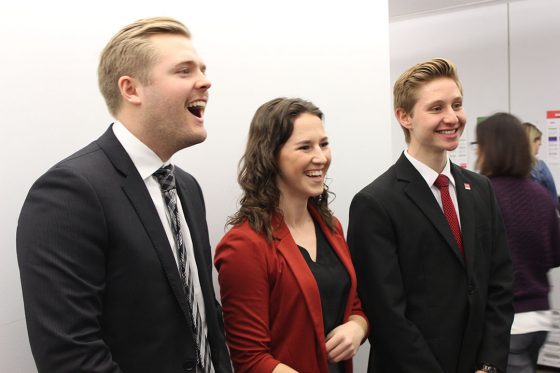
    1st place winners left to right:  Bailey, Olivia, and Josiah of Goodman School of Business.

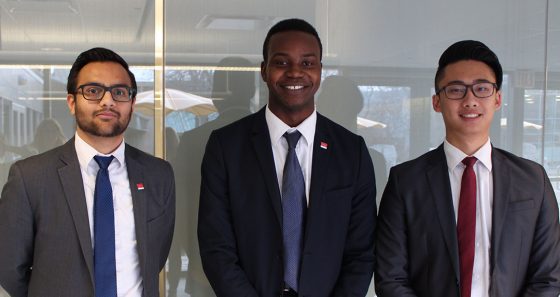
    2nd place winners left to right: Srujal, Mark- Joseph, and Simon of Goodman School of Business

    3rd place winners left to right: Chloe and Larrissa of the Communication, Popular Culture and Film Department
    Best Presenter award: Chloe of the Communication, Popular Culture and Film Department

    Read more about the 17th annual Dobson Case Competition and Terry O’Malley Lecture here