Articles from:March 2018

  • Master of Sustainability student presents research at Ontario Fruit and Vegetable Convention

    Emilie - Fruit & Vegetable Conference

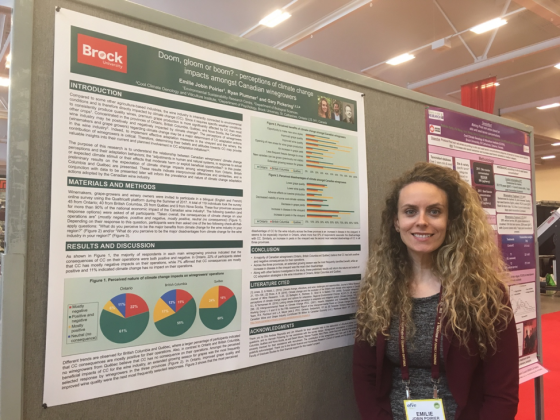
    Master of Sustainability candidate, Emilie Jobin Poirier at the Ontario Fruit and Vegetable Convention in Niagara Falls, ON.

    Maser of Sustainability student Emily Jobin Poirier recently had a poster presentation accepted at the Ontario Fruit and Vegetable Convention. Her poster presentation, based on her Master’s research, was titled “Doom, gloom or boom? – perceptions of climate change impacts amongst Canadian winegrowers.” Emilie is currently working on her Master of Sustainability thesis with supervisors Dr. Gary Pickering and Dr. Ryan Plummer. Congratulations Emilie!

    Follow Emilie on Twitter: @ejobinpoirier

    Categories: Blog, Conferences, SSAS Student Contributor

  • First Year SSAS students impress with ambitious research proposals

    Blog Contributor: Lydia Collas

    SSAS 2017 Cohort

    Master of Sustainability 2017 Student Cohort, September 2017

    March 9th saw students in their first year of the Sustainability Science and Society (SSAS) program present preliminary proposals of the research that they will undertake in the coming months. Being in my second year of the program, I delighted in the opportunity to sit back and watch others undergo what I myself had done a year earlier. The ten students did not disappoint as they spoke with passion and excitement of the research questions they hope to answer.

    Sustainability is an interdisciplinary subject by nature: it brings together aspects from natural science, social science and economics. This was very much reflected in the students’ presentations which covered a vast portion of what can be considered sustainability science. No two students plan to study even remotely similar areas. Lyn Brown presented her plans to investigate invasive species – a major biological and financial issue – in the Niagara Region. Contrast that to Qurat Shahzad whose interest lies in the concept of a de-growth economy and presented her plans to investigate the factors driving consumer behavior across Canada.

    The students’ research was also impressively broad in terms of the geographical area covered. Sylvia Hussein plans to investigate water management in Lake Erie and identify the lessons learned which would help in the management of water resources in her own country, Ghana. Other students are looking closer to home: Leaya Amey plans to conduct her study right in Brock University. Leaya will build on her undergraduate degree in Communications Studies exploring the most effective way to inform Brock University students about sustainability initiatives on campus.

    One of the great strengths of the SSAS program is the variety of programs that students have studied at undergraduate level. This diversity allows students to learn from one another as they each hold their own unique knowledge and skill set. The questions asked by other students, as well as faculty, following the students’ presentations will hopefully have helped them to clarify their thoughts or identify alternative approaches to investigating their research questions.

    All students can be highly commended for their ambition and drive to push the bounds on what is known in sustainability science. Director of the SSAS program, Francine McCarthy, was somewhat lost for words as she spoke after the presentations, Francine said “I feel somewhat like a proud mum today, you’ve all come so far from where you started in September and I could not be more proud.”

    I too would like to add my congratulations to the students and I wish you all well as you set out to conduct this research. My one piece of advice, as a student one year down the line, is to think about scope. The time is going to fly. Think long and hard about whether you’ve got the time to do what you’re aiming to achieve. And then go for it – I can’t wait to hear about what you find!

    Categories: Blog, SSAS Student Contributor

  • Brock unveils a new showcase and a new era for environmental sustainability

    It was built nearly two centuries ago, but the oldest structure on Brock’s campus has been given new life and a new purpose as a focal point for the University’s sustainability efforts.

    Theal House, an original farm cottage that dates to 1837, has been transformed into the home of Brock’s Environmental Sustainability Research Centre (ESRC), which produces world-class research and educates students in topics relating to environmental sustainability.

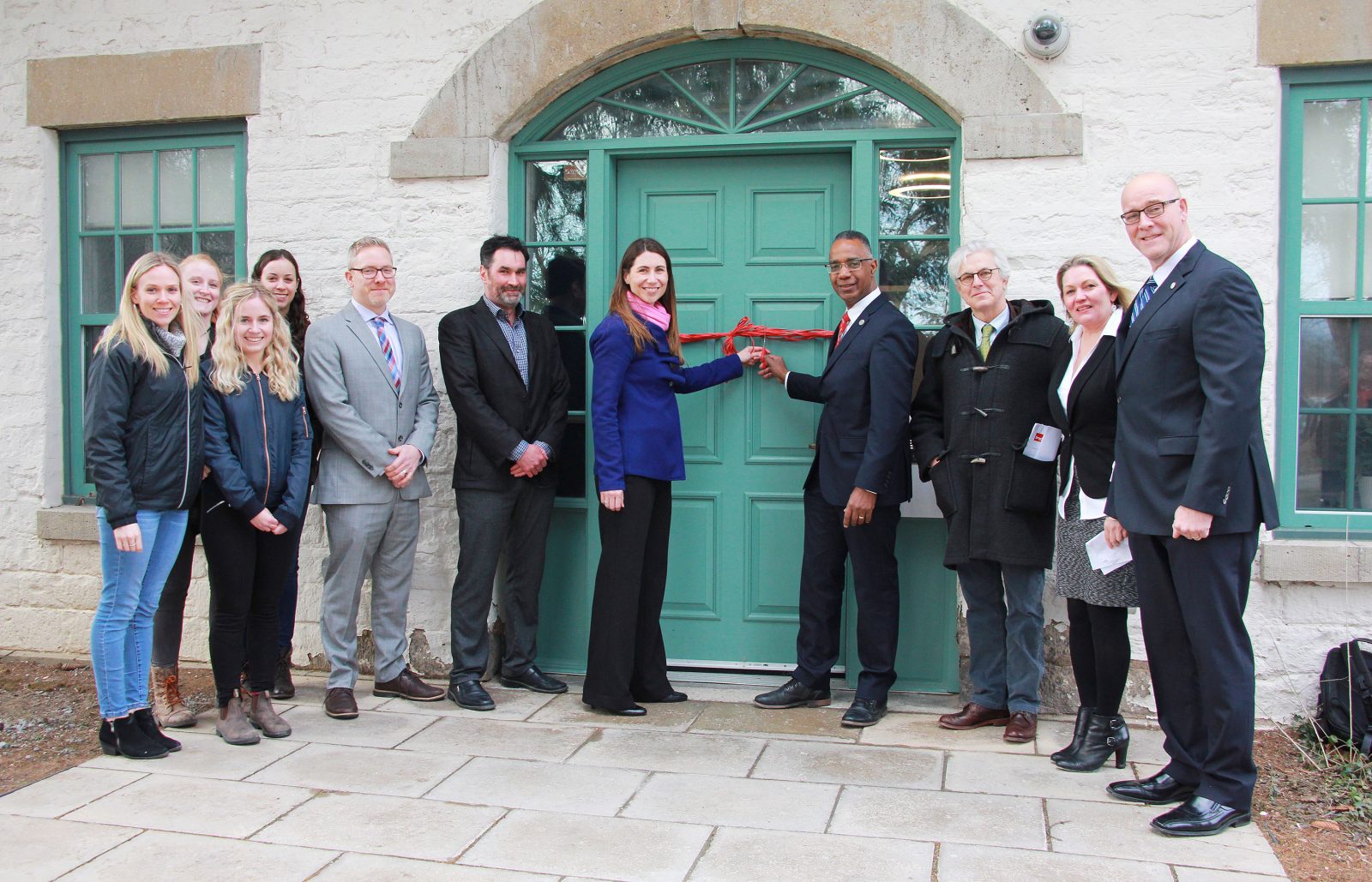
    Unveiled during a ribbon-cutting ceremony Wednesday, Feb. 28, the revamped space features sustainable flooring and furniture, as well as an integrated system that controls heating, cooling and lighting, and monitors real-time energy use for the entire campus.

    Environmental Sustainability Research Centre Director Ryan Plummer, left, reads over a new project charter with Tom Dunk, Interim Provost and Vice-President, Academic, and Brian Hutchings, Vice-President, Administration. The agreement will see the ESRC work with Brock’s Facilities Management team on upcoming sustainability initiatives.

    LED lighting has also been installed throughout the heritage building, with dimmer and daylight harvesting switches in place to reduce energy consumption.

    In addition to highlighting the space, Wednesday’s ceremony was an opportunity to solidify a new collaboration between the ESRC and Brock’s Facilities Management team. The collaboration is enshrined in a formal charter that brings together the academic and operations units on various sustainability initiatives on campus. It is also an important step forward for Brock’s new integrative approach to environmental sustainability, and deepens the University’s commitment to sustainability — one of the seven core values listed within its strategic plan.

    Also announced Wednesday was $5,000 in new scholarship funding provided by Toromont CAT that will support students studying sustainability.

    Professor and ESRC Director Ryan Plummer said the partnership signals a new era in the University’s journey to be a national leader in sustainability.

    “The charter enables rich opportunities for experiential education relating to environmental sustainability, and the scholarships recognize as well as support excellence in this area of study,” said Plummer. “They will have a profound and positive impact by enhancing student experience, promoting innovative approaches for learning excellence and furthering engagement with sustainability.”

    Brock has been dedicated to improving energy and operational efficiency on campus with dozens of energy projects and green initiatives completed over the years, said Scott Johnstone, the University’s Associate Vice-President, Facilities Management.

    “Moving forward, we want to further our partnership with staff, students, faculty members and the larger Brock community to enhance, challenge and maintain a campus culture of sustainability.”

    Sean Goodman and Ron Cocking, of Toromont CAT, presented Scott Johnstone, Brock’s Associate Vice-President, Facilities Management, and Ingrid Makus, interim Dean of the Faculty of Social Sciences, with $5,000 to support students in sustainability programming at Brock.

    Hands-on experiential learning opportunities that contribute to sustainability at the University will be made available to students through co-op placements, research assistant opportunities, independent research and course-based projects.

    This week’s announcements reinforce the University’s values around sustainability, while also taking into consideration Brock’s role in a global context, said President Gervan Fearon. “We’re part of the broader ecosystem and as such, we need to think about the impact our footprint has and what our actions in support of sustainability mean.”

    Brock recognizes its distinction as one of only a few universities within a UNESCO World Biosphere Reserve and intends to continue pushing forward with its environmental sustainability initiatives, he said.

    Brock’s programs concentrating on sustainability are growing quickly. The Master of Sustainability program was introduced in 2014 and continues to receive considerable uptake from across Canada and around the world. In 2017, the ESRC launched the Minor in Environmental Sustainability and early signs suggest it is following a similar positive trajectory.

    Theal House is now the home of Brock’s Environmental Sustainability Research Centre.


  • Welcome to the ESRC’s new home! Here are some of our favourite features of the Theal House

    Blog Contributor: Samantha Morris

    On February 28, 2018, the Environmental Sustainability Research Centre (ESRC) opened the doors to our new home; the Theal House.

    We are excited to tell you more about this new (and old) space. Here’s a quick tour of some of our favourite features:

    1. THE HISTORY

    The Theal house has a history dating back to the 1800s. For many years the house was called Symphony House, this for the St. Catharines Symphony, which was a tenant in the 1970s. Before that it was variously known as the Turney House, Wright House or Field House. But it is now officially called the Theal House — appropriately so, for it was almost certainly built by one Samuel Theal, and the Theal family lived in the house for several decade. Read more about the history of the Theal House by the late Alun Hughes.

    Johnston Map - Brock Lands

    Detail of Colonel Johnston’s map of 1822 showing lots 18, 19, and 20.

    Theal House Gibson 1964

    The Theal house in 1964.

    Exposed brick in Theal House.

    On your next visit to the Theal House look for this bit of exposed brick from the original house.

    2. FLOORING 

    Floors throughout the Theal House were acquired from Interface, a company internationally known for their focus and commitment to sustainability.

    Theal House Carpet Certificate

    Cool Carpet certification from Interface displayed in the upstairs office.

    3. FURNISHINGS

    Sustainable furnishing can be found throughout the Theal House. From the furniture from Creighton House Antiques, a local company in Niagara, to the live edge wood desks made from certified sustainable timber and created by Brock University carpenters.

    Antique furniture in Theal House.

    Antique furniture from Creighton House Antiques.

    Theal House Faculty Space

    Upstairs offices featuring live edge wood furniture and a carpet made from recycled fish nets.

    4. LIGHTING  

    LED lighting has been installed throughout the Theal House. Dimmer and daylight harvesting switches reduce energy consumption.

    LED Lighting in Theal

    One of our many dimmer switches that will reduce energy consumption in the Theal House.

    5. MONITORING

    An integrated system within the Theal House now controls HVAC, lighting and monitors real time energy use.

    Theal House - Upper Level

    Our upstairs offices feature new energy efficient lighting and HVAC systems.

    Theal House Monitoring System

    Our entryway features a monitoring screen that showcases energy use in the Theal House and across campus.

    1. OUR NEW VIEWS

    We can’t forget to mention how much we love our new views. From the trees that surround Theal House to the view of the Tower, there’s always something to look at.

    Theal House, 2018

    The Theal House, 2018.

    View of the Schmon Tower

    View of the Tower out of the boardroom window.

    1. PEOPLE

    Last, but certainly not least, no building on campus would be complete without dedicated and hardworking faculty, staff, and students.

    Francine McCarthy, Ryan Plummer and Marilyne Jollineau

    Master of Sustainability Graduate Program Directors, present (Dr. Francine McCarthy), past (Dr. Ryan Plummer), and future/past (Dr. Marilyne Jollineau).

    Theal House Grand Opening

    Faculty, students, and Brock Administration cutting the ribbon at our Open House on February 28, 2018.


    Is there a feature of the Theal House that you find interesting? Please share your thoughts and photos with us at [email protected] or on Twitter/Facebook @BrockUESRC.

    Categories: Blog