Articles from:September 2017

  • Media Release: Brock University and Town of Lincoln to launch Living Lab partnership

    MEDIA RELEASE

    27 September 2017 R00170 Brock University — Communications & Public Affairs

    Brock University and Town of Lincoln to launch Living Lab partnership

    Brock University will embark on an unprecedented mission with one of its host communities next week, when it partners with the Town of Lincoln on a project that will give the Town important support for planning sustainable growth, and provide valuable experiential learning opportunities for Brock students and researchers.

    Brock’s Environmental Sustainability Research Centre and the Town of Lincoln will officially launch their new Living Lab collaborative project on Tuesday, Oct. 3 at Vineland Estates Winery. The event will be held in the winery’s Carriage House starting at 5 p.m. with remarks to begin at 5:15 p.m.

    The partnership is the result of a Memorandum of Understanding signed between the University and the Town in February aimed at enriching opportunities for students and advancing the town’s economic, social and community development. The Brock-Lincoln Living Lab will focus on addressing specific local needs around sustainable municipal planning. Master of Sustainability students will find hands-on opportunities to contribute to the Living Lab’s work through experiential education placements and research projects.

    On Tuesday, Town of Lincoln Mayor Sandra Easton and CAO Michael Kirkopoulos will join Brock President Gervan Fearon and Ryan Plummer, Director of the Environmental Sustainability Research Centre in launching the first collaborative project.

    Media are invited to attend the launch of the Brock-Lincoln Living Lab. Interview opportunities will be available.

    Quick Facts What: Launch of new partnership between Brock University and Town of Lincoln When: Tuesday, Oct. 3, 5 p.m. to 6 p.m. Where: Vineland Estates Winery, Carriage House, 3620 Moyer Rd., Vineland Who: Lincoln Mayor Sandra Easton; Brock President Gervan Fearon; Lincoln CAO Michael Kirkopoulos; and Brock University ESRC Director Ryan Plummer.

    For more information or for assistance arranging interviews:

    * Dan Dakin, Media Relations Officer, Brock University [email protected], 905-688-5550 x5353 or 905-347-1970

    Brock University Marketing and Communications has a full-service studio where we can provide high definition video and broadcast-quality audio.
  • Master of Sustainability graduate’s research wins Best Paper at International Conference

    By: Lydia Collas

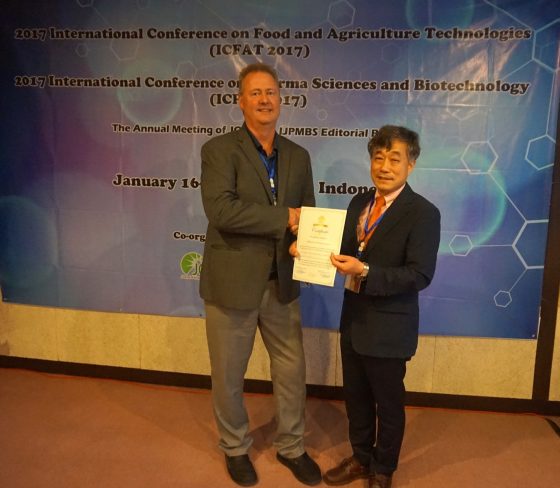
    Gary Pickering accepting best paper award

    Brock University’s Dr. Gary Pickering (left) is awarded Best Paper at the 2017 International Conference on Food and Agriculture Technologies (ICFAT) from Professor Byoung Ryong Jeong (right), Gyeongsang National University, Korea.

    Research of Samantha Stea, an alumnus of the Sustainability Science and Society (SSAS) graduate program, has recently been awarded Best Paper at the 2017 International Conference on Food and Agriculture Technologies (ICFAT) in Bali, Indonesia.

    Stea investigated consumer perspectives on the environmental impacts of red meat production, as well as effective means for encouraging people to reduce their consumption of red meat.

    “We knew there had not been much research done on this topic, especially considering the environmental angle, so we decided it would be a unique research opportunity” said Stea, “It was immensely satisfying to get to do research that involved people’s day-to-day lives and spread some understanding of how their daily lives can have an impact on the environment.”

    Livestock farming is a major cause of deforestation worldwide. This is because of the extensive land needed for grazing and the production of food, such as grain, for these animals. It also uses more water, and creates more greenhouse gas emissions than plant-based foods.

    Stea began her research by identifying peoples’ motivations to eat red meat. She used her findings to design different messages about the negative environmental impacts of meat production. Several respondents indicated that they would reduce their red meat consumption, indicating the effectiveness of the messages.

    Stea’s research was supervised by Dr. Gary Pickering, Professor of Biological Sciences and Psychology who presented the research at ICFAT 2017 on behalf of Stea, “Our lab is very interested and active in research that aims to understand why, as consumers, we make decisions that harm the environment.”

    Pickering is keen to pursue further research in this area, “We also conduct empirical research on how we can optimize environmental messaging to promote pro-environmental behaviors. Sam’s research on red meat consumption combined both of these themes, and we are building on this success with several other projects through the SSAS programme.”

    Stea expressed her delight at her work being named Best Paper at ICFAT 2017, “We knew we had tackled a novel research question, so it was exciting to get some external validation for it. I am very grateful and appreciative that our paper was chosen, I know all the submissions were high quality.”

    Following her graduation from the SSAS program, Stea speaks highly of its impact on her future aspirations, “The SSAS program has led me to continue to pursue a career where I can help people and organizations to understand sustainability and how it can fit into their lives. I believe we can all live a little bit more sustainably, and this program has given me the tools and knowledge to make that happen.”


  • Featured in The Brock Press: Brock University offers new Environmental Sustainability minor

    Brock University offers new Environmental Sustainability minor

    brocku.ca

    With extreme weather becoming more prominent in the world, the need to address and help prevent further climate change has become more necessary than ever. Brock University is now providing students with an opportunity to be a part of that prevention with a minor in Environmental Sustainability provided through the Environmental Sustainability Research Centre (ESRC). With Hurricane Harvey, the first major hurricane to touch landfall in the U.S. since Hurricane Wilma, the timing couldn’t be any more perfect.

    The new minor aims to combine the study of social and environmental sciences with economics, ideally suited to equip the student not only with an understanding of how to protect the natural environments that are necessary for survival, but to do so in a way that helps protect and even improve the overall quality of human life. For instance, what ways can we protect the environment from worsening climate conditions while still supporting the overall population through its continued growth.

    While it is easy to see the larger picture, it is hard to consider the impact of even the smallest actions of an individual on the environment’s overall health. Looking at extreme weather over the past few decades in the form of hurricanes like Katrina, Sandy, or most recently Hurricane Harvey, make it easier to see why it is so important to integrate environmental sustainability into society.

    This new minor will allow students the opportunity to delve into the subject while still in their undergraduate degrees, inspiring more students to consider future paths in green energy, and in protection of the natural environment that is in need of addressing. Additionally, Environmental Sustainability does not only address current issues of climate change, but touches on all aspects of life through addressing the environment and our relationship to it.

    Perhaps the most interesting aspect of the new minor is how varying the range of co-operating centres and departments involved are, from Earth Science and Economics to Studies in Arts and Culture and even Visual Arts. This is for a very specific reason, particularly that the new minor, while being about Environmental Sustainability, is, at its core, about breaking barriers between subjects, working in tandem to provide students with a wider, more nuanced understanding of environmental issues. Additionally, the minor aims to take “ a transdisciplinary orientation to encourage connections among ideas and prepare students to engage with a dynamic and complex world.”

    With the program involving so many different transdisciplinary aspects, the minor is a suitable addition to many different fields of study, so students outside of Geography and Earth Sciences might find this to be an interesting choice in further enriching their educational experience.

    Though the Environmental Sustainability minor is still under development, two second year courses will be available online for the fall semester: Introduction to Environmental Sustainability (ENSU 2P01) which involves a look into the overall concepts and importance of Environmental Sustainability, and Environmental Sustainability in Practice (ENSU 2P02) which involves an introduction into the practice of Environmental Sustainability in a variety of fields.

    Additional third year courses are also available and while they do not have the second year courses listed as prerequisites, students are strongly recommended to take the second year courses first. A minor in Environmental Sustainability will require 1.5 ENSU credits to be quantifiable as well as an additional 2.5 credits from a list of approved courses. Students are allowed to take an Environmental Sustainability course without minoring, however registration will favour those who are minoring first.

    While there is only a minor currently available in Environmental Sustainability, if students wish to continue exploring the subject post-undergrad, Brock University also offers The Sustainability Science and Society (SSAS) graduate program, first available in 2014. This program offers students the chance to gain a Master of Sustainability within either 16 months or 24 months, as the program is offered in two different paths: Scheme A which includes classroom studies and practical experience, or Scheme B which involves extensive research experience. The program totes an emphasis on “overcoming barriers among traditional disciplines and sectors”.

    Story featured in The Brock Press

  • Christine Diagle awarded a Partnership Development Grant for “Posthumanism research network”

    Brock awarded $2.2 million in SSHRC funding in 2017

    What do psychopaths look for when they pick their next victim? And how do psychopaths come across when they lure in those victims?

    Brock psychologist Angela Book’s previous research has shown that the way that a person walks — shuffling, looking at the ground, hunched over — can make them a potential target for a psychopath.

    Now the associate professor of Psychology is taking her work one step further by researching the personality traits that would make someone likely to become a victim.

    With her grant from the federal government’s Social Sciences and Humanities Research Council (SSHRC), Book and Lakehead University Assistant Professor of Psychology Beth Visser will be running a series of experiments that will assess where participants fall on the HEXACO scale, a model co-developed by Brock and the University of Calgary that measures six major dimensions of personality. The scale measures: honesty-humility; emotionality; extraversion; agreeableness (versus anger); conscientiousness; and openness to experience.

    “Our new project is going to look at the personality associated with being gullible and vulnerable to such manipulation or victimization,” says Book. “The second part of our research is to look at whether that translates into accurately predicting victimization.”

    In the federal government agency’s 2017 competition, Brock received a total of $2.2 million from SSHRC’s Insight Grants, Insight Development Grants, Partnership Development Grants, and student research awards.

    This total includes graduate student scholarships and fellowships.

    “Brock continues to do very well in receiving funding from SSHRC,” says Brock’s Interim Vice-President Research Joffre Mercier. “The applications go through a very competitive process, and Brock’s success is a clear demonstration of the excellence of our researchers in humanities and social sciences research.”

    Book says her research results will help people to better understand their own vulnerabilities, taking the randomness out of abuse and hopefully preventing victimization from taking place.

    “It’s amazing that SSHRC gives the opportunity to do this kind of research,” says Book. “There’s no way I could afford to do this without the funding.”

    Brock researchers awarded Insight Grants in 2017 are:

    • Natalie Alvarez, Department of Dramatic Arts, “Scenario training to improve interactions between police and individuals in mental crisis: impacts and efficacy
    • Angela Book, Department of Psychology, “Psychopaths as social predators: victim selection, social mimicry, and interpersonal interaction
    • Chantal Buteau, Department of Mathematics, “Educating for the 21st Century: post-secondary students learning progmastics, computer programming for mathematical investigation, simulation, real-world modelling
    • Jane Koustas, Department of Modern Languages, Literatures and Cultures, “Contemporary Irish and Quebec theatre: national identity/global reach
    • Jennifer Rowsell, Department of Teacher Education, “Maker literacies
    • Louis Volante, Department of Teacher Education, “Immigrant student achievement and education policy: a Pan-Canadian analysis
    • Anthony Volk, Department of Child and Youth Studies, “Reconceptualizing bullying: strengthening the foundation for measurement, research, interventions and policies
    • Dawn Zinga, Department of Child and Youth Studies, “Breaking down barriers: first generation students and programming that addresses barriers to post-secondary achievement

    Brock researchers awarded Insight Development Grants in the 2017 are:

    • Jin Lei, Department of Finance, Operations and Information Systems, “Credit risk spillovers and corporate financial policies
    • Robert Steinbauer, Department of Organizational Behaviour, Human Resources, Entrepreneurship and Ethics: “How do mentors affect student entrepreneur proteges’ moral cognition and ethical conduct?
    • Dawn Zinga, Department of Child and Youth Studies, “Why do competitive dancers commit to dance? Exploring the lived experiences of young competitive dancers within a motivational framework

    Brock researchers awarded a Partnership Development Grant in 2017 are:

    • Christine Daigle, Department of Philosophy, “Posthumanism research network

    SSHRC’s Insight Grants program provides funding for three to five years for research that accomplishes a number of goals, including: building knowledge and understanding; supporting new approaches to research; and providing training experiences for students.

    SSHRC’s Insight Development Grants program supports research in its initial stages. The grants enable the development of new research questions, as well as experimentation with new methods, theoretical approaches and/or ideas.

    Partnership Development Grant proposals are expected to respond to the objectives of the Insight program or the Connection program, or a combination thereof.

    Story from The Brock News