News

  • CPCF Welcomes Prospective Students on Fall Preview Day

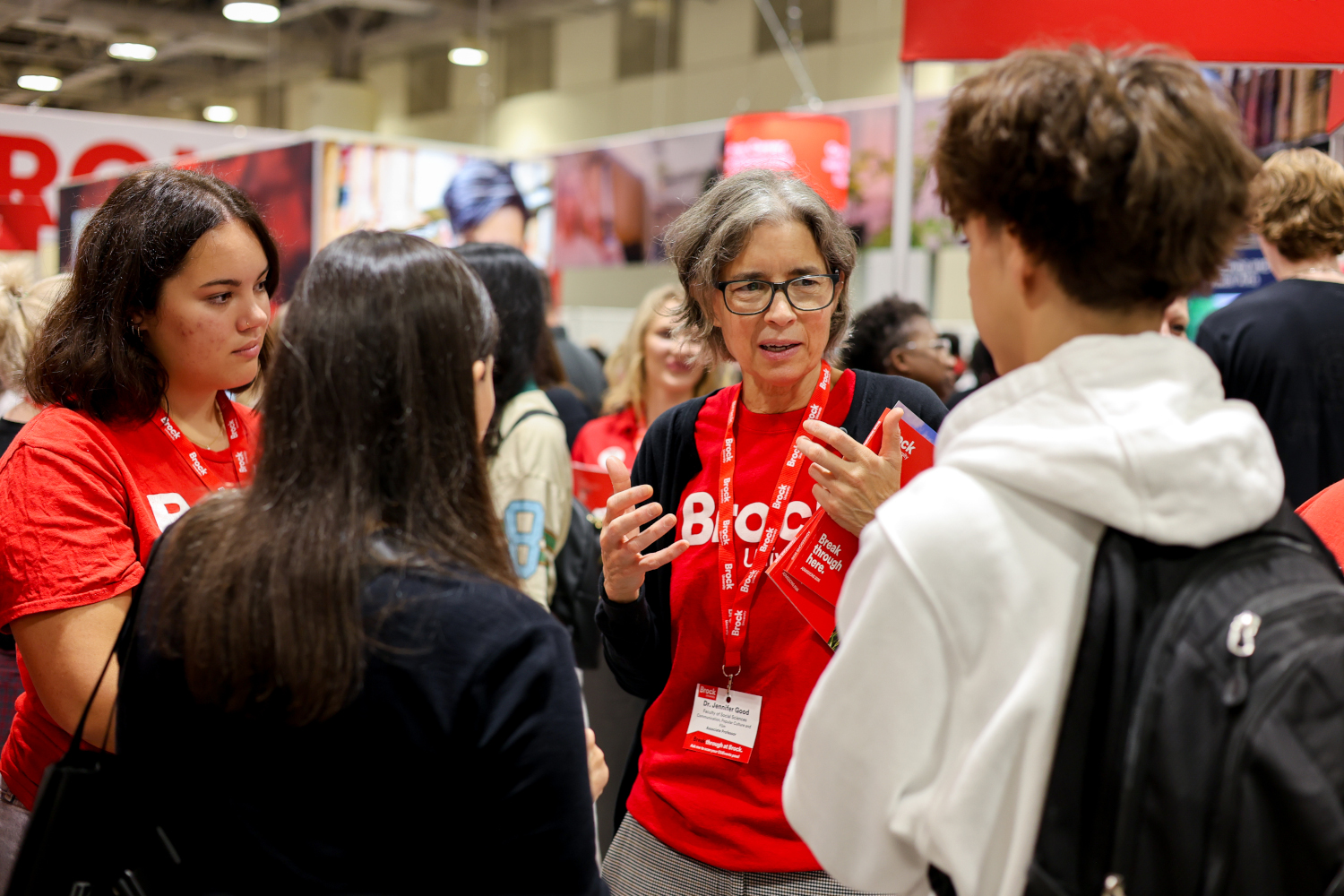
    The department was well represented at Fall Preview Day on Sunday Nov 2, as staff, faculty and student ambassadors welcomed prospective students to Brock.  The university estimates there were more than 4,700 guests — the largest draw since the COVID-19 pandemic.

    Visitors were able to speak with their future professors and peers and learn about our multi-disciplinary program and how it can set them up for future careers.  Whether they had questions about emerging AI, an ever-changing media landscape, or how a strong understanding of communication can shape success in the business world, students left with a clear understanding of how CPCF can offer the tools needed in an increasingly unpredictable world.

    Tags: , , , ,
    Categories: Events, News

  • CPCF Meets Prospective Students at the Ontario Universities Fair

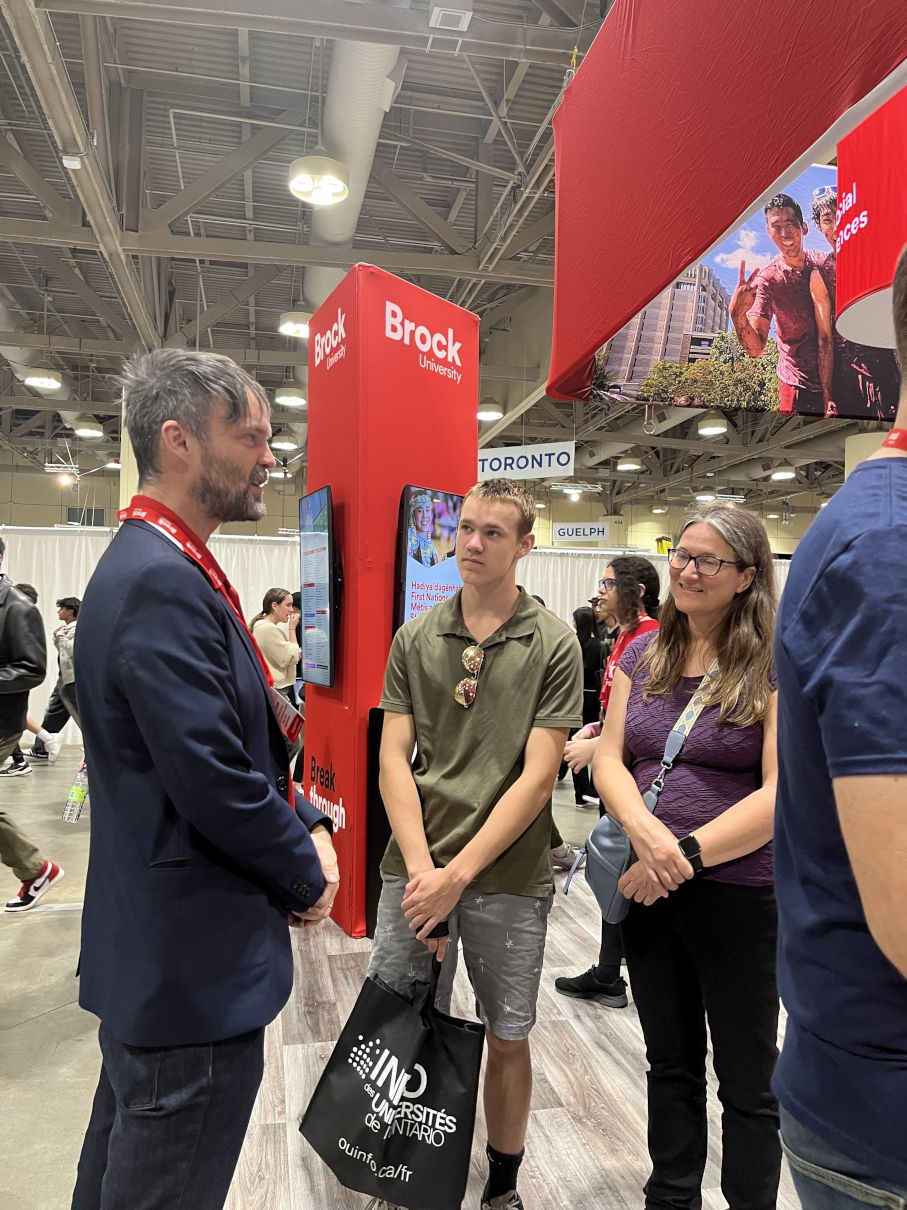
    This past weekend, the Ontario Universities Fair was held at the Metro Toronto Convention Centre. OUF is the main recruiting event for Brock University, as the two-day event draws over 80,000 prospective students and their families annually, and CPCF was well represented.

    Staff, faculty, and student representatives promoted our Communication and Film programs. It is always a great opportunity for CPCF to meet prospective students and share how our programs offer fresh, relevant ways to understand the world we live in. Department Chair Dr. Derek Foster was there to share his enthusiasm and “looks forward to seeing many more potential CPCF students at Brock’s Fall Preview Day on Sunday, November 2nd.”

    If you are interested in the programs offered by the Department of Communication, Popular Culture and Film, have a look at the courses offered here.

    Tags: , , , ,
    Categories: News

  • Professor Joan Nicks Returns to the Niagara Falls Museum for the Fall Film Series

    Over 10 years ago, CPCF’s Adjunct Professor Joan Nicks was approached by the Niagara Falls History Museum to program a public film series, and today it is still going strong. Professor Nicks curates two series a year, one in the fall and one in the winter. On September 25th, the newest series begins with “Borders – Crossing the Line North and South.”

    Each series has its own theme. This fall, it is “borders” and how particular genres, from westerns to crime films, characterize border themes. Professor Nicks explains that it “fits today’s social and cultural currents of unstable borders, something people in the Niagara Region understand directly.”

    Every film receives an introduction from Professor Nicks, followed by a lively discussion with the audience. “Museum audiences are very engaged,” Professor Nicks explains. “Many are regulars from the get-go. Some are first-timers discovering a particular series (and, in some cases, the Museum) for the first time. What they all share is an appetite for a special movie-going experience.”

    The first film in the series is The Grey Fox (Phillip Borsos, 1982). The film is about an aging stagecoach robber who crosses into British Columbia to rob trains and finds romance. For the full line-up and to purchase tickets, check out the Museum’s website. Films are free with a museum membership or $5 at the door.

    Tags: , ,
    Categories: News

  • Professor Anthony Kinik Participates in Terry Fox Run

    On September 14, 2025, CPCF professor Anthony Kinik participated in the Terry Fox Run in St. Catharines, Ontario. A tradition for Professor Kinik, he runs in honour of his father, John Kinik. He explains that his father “started jogging in his 30s as part of the jogging craze of the 1970s, continued running for nearly 40 years after that, and… instilled a love of jogging in me when I was just a kid.”

    The goal for this year was $2,479. Professor Kinik explains, “My father died of cancer 17 years ago. This year, he would have been 87 years old. As a result, my personal goal was to raise $2,479 (17 × 87 + 1,000).”

    However, this year’s run had additional meaning for Professor Kinik. He recently became the director of the Centre for Canadian Studies at Brock University. “Canadian icons like Terry Fox are an important part of our curriculum, so it made sense to start a team to honour him and his remarkable Marathon of Hope, and to further help with the cause.” CANA is the code used for Canadian Studies courses, so the team name is “Yes We CANA.”

    A huge congratulations to all involved. Not only did Yes We CANA end up raising over $3,500, but Professor Kinik also surpassed his personal goal, raising over $2,500.

    If you would like to donate or get involved with the Terry Fox Foundation, [click here].

    Tags: , , , ,
    Categories: News

  • Congratulations to our new CPCF graduates!

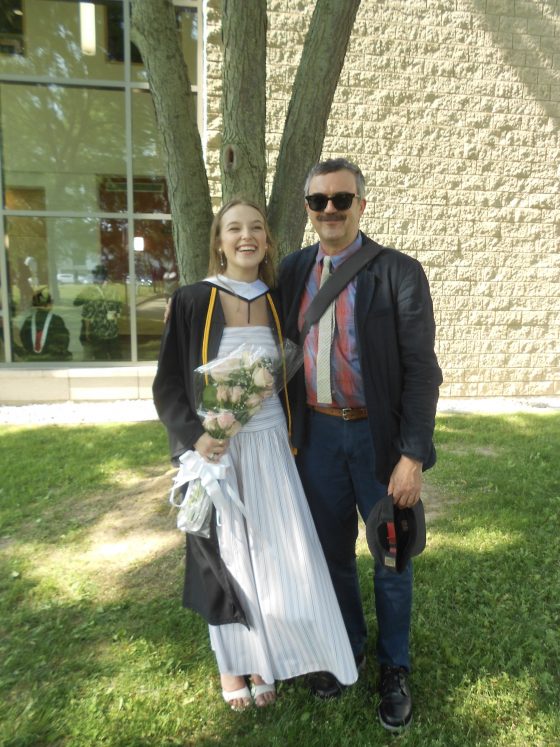
    Brock University CPCF graduate Chloe Pasco in a graduation gown and holding a bouquet of flowers, standing next to Associate Professor Anthony Kinik.

    Congratulations to all the CPCF graduates who crossed the Convocation stage this spring!

    Your passion, dedication and hard work have paid off. We are so proud of all that you’ve accomplished during your time at Brock University, and we can’t wait to see where your next adventure takes you.

    Check out the full 2025 Spring Convocation gallery on the Brock University Facebook page.

    Categories: Events, News

  • 2025 CPCF Spring Courses

    Whether you want to jump on the fast track to graduation, reduce next year’s course load, satisfy a program requirement or pick up an elective, Brock’s Department of Communication, Popular Culture and Film is offering Spring courses to help you advance your area of study and explore topics of interest.

    Course Spotlight: Nonverbal Communication (COMM 2P96)

    ONM – ONLINE MIXED

    How much of what we’re thinking and feeling is communicated without saying a word? In this course, you’ll decode the hidden language of nonverbal cues and gain greater insight into how people manage conversations and relationships across the channels of communication that escape our everyday attention.

    • Examine how body language, facial gestures, clothing, tone of voice, proximity and other nonverbal cues convey emotions and intentions.
    • Develop a deeper understanding of how you can tap into the power of nonverbal communication to support your personal and professional pursuits.
    • Explore how nonverbal communication influences significant moments such as job interviews, first dates, boardroom negotiations, courtroom trials and police interrogations.

    Recommended for Business Communication and Media Communication students looking to fulfill a third year COMM 290+ requirement.

    Prerequisite(s): COMM 1P91 and COMM 1P92 (COMM 1F90) or permission of the department. Please email [email protected] to request permission.

    This course may also be of interest to students in Sociology, Psychology, Political Science, LawPlus and Business.

    Other Spring CPCF Courses

    • FILM 1F94: Introduction to Film Studies

    Learn more about our Spring COMM courses and FILM courses.

    Registration opens March 5!

    For more information or to register for Brock’s Spring/Summer courses, visit brocku.ca/springsummer

    Categories: News

  • Jennifer Good examines how a “turning it off” approach to climate change could help the climate, Canada and you.

    This article written by Jennifer Good, Associate Professor of Communication, Popular Culture and Film, originally appeared in The Conversation.

    The challenge for climate change communicators a couple of decades ago was conveying what the research was showing: that the burning of fossil fuels was altering the planet’s climate. That communication played a vital role in facilitating the current widespread understanding that the climate is changing and it is a crisis

    There remains, however, a fundamental communication challenge in moving the focus from consuming different kinds of energy to facilitating a revolution of consuming less. Recent electrical grid events in Alberta offer a compelling case study.

    On Jan. 13, 2024, extreme cold hit Alberta — the coldest in half a century. As people turned up their thermostats to stay warm, Alberta’s power grid was put under immense strain. To avoid taking pressure off the electrical grid with rolling blackouts (rotating half an hour power outages throughout Alberta), the Alberta Emergency Management Agency sent an alert to all Albertans.

    This unprecedented use of the emergency system, the first of what would be four alerts, asked Albertans to turn off unnecessary electricity — lights, electrical appliances and devices — and use “essentials only.”

    Albertans responded. Within minutes of the initial emergency alert being issued, demand on Alberta’s power grid decreased by 150 megawatts and continued to fallAlberta has an estimated generative capacity of around 16,330 megawatts..

    Because many people and some businesses voluntarily switched off appliances and other electrical devices that were not needed, there was no need for the rolling blackouts.

    Switching off

    The brief experience of turning off highlighted a couple of things. First, that people are willing to change behaviours when asked. Second, the behaviour change, for some, was positive. As one Albertan posted on Reddit

    “Our kids made a game out of it. Showered with a candle in the bathroom, we had one small light to read books, ALL the lights off in and outside the house, no TV obviously.”

    Another poster on the same Reddit thread offered that their 10-year-old excitedly asked that all the lights and TV be turned off and added: “It looks like the alert does work.”

    In the aftermath, the news has focused on critiques of Alberta’s current energy generation and how to facilitate growing energy output in the future as fossil-fuels continue to be phased out. Politicians and experts wondered how the grid could be more robust and fail-safe so that there is no need to ask people to turn things off.

    Critiques of solar and wind were also quickly offered as were the benefits of new power generation such as Alberta’s Cascade Power Project — a 900 megawatt natural gas-fired plant — and increased energy generation flexibility.

    But what if the opportunity in Alberta’s power grid struggles is not about producing different kinds of energy but consuming less?

    Looking beyond supply

    The January cold wave is a critical moment to reflect upon the status quo and reimagine a system that values consuming less, not producing more.

    Alberta’s electrical grid alerts gave us a glimpse, for a few hours, of a topic largely absent from climate communication: we are consuming too much of everything. We must use and consume less. Less energy, less stuff. We cannot consume our way out of this crisis.

    We must consume less, and Albertans proved that this is not only possible but can even be a positive experience.

    It is also important, in the depths of an unprecedented cold-weather event, to not lose sight of the fact that globally 2023 was the warmest year on record “by far” — beating 2016 (the previous record-setting year) by .15 degrees Celsius (also a record).

    The 10 warmest years on record — since 1850 — have been in the past 10 years and this changing climate is causing extreme wildfires, tornadoes, cyclones, drought, flooding, heat and cold. Here and around the world lives and habitats are indiscriminately being destroyed. This is our emergency alert.

    A new normal

    Shifting to turning off and reducing consumption patterns for individuals, businesses and industry will be incredibly hard. The global economy, and related jobs, are built on consuming more. But the climate crisis, as well as growing inequality and ecosystem destruction, will make status quo levels of consumption increasingly untenable.

    The Alberta Emergency Management Agency sent emergency alerts asking people to turn off because the alternative would have been mandatory rolling blackouts. Asking people to turn off voluntarily allowed Albertans to respond with thoughtfulness, dignity and agency.

    We, collectively across Canada and around the world, are in an emergency. The climate crisis is upon us and we have a choice. We can delay structural change and await the extreme climate crisis consequences. Or we can demand that government and industry implement the systemic changes required to avert (or at least mitigate) this catastrophe.

    Regardless, the lessons from Alberta are clear. We could all try “turning off” from time to time — saving money, helping the planet and perhaps reconnecting with friends and family. That, if nothing else, could be a benefit worth championing.

    Categories: News

  • Dragons’ Den pitch proves successful for CPCF student

    Brock student Cecily Zeppetella, together with her father Pete Zeppetella, entered the Dragons’ Den earlier this month and walked away with not one but two investors.

    The fourth-year Media and Communications student took part in her father’s pitch for Zeppsgear, which produces patented outerwear for labourers working at heights. The company’s jackets allow for safety harnesses to be worn underneath without a risk of choking in the event of a fall.

    The pitch, which lasted about 40 minutes in real time, demonstrated the effectiveness of the gear with a surprise dummy drop from the studio ceiling, catching the Dragons off-guard.

    Zeppetella says the pressure of the pitch combined with that of being on camera and following production’s cues, while wearing warm jackets under studio lights, made for an interesting and exciting experience.

    And the outcome is just what she and her dad hoped for.

    “We’ve had opportunities from investors before, so it was more about the Dragons’ expertise rather than the money for us,” says Zeppetella. “We knew that it would be a good kick-start on the marketing side and that some of the individuals on the panel would be able to help us wanting to regulate or mandate the product.”

    She notes that website traffic spiked after the episode aired on Thursday, Oct. 5, and that the women’s line sold out quickly.

    “We got orders, which was great, but we also had wholesalers and distributors reaching out to us, especially for the women’s side because it’s hard to find good quality women’s workwear,” she says. “We’ve been really focused on the southern part of Ontario, but now we have a lot of people from out west reaching out, and we have a fashion show coming up in B.C. for safety wear for women.”

    Zeppetella, who started at Brock in Business Communication, says she changed majors when she realized how keen she was on media policy and research. These interests and her training have served her well as she has grown more involved in the family business over the past few years, looking at how Zeppsgear might be mandated and thinking creatively about how to get her father’s innovations into broad use.

    Cecily’s experiences in applying policy and research ideas from her CPCF degree really resonates with me,” says Associate Professor Karen L. Smith in the Department of Communication, Popular Culture and Film. “I have seen first-hand that Cecily leverages both classroom and co-curricular opportunities to develop innovative ideas, like enhancing worker safety through Zeppsgear.”

    Zeppetella believes that community involvement should be a big part of any entrepreneurial journey. She says she has worked hard to involve Zeppsgear with different organizations, charities and safety training programs, and has jumped at opportunities to engage, including at Brock.

    “In the Goodman School of Business, Zeppsgear was studied by one of the marketing classes in 2021 as a case study,” she says. “For a startup, I think it’s really important to be connected, especially to growing minds and youth for perspective — and you never know who you’re going to meet.”

    Watch the full Zeppsgear pitch on the Dragons’ Den website.

    Written by Amanda Bishop

    Categories: News

  • Jennifer Good discusses how humanity’s relationship with heat impacts climate action

    This article written by Jennifer Good, Associate Professor of Communication, Popular Culture and Film, originally appeared in The Conversation.

    Humans are a species borne of the heat, as hot and dry temperatures played a key role in our evolution, and many of us (at least in the United States) prefer to be in the heat.

    We as a species have known for decades that the carbon-fuelled actions of some nations meant that devastating heat and related extreme weather events were coming.

    And yet, most of us did nothing.

    The summer of 2023’s unprecedented forest fires, floods and rising ocean temperatures are the consequences of collective inaction and while there are many reasons for these failures to act, humanity’s complex relationship with heat is arguably a critical one.

    The comfort, and dangers, of heat

    At a fundamental level, heat is what allows for humans and the Earth’s biological diversity to exist. A stable core body temperature facilitates human survival and the greenhouse effect facilitates all life on Earth. However, while heat may be essential to life, and desirable to many, too much heat is devastating.

    One way to articulate this complex balance has been to use the metaphor of a fever. If a human’s body temperature increases even a couple of degrees, then an illness is likely occurring. If a person’s core body temperature increases only three to four degrees celsius it can be fatal. Likewise, a rise in planetary temperatures above just 1.5 C could be equally fatal.

    A seemingly easy to understand threshold. However, in practice, communicating a 1.5 C tipping point has been extremely challenging. Humans generally struggle with disentangling short-term daily temperatures from a long-term climatic shift and as a result fluctuations in temperature have been easily misunderstood. And confusion over these questions are readily misused to question the veracity of an anthropogenically induced changing climate.

    All under one greenhouse?

    An early attempt at circumventing our innate fondness for heat in climate change communications was through leveraging the term greenhouse effect — a phrase which notably removes heat from the equation altogether.

    Knowledge of the greenhouse effect goes back to the mid-19th century. In the latter half of the 20th century, the term became an evocative label for what the burning of fossil fuels was doing to the planet.

    But the term is inaccurate.

    The greenhouse effect is the well-established phenomenon of the Earth’s atmosphere trapping the sun’s radiation and allowing the planet to be a warm and hospitable place. Using the greenhouse effect as a term referring to the warming of the planet due to the burning of fossil fuels conflated a naturally occurring and well-established phenomenon with an unfolding anthropogenic disaster to confusing results.

    In response to this limitation, global warming increasingly became the terminology of choice for the changing climate — phasing out the banal inadvertent climate modification which had also been in use since the 1970s. So much so that by the 1990s, it became the single most used term. But this also had challenges.

    Warming has a certain coziness and as climate change researchers Julia Corbett and Jessica Durfee highlighted, ‘global warming needs a more salient metaphor that emphasizes its seriousness, immediacy and scientific credibility.’

    Global warming was also a narrow term, as global average temperature increases would cause a range of extreme weather effects

    In response to these limitations, the term climate change gradually came to replace global warming as the most widely accepted and used descriptor. Though more recently, this somewhat benign term has been altered again by some to more accurately address the urgency of the situation.

    For example, in 2019 The Guardian moved from using climate change to the terms climate emergency, crisis or breakdown in response to climatic effects of ever-increasing severity.

    This confused discourse has led to even further confusion and arguably hampered climate change mitigation efforts for decades.

    Too much of a good thing

    Research indicates that in the summer of 2022, over 60,000 people in Europe alone died from extreme heat. July 2023 was the hottest month ever recorded and it is increasingly looking like 2023 will be the hottest year on record. Heat-related deaths are mounting and the heat is being exacerbated by raging fires and extreme ocean temperatures.

    Human beings, alongside all life, exist on Earth because of a delicate celestial balance of gasses that trap the sun’s warmth. For millions of years, this greenhouse effect has made Earth a miraculously habitable orb in the coldness of space.

    While all human beings have a complex — and often positive — relationship with heat, in the Northern Hemisphere it is something which many of us particularly crave. However, the reckless pursuit of it (among other comforts) through the burning of fossil fuels has turned heat from a source of life to a harbinger of doom for all.

    It is only through confronting this complex relationship — by accepting the inherent dangers of more heat — that we can hope to seriously pursue real action on fossil fuel emissions.

    Categories: News

  • CPCF mourns the loss of Professor Emeritus William “Bill” Hull

    The Department of Communication, Popular Culture and Film mourns the death of Professor Emeritus William “Bill” Henry Nelles Hull, who passed away Wednesday, Nov. 2 at the age of 93.  

    In the early 1980s, Hull was one of the founders of the Interdisciplinary Program in Communication Studies from which the Department of Communication, Popular Culture and Film (CPCF) evolved following a merger with Film Studies more than two decades ago.

    Hull retired from Brock’s Department of Politics, as it was then known, in 1995. He was a major scholar in Canadian and Comparative media policy, especially in the area that used to be known as “broadcasting policy.”

    To learn more about Bill Hull and his impact on Brock University, please read The Brock News article.

    His funeral will take place on Thursday, Nov. 10 at 11 a.m. in St George’s Anglican Church in St Catharines. Reception to follow.

    Categories: News