Blog Contributor: Madelaine Legault
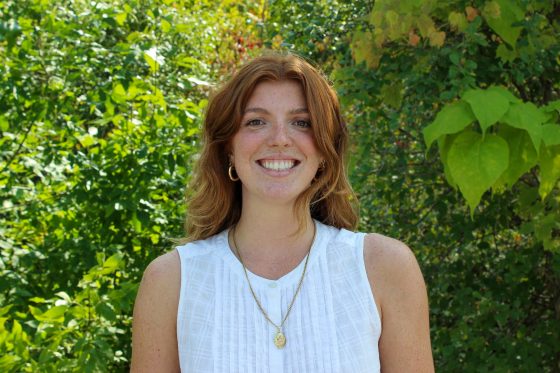
Makenna Kollo is a first year student in the course-based pathway of the Master of Sustainability program. She recently sat down with PhD in Sustainability Science student and graduate ambassador Madelaine Legault to share her experience in the SSAS program as she finishes her first term.
What inspired you to pursue graduate studies in environmental sustainability?
I completed my Bachelor of Recreation and Leisure Studies at Brock University, and through that, I did a lot of outdoor educational courses that were centered around our relationship with the environment. Climate change and climate action have been very important topics, especially with younger generations, and it was instilled in us that you cannot have a relationship with an environment or a natural space that no longer exists. So, my inspiration was trying to preserve, maintain and sustain environments for future generations to also have the same opportunities that I had as a child, like going to summer camp. I feel very passionate about it. I feel as though I can make a change.
How would you describe your typical day in the program?
I have four classes this term, so that leads me to be on campus three days a week for structured activity. On Mondays, I have a biology course at night. Typically, I will do my readings and get everything done on Mondays and then go to class. On Tuesdays and Thursdays, I also have classes. Those days involve me generating conversations with other students and faculty to broaden my perspectives and learn more about sustainability topics that are not within my scope of interest but expand my knowledge through conversations with my peers. And then I typically move on to a group meeting or work with my peers to work on projects together. It’s crucial in this role to try and think of other perspectives on sustainability. Overall, my days involve a lot of collaboration with faculty, staff, students, as well as other partners (both on and off campus) involved with the program. For example, this term we are working with Facilities Management at Brock and partners at Niagara Parks Commission.
What program experiences have had the most impact on you?
It almost feels like we’re doing an internship of sorts with different organizations in our courses with more experiential learning components. For example, right now we are working with the Niagara Parks Commission in SSAS 5P02 with Dr. Lina Taing. It feels as though we’re working directly with them towards a goal. Having the opportunity to work directly with an organization like that opens so many doors. It’s something I can speak about in interviews and in job applications.
I’m also thoroughly enjoying SSAS 5P82 with Dr. Marilyne Carrey. It is completely changing my perspective on what nature-based solutions are, because we are diving feet first into what they could be, rather than just learning the theory while sitting in a classroom. It is fully experiential, and she has developed this course where it is all to the beat of your own drum. We work collaboratively as a class towards a final goal. For example, we’re creating a “talking tree” tour right now. We’re choosing a tree, and we’re explaining how it’s impactful on the environment around it, and then also how we’re connected to the tree. We’re also talking about why you should care about it, and why it’s important. My tree is the eastern white pine, which is typically found within eastern Canada, and it is the provincial tree of Ontario. I have a tattoo of it, I’m super into it!
How has your understanding of sustainability science evolved since starting your graduate studies?
I’m embarrassed to admit it, but I was a small thinker before I came into the program. I thought of sustainability strictly in terms of environmental sustainability in natural landscapes. I was thinking of forests, mountains, fields, things like that. But for example, in one of our courses, we’ve done a tour of the energy system on campus, and through that I was able to understand that it’s not just cost effective when you turn off your light bulbs or your light switches or unplug something, it’s actually better for the environment.
In our courses, we talk a lot about international implications and sustainability sciences in our courses. It takes my understanding from a local to a global level. It’s broadening my horizons.
How has the program faculty and your peer group supported your academic journey?
There’s not a single time that I speak to my professors when they don’t have a smile across their face. They are so welcome to new ideas about the program, about how they teach, even about what you have to say about a topic, which really makes it more intriguing and appealing to go to class. They are guideposts that I have definitely clung to.
As for my peers, I just love listening to people talk. We have backgrounds in chemistry and aviation, and water resource management, and then we have someone working in the wine industry, and then we have a politician. There’s just so many vastly different perspectives and somehow, we all care about the same things. It’s just so interesting. It’s making me a better person just to sit with them and hear why they care about sustainability. It’s amazing that we get to come together and all work towards a common goal while being such different people and still staying true to ourselves at the same time.
I think every vantage point is also so necessary in this field, because addressing this issue is arguably like the largest target that we will ever have. And it is not a solo job, and solutions do not come from one perspective but from a community of people that have banded together to make a change. And that’s what we’re seeing is happening here.
How do you stay motivated when facing or when thinking about these complex and often very overwhelming crises?
I’m going to share a story. Last year, maybe two years ago, I think it was an El Niño year, where we saw a lot of climate events happening. I was on a side of social media that was just full of doom. I would go on my phone and I would scroll, and I would see glaciers melting, a volcano in Iceland is blowing up, hurricanes, countries going underwater… I hated the fact that I could scroll past these news events and not think about it again. Part of me staying motivated comes from not wanting to see these things happen again. If I give up, I’m just one more person that’sconforming to the idea that someone else will fix it. So, I say, why not me? I’m so grateful that I get to have an education and that I get to be here, to have networking possibilities to advance into industries that can push for these changes. It’s not something that everyone can do in their lives. So, I take every day with grace.
What advice would you give to someone thinking about graduate studies in sustainability science?
Stay true to yourself. There’s a lot of people out there that don’t believe in sustainability science or have differing opinions about it. And I would say if this is where your heart lies, stick with it. You will be fruitful in any endeavor that you pursue when you are passionate about it. Also take every opportunity that comes to you. Someone asks you to volunteer? Do it. Someone asks you to join this class with them? Do it. If someone asks you to sit down for a coffee chat, absolutely do it. Because the best way to build and learn is to listen to other people. So, if you’re thinking about doing a masters in sustainability science, I say jump in, feet first. Take the risk. Take as many risks as you can but be true to you.