By Melina Christopoulos
Under the mentorship and guidance of our members, high school student athletes are supported in publishing their blogs created as part of their volunteer activities at the Centre for Healthy Youth Development through Sport (CHYDS). This is an original article sponsored by Dr. Panagiota (Nota) Klentrou, professor in the Department of Kinesiology and member of both CHYDS and the Centre for Bone and Muscle Health.
This resource is also available in French HERE.
Ce blog est accessible en anglais en cliquant ICI.
Abstract
Platelet-Rich Plasma (PRP) therapy is an innovative solution for the treatment of tendon and joint injuries in athletes, as well as other musculoskeletal conditions. With PRP therapy, the patient’s own blood is injected in form of platelets (the blood cells controlling bleeding) into the damaged tissue. When injected at the site of an injury, the platelets become activated and release growth factors and hormones that promote the accelerated healing of injured tissues
This report outlines the key steps involved in PRP, its key mechanisms, and the role of ultrasound guidance in ensuring maximum precision during the injection. It also explores the effectiveness of PRP in enhancing tendon healing, based on ultrasound assessments of tissue changes before and after treatment.
What is PRP?
Platelet-Rich Plasma (PRP) is a treatment that uses a concentrated form of part of the patient’s own blood, namely the platelets, to enhance and speed up healing. Platelets are blood cells known for controlling bleeding and containing a large amount of growth factors that play a key role in tissue, tendon and joint regeneration and repair. PRP harnesses these growth factors to accelerate the healing process, especially in areas like tendons and ligaments, where natural recovery is slow due to limited blood supply. Because of its effectiveness and shorter recovery time necessary, PRP is used to treat mainly sports related injuries such as tendon and joint injuries in athletes but can also be used to treat other musculoskeletal conditions in the general population. In order to provide anatomical context for the PRP therapy injections in the ATFL and CFL, a labeled illustration of the foot’s musculoskeletal structure is presented bellow (Figure 1). This figure highlights the key bones and ligaments involved in ankle stability, offering a visual reference for the locations targeted in treatment.
Figure 1. Anatomical illustration of the foot, highlighting key bones and ligaments

PRP contains a variety of agents, including:
- Platelet-Derived Growth Factor (PDGF) which stimulates cell growth and division, and tissue formation.
- Fibroblast Growth Factor (FGF) which supports the formation of new tissue and wound healing.
- Insulin-like Growth Factors 1 and 2 (IGF-1, IGF-2) which promote cellular growth in both adults and children, aiding in tissue repair.
- Vascular Endothelial Growth Factor (VEGF) which encourages the formation of new blood vessels, increasing blood supply to the injured area.
- Epidermal Growth Factor (EGF) which promotes skin and tissue regeneration.
These growth factors are essential in the body’s natural repair mechanisms, and by concentrating them into a specific area through PRP therapy, healing processes are significantly accelerated.
The PRP Process
PRP therapy consists of a simple but highly effective three-step process (Figure 2):
- Blood Collection: A small amount of the patient’s blood is drawn (like a regular blood test).
- Centrifugation: The blood sample is then placed in a centrifuge. The centrifuge spins the blood rapidly to separate its components, isolating the platelets from red and white blood cells (which can potentially negatively affect healing in joints or cartilage). This process results in a small amount of plasma rich in platelets, which contains a higher concentration of healing growth factors compared to normal blood.
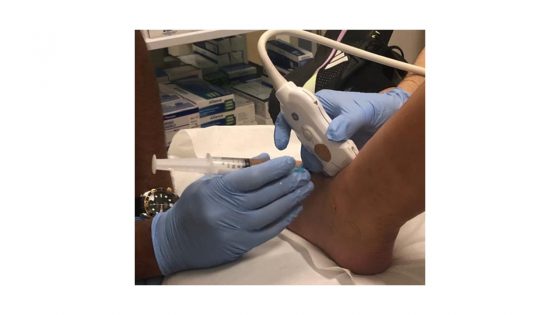
- Injection: The final step involves injecting the concentrated PRP directly into the injured ligament or tissue (Figure 3). This is almost always done with the aid of ultrasound (U/S) technology, ensuring precise placement of the injection into the damaged area. This precision maximizes the potential for healing by delivering the growth factors exactly where they are needed.
Figure 2. Main components of blood; and their transformation of blood to platelets (Created in Biorender)

Figure 3. PRP Injection
How does PRP Promote Healing?
PRP accelerates the body’s natural healing processes by delivering a concentrated dose of growth factors to the injured area. These factors have several beneficial effects:
- Tissue Regeneration: The growth factors in PRP stimulate the production of new cells, particularly in tendons and other tissues that are slow to regenerate on their own.
- Increased Collagen Production: Collagen is a crucial protein that provides structure and strength to tendons. PRP promotes faster and more robust collagen production, which improves tendon integrity and resilience.
- Reduced Inflammation: PRP contains anti-inflammatory proteins that help reduce inflammation at the injury site. This not only reduces pain but also allows the tissue to repair more efficiently by creating a healthier environment for healing.
- Enhanced Blood Flow: The growth factors promote angiogenesis (the formation of new blood vessels), improving circulation to the injured area and further accelerating the healing process.
By focusing the body’s healing factors on the damaged tissue, PRP can significantly speed up recovery times compared to traditional treatments which can be riskier and more invasive.
Musculoskeletal Ultrasound (MSK U/S) Guidance in PRP Therapy
The success of PRP therapy largely depends on accurate delivery of the injection. Tendons, ligaments, and other soft tissues can be difficult to target precisely due to their size and density. This is where MSK U/S guidance becomes a vital tool. This technology uses sound waves to create real-time images of the tissues beneath the skin. The U/S performed by the technologist allows the doctors to visualize the injury site with extreme precision while guiding the needle directly into the most damaged areas within the tendon (Figure 3). By ensuring that the PRP is delivered exactly where it’s needed, ultrasound helps maximize the treatment’s effectiveness and minimize risks associated with misplacement. During the actual injection, the ultrasound offers full clear visibility of the plasma circulating into the tear (Video 1 and Video 2).
Before and After: Monitoring Progress with Musculoskeletal Ultrasound
U/S not only helps with the injection process but also plays a crucial role in monitoring the healing process after PRP treatment. Physicians can use follow-up U/S to track changes in the injured tissue and assess how well the tendon is healing (Figure 4 and 5). Key signs of recovery which are visible through ultrasound include:
- Reduced Fluid Buildup: A decrease in the amount of fluid surrounding the tendon indicates reduced inflammation and a healthier healing environment.
- Increased Tissue Density: The affected area will begin to appear denser on ultrasound, reflecting the strengthening of the tendon as new collagen is produced.
- Fewer Micro-Tears: As the tendon repairs itself, the number of visible micro-tears will decrease, demonstrating successful tissue regeneration.
The U/S comparison images below (Figures 4 and 5) provide a clear picture of how the PRP therapy is working and whether additional treatments are necessary.
Figure 4. ATFL post injection U/S comparison

Figure 5. CFL post injection U/S comparison

Conclusion
PRP therapy represents a revolutionary approach to healing tendons, ligaments and soft tissue injuries by concentrating the body’s natural healing powers. With the added precision of ultrasound guidance, this treatment offers a safer, less invasive alternative to surgery and other traditional methods. As the therapy continues to evolve and gain widespread use, PRP is proving to be an effective solution for athletes and individuals seeking faster recovery and long-term relief from MSK injuries.
Acknowledgments
I would like to extend a special thank you to Dr. Guru Kandasamy, Dr. Alvaro Germán, and Dr. Chris Klachan for their kindness and support during my treatment and recovery. Their willingness to allow me to document the process has provided valuable insights and visual resources that have greatly enhanced this paper.
Author Bio
 My name is Melina Christopoulos, and I am a tennis player and a volunteer at the Centre for Healthy Youth Development through Sport (CHYDS) and the Centre for Bone and Muscle Health at Brock University. Currently, I am working under the supervision of Dr. Panagiota (Nota) Klentrou in sports bioscience and exercise nutrition. I am a grade 11 student attending the Virtual Highschool, an online accredited program sanctioned by the Ontario Ministry of Education. I have a strong interest in Kinesiology and Health Sciences, and I am passionate about transmitting the value and importance of healthy lifestyle choices to young kids. This blog was written as part of a series of short articles and is based on my personal experience as a youth athlete dealing with a torn tendon injury. As a high-performance athlete, I’ve endured numerous injuries over the years, many of which demanded extended periods of rest and rehabilitation. This time, however, rather than simply waiting for my body to heal naturally, I had the opportunity to explore an advanced, accelerated healing method known as Platelet-Rich Plasma (PRP) therapy. I found this approach to be both innovative and fascinating, as it harnesses the body’s own regenerative abilities to promote faster recovery. Through this paper, I aim to shed light on the PRP process and its potential benefits, hoping to inform other athletes seeking efficient and effective options for injury recovery.