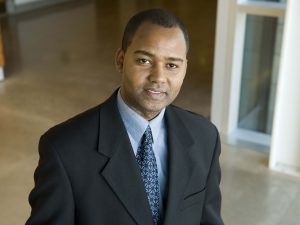
Distinguished Professor Emeritus Maurice Feldman, shown here at Bethesda Family Services, retired from the Departments of Applied Disability Studies and Child and Youth Studies in 2022 but continues to influence research, practice and policy in the disability field.
Brock University’s Distinguished Professor designation is a lifetime appointment recognizing outstanding achievement in each recipient’s academic discipline. This series of articles highlights this year’s recipients. Read more about the award and its recipients on The Brock News.
Maurice Feldman has spent his career advancing the rights and dignity of individuals with disabilities.
The Distinguished Professor Emeritus’ innovative research into intellectual and developmental disabilities (IDD) and the resulting evidence-based interventions he’s developed have been used around the world.
“I always wanted to be a researcher and a clinician,” says the internationally respected expert in the field of disability studies. “I felt I could improve the lives of the families I work with directly, but if I published systematic research, whoever read those publications could apply the research to their clients.”
Even as an undergraduate student, Feldman believed clinical psychology needed better evidence to ensure interventions were safe and effective. For many years after completing his doctorate, he split his time between academia and clinical/consulting positions at IDD service agencies.
In 2003, Feldman joined Brock’s Department of Child and Youth Studies and in 2006, he helped launch a new Centre that has since become the Department of Applied Disability Studies (ADS), where he served terms as Director, Chair and Graduate Program Director until 2022.
He says the department combines applied behaviour analysis instruction with disability studies so students appreciate the lived experience of individuals with disabilities.
“When working with a person with disabilities, you need to be cognisant of how other people treat that person because of their disability,” says Feldman. “From day one, I have emphasized the importance of being sensitive and respectful to how an intellectual disability affects how someone sees the world and how they are treated.”
Feldman’s involvement with policy recommendations, standards and consultation dates back to the 1990s, when he helped establish the Ontario Association for Developmental Disabilities (OADD) and the Ontario Association for Behaviour Analysis. He became the first behaviour analyst appointed to the province’s ASD Clinical Expert Committee in 2017.
He has published extensively, including more than a dozen books and manuals, and received research funding from multiple government, charitable and community organizations.
One of Feldman’s biggest research contributions has been advocating for the rights of parents with disabilities by showing how variables such as trauma, social supports and poverty influence a person’s caregiving ability more than IDD.
“When you statistically control large sample sizes for these contextual variables, differences in maternal health, child outcomes and child removal either disappear or are significantly reduced between parents with disabilities and parents without disabilities,” he says. “That’s strong support for a contextual view of parenting, and these findings have played a significant role in moving our field to the next level.”
The Step By Step Parenting Program, training adults with IDD and other cognitive disabilities in parenting skills, has had powerful social and legal ramifications wherever it is implemented. He has trained hundreds of workers around the world to implement the program. Feldman is now investigating an intervention for expectant parents with IDD to support caregiving for infants from birth to prevent separations.
In addition to being included in multiple top scientist lists and receiving the OADD Hull-Roeher Award of Merit for lifetime achievement, Feldman has received several awards for distinguished research, including the Brock Chancellor’s Chair in Research Excellence.
Feldman says he takes pride in seeing the researchers and practitioners he has trained — including more than 100 graduate students and clinical placements — helping families around the world.
“At one point, we estimated that at least 60 per cent of all board-certified behaviour analysts in Ontario were Brock ADS graduates,” he says. “Our graduates have had a major impact, particularly in autism services, but more broadly in developmental disabilities and acquired brain injury, as well.”
While he retired in 2022, Feldman says has no Intention of slowing down. He recently started collaborating with colleagues in China to implement the Parent Observation Checklist, an online tool to help parents identify early symptoms of autism spectrum disorder.