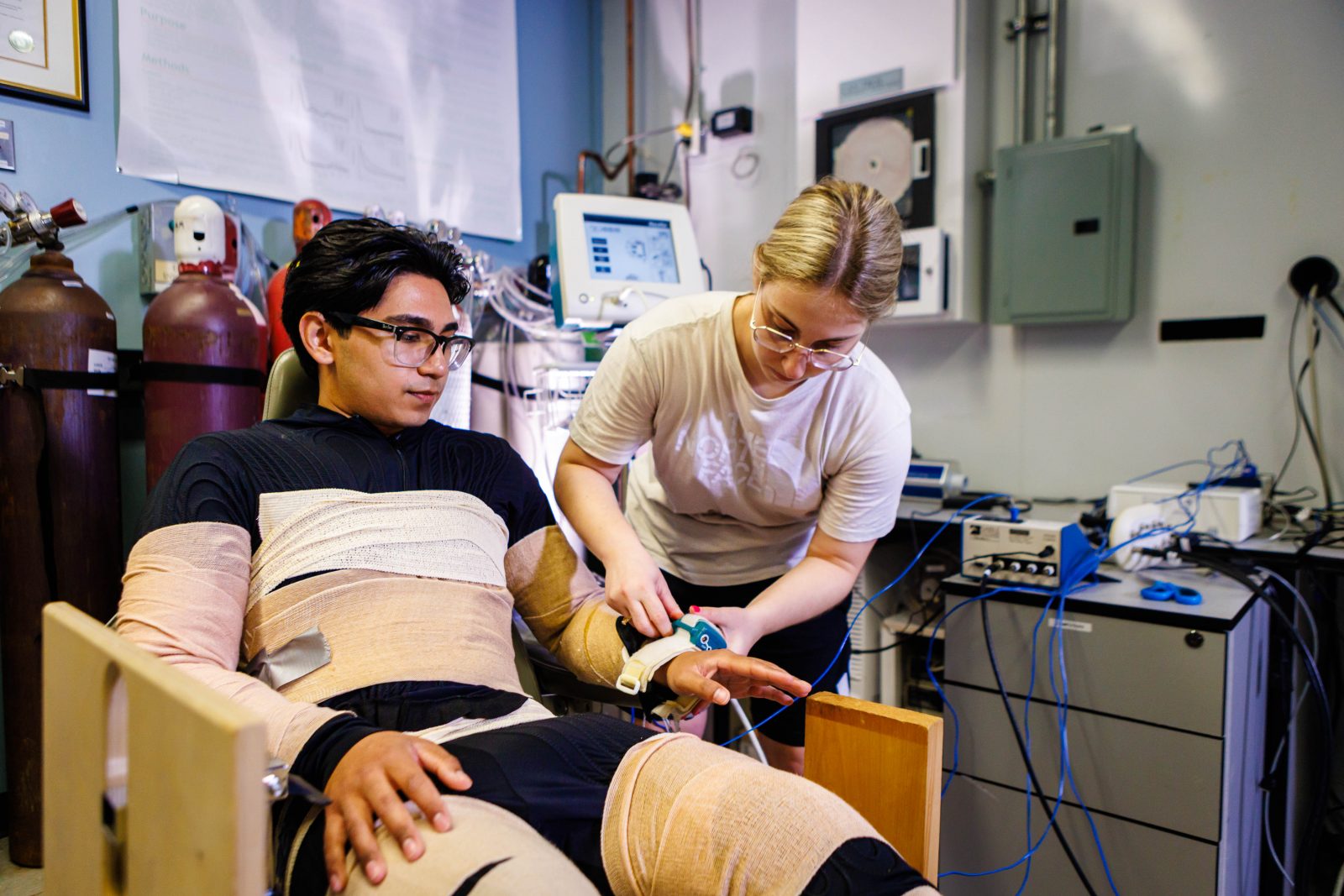
 Brock University PhD student Georgia Charachousou (right) attaches a sensor to research participant Matthew Ramdial as part of a study examining how people with multiple sclerosis (MS) respond to heat. The research aims to better understand the physiological mechanisms behind MS-related heat sensitivity.
While some people may find summer stifling, those living with multiple sclerosis (MS) tend to suffer in hot environments more than the average person, says Georgia Charachousou.
“Symptoms get worse with MS heat sensitivity,” says the Brock University PhD in Applied Health Sciences student. “People with MS feel much more fatigued than you or I might in the heat. They may also experience blurred vision, confusion and less co-ordination in their hands when temperatures rise.”
Charachousou says research isn’t clear on why individuals with MS are more sensitive to heat — but she’s hoping to change that.
“Is this heat sensitivity more driven by core temperature or skin temperature? Knowing this can guide us towards better interventions to improve comfort and capacity to perform everyday tasks,” she says.
According to MS Canada, Canada has one of the highest rates of MS in the world, with more than 90,000 people living with the neurological disease.
Charachousou is looking for people in the Niagara area who have MS to participate in research that aims to answer questions about the disease’s impact on body temperature.
Participants should have relapsing MS and score six or less on the 10-point Expanded Disability Status Scale (EDSS), a tool used by neurologists to assess level of disability. With relapsing-remitting MS, the most common form of the disease, people experience neurological symptoms that partially or completely disappear during periods of remission.
Those interested in being part of the study can contact Charachousou at [email protected]
The study is the first in a series Charachousou aims to pursue to understand the physiological mechanisms of heat impairment with MS.
Research has shown people living with MS tend to sweat less than those without the disease, she says. When core temperature becomes too high or low, an area of the brain called the hypothalamus sends out signals to sweat glands, the circulatory system and skin.
Charachousou wants to know if this reduced sweating capacity is due to interference in brain signals to the body’s systems or if there’s a shortcoming in the way sweat glands themselves receive that signal and act on it.
Distinguished Professor of Kinesiology Stephen Cheung, who is Charachousou’s supervisor, previously studied MS heat sensitivity in his time at Dalhousie University.
In Cheung’s 2011 study, MS research participants who were first cooled down by wearing a special hood, performed much better in a series of simple tests mimicking everyday tasks, such as getting up off a chair and walking.
“Studies like the one we did show that cooling can help with MS symptoms, but we need to know more about the physiological mechanisms before we can explore the best way to keep MS individuals cool,” says Cheung. “Heat sensitivity limits the capacity to exercise, which we know is good for health, and also carry out activities of daily living.”