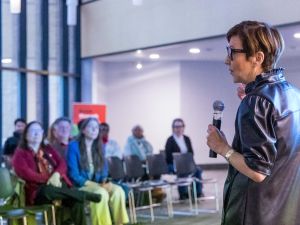
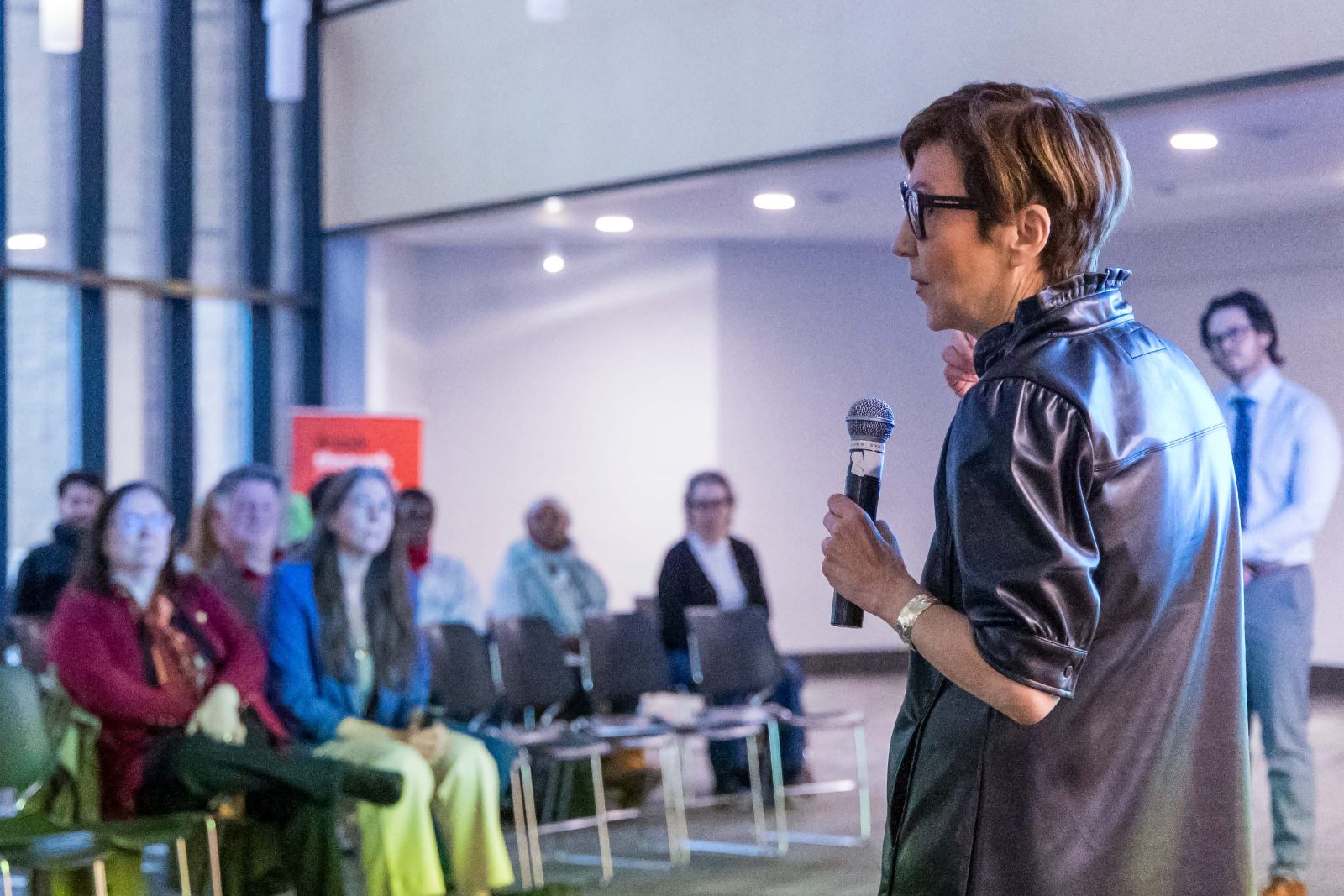
 Indigenous rights advocate and scholar Cindy Blackstock delivered the ninth annual Yosif Al-Hasnawi Memorial Lecture, held in memory of a Brock student whose courage continues to inspire advocacy for justice and anti-racism in health care.
A decade after a landmark ruling that found Canada racially discriminates against First Nations children when it comes to equitable health care and education access, Cindy Blackstock says the fight for change continues.
Her decades of work as an advocate for First Nations children and families shows that accountability in health care and public systems takes sustained pressure, and the more people applying that pressure the better.
“Children don’t just deserve justice. They deserve love,” says Blackstock, Executive Director for the First Nations Child and Family Caring Society and a member of the Gitxsan First Nation.
Working alongside other Indigenous child and youth advocates and the Assembly of First Nations, Blackstock and the Caring Society played an instrumental role in a decade-long human rights challenge before the Canadian Human Rights Tribunal (CHRT) that showed Canada had been discriminatory in its delivery of services to First Nations children, youth and families.
In 2016, the CHRT ordered Canada to stop its discriminatory practices and immediately implement the full meaning and scope of Jordan’s Principle, a child-first principle to ensure First Nations children get the services they need when they need them.
Ten years later, Blackstock says the principle is still unevenly applied. Around 35 non-compliance and related orders have been issued since the 2016 ruling, and a backlog of roughly 120,000 requests was ordered cleared in 2024.
Speaking at Brock University’s annual Yosif Al-Hasnawi Memorial Lecture, she urged those in attendance not to be patient.
“Being patient is actually a problem,” she says, because exhausted advocates are easier to outlast.
Instead, she called on students and those already working in health care to learn the history behind Jordan’s Principle and urged them to demand that governments act by contacting elected officials directly and publicly.
Her words carry particular weight at Brock, where the memorial lecture is held in honour of a Brock Medical Sciences student whose courage continues to inspire advocacy for justice and anti-racism in health care. Now in its ninth year, the annual event is hosted by the Department of Health Sciences.
In December 2017, 19-year-old Al-Hasnawi was fatally shot while intervening on behalf of a stranger being accosted across the street from the Hamilton mosque where he had just recited evening prayers. The paramedics that responded to the scene were later found guilty of failing to provide necessaries of life.
Blackstock says stereotypes shape who is believed and who gets timely care. She encouraged health-care providers to ask additional questions that may help them see beyond bias.
The Nov. 13 lecture wasn’t the first time Blackstock has engaged with the Brock community. During a 2020 colloquium hosted by Child and Youth Studies graduate students, Blackstock invited the University to participate in the Reconciliation Ambearrister program, which led to the introduction of Brock’s Spirit Bear, Entiohahathe’te, and a Spirit Bear Little Library on campus.