
All University Members (faculty, professional librarians, staff, students, and volunteers) travelling on behalf of the University must communicate their proposed travel plans and related activities to their respective unit/department head or designated authority, obtain acknowledgement, and adhere to applicable University policies.
Planning Your Travel on Behalf of Brock University
Planning Your Travel on Behalf of Brock University
All Authorized Principal Travellers should complete and submit the TravelReady process to [email protected] and their unit/department head or designated authority. This step ensures that the activity is University sanctioned prior to travel arrangements being made. It is advised that this communication be saved for possible insurance purposes.
The Principal Traveller is the primary individual undertaking the trip on behalf of the University. This person leads or represents the off-campus activity and serves as the designated point of contact for all required travel documentation. The Principal Traveller is responsible for the overall purpose of the travel, including the supervision of accompanying participants or researchers (if applicable), and for ensuring that all University guidelines, procedures, and regulatory requirements are followed.
Once the required communication and acknowledgement of the proposed travel have been reviewed and obtained by the unit/department head or designated authority, Principal Travellers must complete the TravelReady process as detailed below.
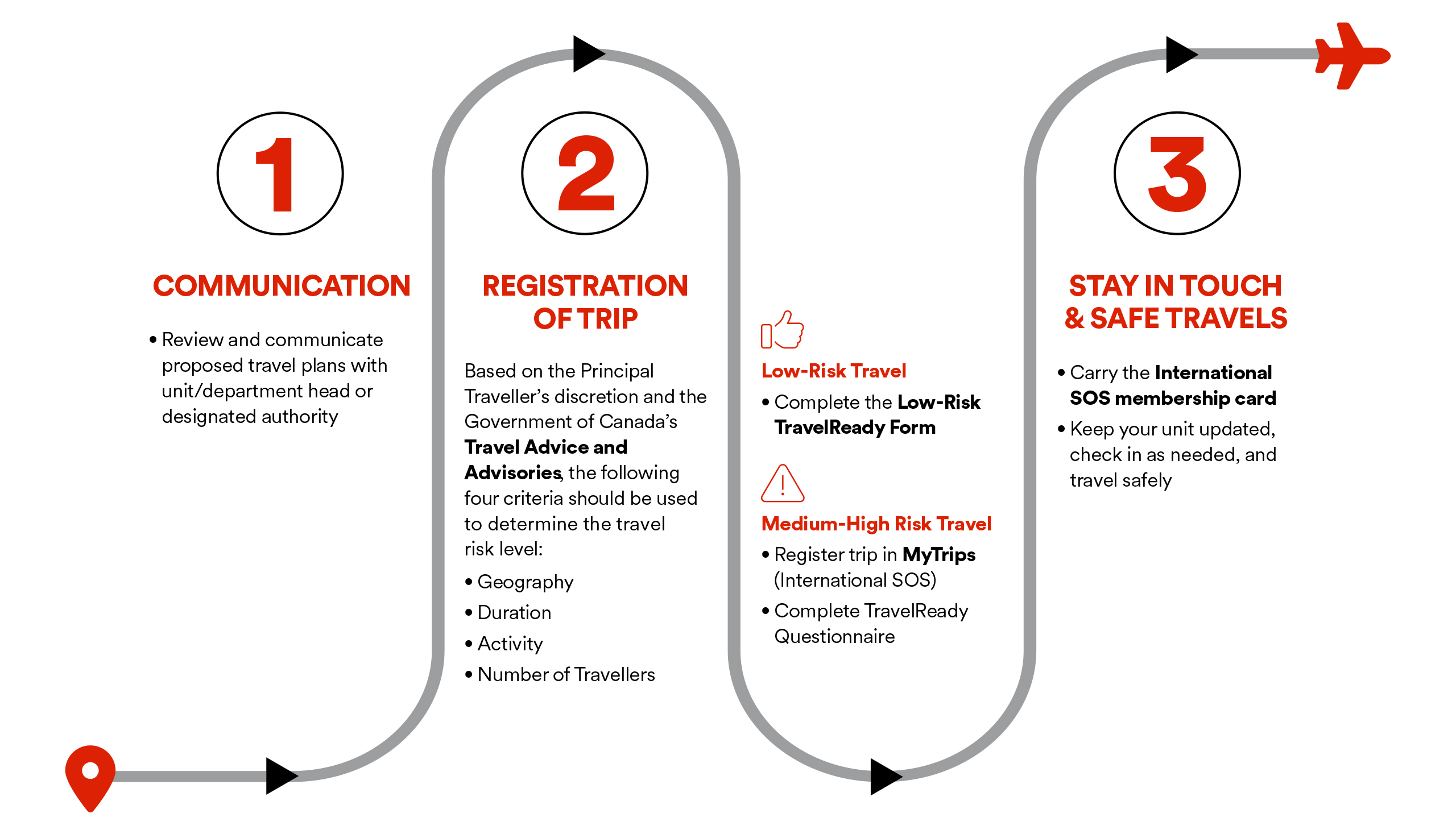
Step 1: communication
Review and communicate proposed travel plans with unit/department head or designated authority.
Step 2: registration of trip
Based on the Principal Traveller’s discretion and the Government of Canada’s Travel Advice and Advisories, the following four criteria should be evaluated to determine the travel risk level:
- Geography
- Duration
- Activity
- Number of Travellers
Low-Risk Travel
- Complete the Low-Risk TravelReady Form
Medium-High Risk Travel
- Register trip in MyTrips (International SOS)
- Complete TravelReady Questionnaire
Step 3: stay in touch & safe travels
- Carry the International SOS membership card
- Keep your unit updated, check in as needed, and travel safely
Travelling to the United States
This FAQ is intended to provide guidance to any Brock employee or student travelling to the United States. The following is not intended to be legal advice and is subject to change. Please consult with University Risk Management, and/or Brock International before travelling.
While in the US, travelers (as well as international passport holders and other categories that undergo temporary or permanent immigration rules) should keep the following documents depending on their applicability:
- A valid international passport
- A green card (Form I-551)
- Proof of legal residence, such as an Employment Authorization Document (EAD) (Form I-766)
- Nonimmigrant visa
- Any other valid and unexpired travel entry document marked at Form I-94
Here’s a more detailed breakdown:
- Travelers:
-
- Passport: A valid passport from their country of citizenship is essential for travel and must be kept valid throughout their stay and not expire within 6 months.
- Visa (if applicable): If a visa is required for entry, ensure it is valid and kept safe.
- ESTA (if applicable): Traveler must be a citizen of a country under the Visa Waiver Program.
- I-94/I-95: If issued, keep this document printed (preferably in colors), which serves as proof of admission into the United States, and return it when leaving.
- Travel Itinerary: Keep copies of travel itineraries, tickets, and boarding passes for future reference.
- Financial Documents: Consular officers may request financial documents to assess your ability to cover your expenses.
- Other Immigration and Nonimmigration related documents that are recommended to keep:
-
- Green Card (Form I-551): This is the primary document for lawful permanent residents and must be kept safe and carried at all times.
- Employment Authorization Document (EAD) (Form I-766): If a traveler has an EAD, it should be keep with him/her.
- Re-entry Permit (Form I-131): If a traveler plans to go outside the U.S. for a longer period, it is recommended to consider applying for a re-entry permit.
- Proof of Insurance: A traveler should maintain health insurance coverage throughout the stay.
- Refugee Travel Document: If a traveler has a status of a refugee, a refugee travel document should be keep with him/her.
- Financial Documents: Consular officers may request financial documents to assess the traveler’s ability to cover your expenses.
For any further details regarding the Travel Documents you may also wish to refer to the official information from the USCIS at: Travel Documents | USCIS.
Yes, US border officials may search a traveller’s electronic device. Learn more on the US Customs and Border Protection website.
Please be mindful of sensitive academic or work-related data stored on your device(s).
Faculty, professional librarians, student researchers, and staff:
- Contact your Dean or supervisor to discuss
- Frank Marcella, Director of Enterprise Risk Management and Insurance – [email protected]
Students:
- Rox Chwaluk, Manager, International Learning – [email protected]
All faculty, professional librarians, students, staff and volunteers are encouraged to complete the appropriate Travel Risk and Emergency Management Plan form based on the purpose and location of travel.
For more information, visit the University Risk Management’s SharePoint page.
Additional pre-trip assistance is available via ISOS.
Updated April 2025.
Helpful resources
Government of Canada Travel Advisories
The Government of Canada’s official source of travel information and advice, the Travel Advice and Advisories help you to make informed decisions and travel safely while you are outside Canada. Check the page for your destination often, because safety and security conditions may change.
Registration of Canadians Abroad
Canadian travelers can add their name and contact information to the Government of Canada’s Registration of Canadians Abroad (ROCA) service. This listing allows consular services to assist you with advice and support should there be an emergency while you are abroad.
Travel Vaccination Recommendations
Learn more about vaccinations you may require or want to consider before you travel abroad.
Download the International SOS App
Brock University has partnered with International SOS (ISOS), the world’s largest medical and travel security service firm, to provide Brock students, staff and faculty with medical, safety and security advice, referrals and emotional support when traveling or living abroad.
With the ISOS app, you will have 24/7 access to:
Medical advice from a worldwide network of doctors and nurses
Referrals to local medical professionals wherever you are in the world
Emotional support while traveling
Safety and security advice
Notifications of emergency/security situations or disruptions that may arise where you are traveling so you can plan around them
Contact [email protected] for instructions on how to register for ISOS under Brock’s membership.
 Get it on Google Play Get it on Google Play |
 Download on the Apple app store Download on the Apple app store |