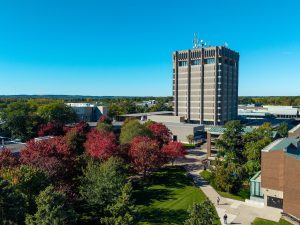
Brock University's main campus.
Community consultation continues this month for Brock University’s first institutional Equity, Diversity, Inclusion and Decolonization (EDID) Action Plan.
Grounded in Brock’s Institutional Strategic Plan, the University’s first EDID Action Plan is organized around nine transformative goals that reflect priorities identified through community feedback, including insights from EDID focus groups, consultations and recommendations gathered over the past five years.
Each goal has corresponding actions that will be tracked through annual reporting processes and shared on the University website to promote transparency and ensure accountability.
“Brock’s first EDID Action Plan is an important milestone in our ongoing journey toward a more equitable and inclusive university,” says Chelsea Takalo, Associate Vice-President, Equity, Diversity and Inclusion. “This work is about more than priorities on paper. It is about embedding EDID into the everyday fabric of Brock, so it informs how we lead, make decisions, build relationships, and hold ourselves accountable across the institution.”
Once complete, the plan will serve as a four-year framework to address systemic barriers and gaps, strengthen institutional accountability, and guide the Brock’s work to advance equity, inclusion, human rights and decolonization through 2030.
Actions related to decolonization will also complement the University’s recently launched Indigenous Strategic Plan by addressing the ongoing impacts of anti-Indigenous racism within broader institutional, legislative and human rights frameworks.
More than 270 members of the Brock community have participated in the campus-wide consultation process that started in the spring. Participants have shared their lived experiences, implementation strategies and visions for the future to help shape the action plan.
Additional consultation sessions are planned throughout October to allow more members of the Brock community to share their perspectives, regardless of whether they have participated in an earlier consultation.
Upcoming consultation sessions include:
- A virtual faculty member session from 3 to 4:30 p.m. on Tuesday, Oct. 13
- An in-person session open to all from 9 to 10:30 a.m. on Wednesday, Oct. 21
- A virtual session open to all from 1 to 2:30 p.m. on Monday, Oct. 26
Those interested in attending are asked to register online in advance.
The action plan is expected to be finalized later this year.