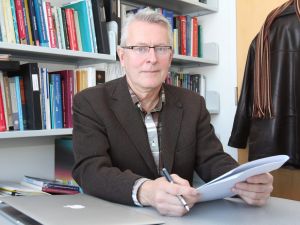
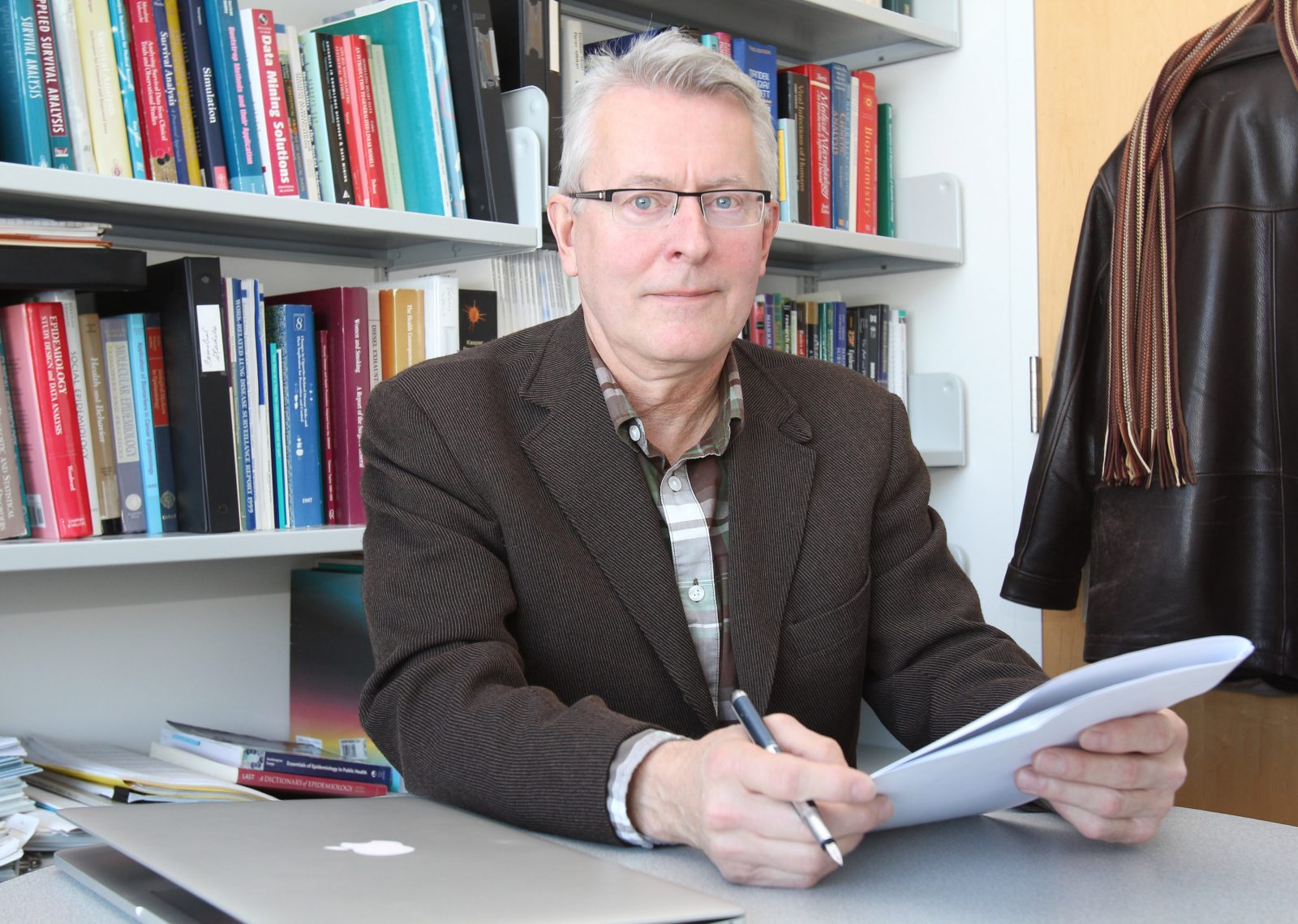
 Epidemiologist Martin Tammemägi was recently honoured by the International Association for the Study of Lung Cancer for his impactful 36-year research career.
 Could poor dental hygiene be linked to a greater risk of lung cancer?
Epidemiologist Martin Tammemägi and his team are uncovering some unusual potential lung cancer risk factors in the FALCONS study, an international research project investigating lung cancer among those who have never smoked.
The first phase of study, an extensive information and literature review, is near completion.
Then-master’s student Azam Mansuri and Meshari Alradhi (BPH ’18, MA ’23 ) have gathered extensive information from lung cancer studies, reports, the Internet and other sources. The researchers are now inputting associations coming from the data analysis into models that more accurately predict who is at greater risk for lung cancer.
“Some of the factors we found in the literature that might be associated with lung cancer are things like oral health, loss of teeth, psychological stress, a person’s height and anemia – it’s an interesting and unexpected list,” says Tammemägi, the study’s co-leader.
In the final phase, expected to wrap up by the middle of next year, researchers aim to identify the models and model characteristics that are best able to identify never-smoking individuals eligible for lung cancer screening. The team is working with the Canadian Partnership Against Cancer and Statistics Canada to create platforms for these models.
The FALCONS study is one of many research programs and activities Tammemägi has been involved with over his 36-year career as a lung cancer researcher.
The Professor Emeritus of Epidemiology is widely known for developing the PLCOm2012 lung cancer prediction model for smoking individuals and others at high risk of developing the disease, which is currently being used by the United Kingdom’s National Health Services and in British Columbia, Ontario, Quebec and Nova Scotia to inform screening programs.
His current and upcoming research focuses on modifying and expanding his PLCOm2012 lung cancer prediction model for specialized populations.
For example, Tammemägi is co-leading the Air Pollution and Lung Cancer Risk Prediction project funded by the Terry Fox Research Institute. This research aims to add airborne pollutants known as particulate matter, such as tiny particles of soot or elemental and organic carbon, to his prediction model. This risk factor is particularly relevant for those living in heavily polluted areas, he says.
Tammemägi is also modifying his lung cancer prediction model for people living with HIV-AIDS, who are at elevated risk of lung cancer, as well as Indigenous populations in Canada, Australia and New Zealand who are at elevated risk in excess of what the current model predictors explain.
For these and other achievements, Tammemägi was awarded the 2026 Joseph W. Cullen Prevention/Early Detection Award from the International Association for the Study of Lung Cancer (IASLC) for lifetime achievement in the prevention of thoracic malignancies.
The award was conferred Sept. 12 at the IASLC’s World Conference on Lung Cancer, the largest international gathering of clinicians, researchers, nurses, scientists, and advocates in the field of thoracic malignancies such as lung cancer.
Tammemägi says he is gratified by the widespread adaptation and expansion of his lung prediction model, made possible by the contributions of many colleagues.
“Prediction modeling in medical research is becoming more and more recognized, popular and topical,” he says. “The fact that it saves lives is an impetus for those in other medical fields to use modeling as a way of identifying people who will benefit most from screening or investigation.”
Other of Tammemägi’s notable achievements include:
- Developing a model predicting the probability that a nodule showing up on a CT lung scan is cancerous.
- Serving as Scientific Lead of the Ontario Health-Cancer Care Ontario Lung Cancer Screening Pilot and the Ontario Lung Screening Program from 2016 to 2023.
- Participating in multiple trials, including the Prostate Lung Colorectal and Ovarian Cancer Screening Trial, the National Lung Screening Trial, the Pan-Canadian Early Detection of Lung Cancer Study and the International Lung Screening Trial.