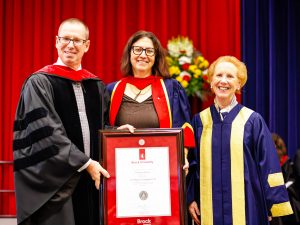
 Brock University Professor of Geography and Tourism Studies Michael Pisaric and Professor of Earth Sciences Francine McCarthy were members of a research team studying ancient DNA gathered from Crawford Lake’s sediment layers.
Ancient plant, animal and fungi DNA is shedding light on centuries of human activity around Crawford Lake, a spot researchers believe pinpoints the beginning of a new geological epoch.
Brock Professor of Geography and Tourism Studies Michael Pisaric and Professor of Earth Sciences Francine McCarthy were part of an international team gathering and analyzing ancient DNA samples found in sediment, known as sedaDNA, from the Milton, Ont., lake.
The study, published in Molecular Ecology, was led by McMaster University evolutionary biologist Hendrik Poinar and co-authored by Tyler Murchie at the Hakai Institute in B.C. and Matthew Emery at Binghamton University in the United States.
The team’s findings verify and expand on earlier research led by McCarthy documenting pollen and other materials trapped in the lake’s sediment layers, or varves, says Pisaric.
“In some instances, the ancient DNA contains more detailed information about plants than what we can find with remnants of pollen,” he says. “From that DNA, we can determine the plant’s species and its development.”
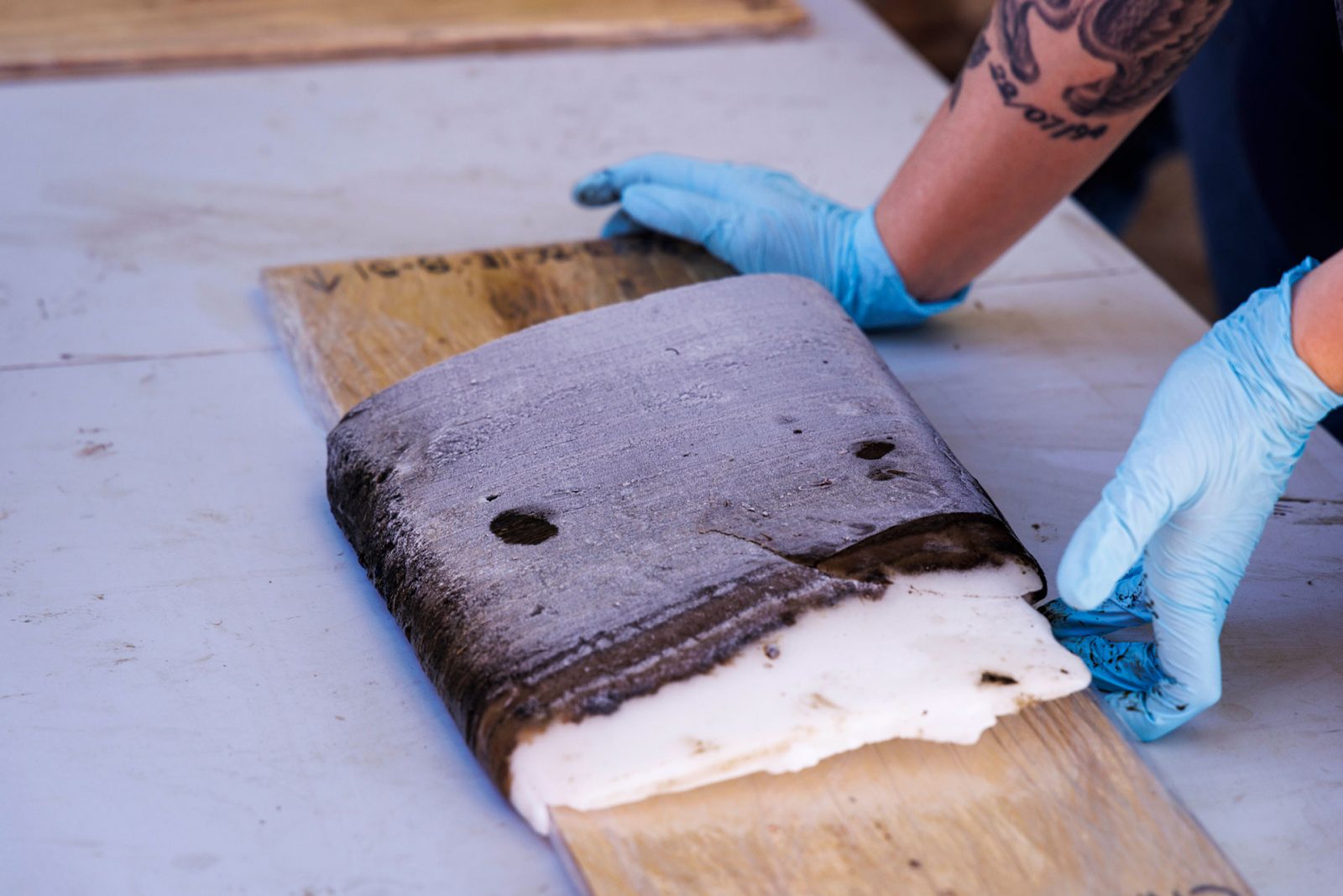
As part of the study, Pisaric and his team extracted sediment cores from the lakebed. The cores were then treated to isolate sedaDNA samples of plants, animals, algae, fungi and bacteria.
From the sedaDNA dataset, the team was able to confirm four sediment “zones” reflecting different periods of human activity over the past thousand years, each with distinctive ecosystems: pre-farming; Indigenous farming; post-Indigenous farming and Euro-Canadian.
The record reveals that pine, hemlock, beech, cedar and birch trees, along with mallard ducks and Canada geese, were plentiful in the pre-farming layers.
With the introduction of Indigenous farming in 1300 CE, the amount and diversity of sedaDNA increased significantly, particularly sunflowers, maize and pathogenic fungi associated with farming.
Although excavations of a nearby Indigenous village indicated beans and squash were grown in addition to maize — forming the “three sisters” of traditional Indigenous agriculture — there was no evidence of these plants in the sedaDNA. The researchers believe this is because Canada geese grazed on maize and sunflowers and their droppings sank to the bottom of the lake, depositing DNA from the plants in the sediment.
According to the study, plant nutrients in geese droppings caused algal blooms and excess plant growth that lowered Crawford Lake’s oxygen levels. That process called eutrophication, allowed the lake’s distinct annual sediment layers to form.
The team’s analysis revealed a rapid decline in sedaDNA around 1600 CE when Indigenous farmers left the area. Data show that DNA from wild animals such as white-tailed deer, hares, beavers and loons surged during that time, while fungi DNA associated with farming disappeared.
In the Euro-Canadian period, which began around 1800 CE, the team found sedaDNA evidence of cattle, a “surprising” finding that hadn’t shown up in the sediment cores of previous research, says Pisaric.
Green and golden algae DNA the team found in later Euro-Canadian layers indicate an environment high in carbon dioxide.
“Research carried out with several of my former students suggest that the increase in these two types of algae is a key marker of the Anthropocene, identifying a significant change at the base of the food chain of lakes that resembles changes millions of years ago when the global climate was warmer in a ‘greenhouse world.’” says McCarthy, who lent her expertise to this latest project by facilitating sample collection at Crawford Lake and co-ordinating various sampling initiatives.
McCarthy and her team have been studying Crawford Lake for several decades. From the sediment cores extracted from the lakebed, the researchers have documented how human activities have dramatically and irreversibly transformed the planet’s geology since thermonuclear bomb testing began in 1952.
An international geology group chose Crawford Lake as the location of the “golden spike,” an internationally agreed reference point in a section of rock or sediment layers signalling the beginning of a new epoch in Earth’s geological timeline.
The proposed Anthropocene was rejected by the International Commission on Stratigraphy in 2024.
In two recent Nature Reviews Earth & Environment articles, however, McCarthy and Professor of Earth Sciences Martin Head are among scientists rekindling calls for a new Anthropocene epoch.