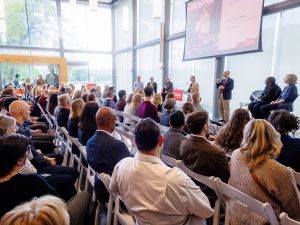
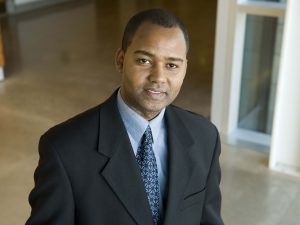
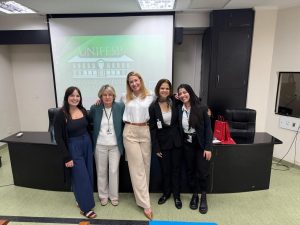
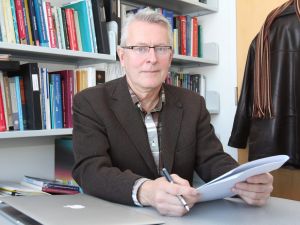
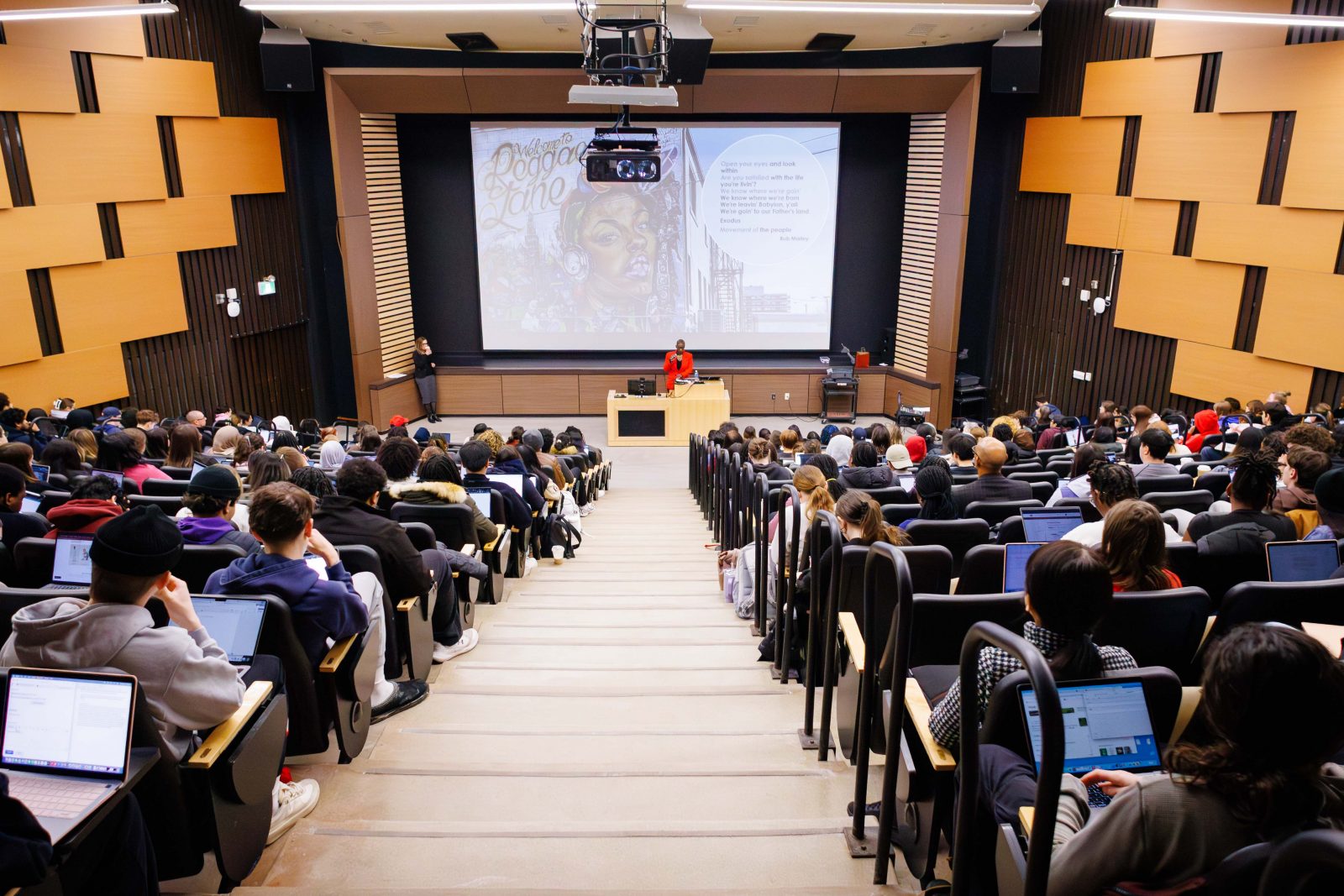
 Associate Professor of Health Sciences and Sport Management Janelle Joseph presented at the eight annual Yosif Al-Hasnawi Memorial Lecture on Tuesday, March 3.
As a researcher, Janelle Joseph strives to keep people, and ideas, moving.
The Brock University Associate Professor of Health Sciences and Sport Management discussed how lived experiences shape health equity during the eighth annual Yosif Al-Hasnawi Memorial Lecture on Tuesday, March 3.
Her talk — Movement of the People: Setting our Priorities for Racial Justice, Health and Sport — drew on qualitative research, narrative inquiry and her work as Tier 1 Canada Research Chair in Racial Justice, Health and Sport.
Hosted by the Department of Health Sciences, the annual lecture honours its namesake while also encouraging advocacy for justice.
The series was founded by Zanab Jafry (BSc ’19) in partnership with Yosif Al-Hasnawi’s mother, Amal Alzurufi, following his passing December 2017. The first-year Brock Medical Sciences student was fatally shot while intervening on behalf of a stranger being accosted on the street outside of the mosque in Hamilton where he volunteered. Paramedics who responded to the scene were later found guilty of failing to provide necessaries of life in their treatment of Al-Hasnawi.
During her talk, Joseph drew parallels to Al-Hasnawi’s lived experience, including his love of soccer and the diverse community it fostered.
“Yosif helped create a space where people are learning about each other and about human differences while they’re playing,” she said during the lecture.
A self-described “movement researcher,” Joseph sees leisure, sport, fitness and physical activity as important ways to improve social health.
“I’m interested in movement as physical activity, political movements, social movements, movements across national borders and the ways that people can use their communities to activate change,” she says.
In the lecture, Joseph explored how those involved in health and sport systems can face barriers to access, particularly when they come from racialized communities and other marginalized groups.
She believes storytelling and qualitative research can play an important role in addressing these challenges.
“People who are making the policies need to hear about the barriers that people are experiencing,” Joseph says. “We have to humanize their stories so that people can make appropriate change.”
A 2021 Ontario University Athletics Anti-Racism Project research project led by Joseph, for example, highlighted that structural racism, racial microaggressions and a lack of diversity contributed to feelings of non-belonging among some student-athletes.
“Decision-makers are often a relatively homogeneous group whose lived experience in the sports system has been a relatively smooth ride,” Joseph says. “As a result, the policies that they make don’t always serve those student-athletes who are most marginalized.”
While there were no racialized athletic directors and very few staff members solely devoted to equity, diversity, inclusion and antiracism at the time of the project, Joseph says progress is being made.
“Since then, there has been more hiring, but we cannot put the onus to change the entire system of organization on the few people who come in who expand diversity,” she says.
Drawing on research about the benefits of cricket, ballroom culture and a form of Brazilian martial arts called capoeira, Janelle’s talk also highlighted the need for future health equity leaders to understand how racialized communities support their physical and mental well-being outside of mainstream health-care systems.
“Before you can jump to a solution, it is important to know what people’s experiences have been,” she says. “To know where we’re going, we need to know where we’re from.”