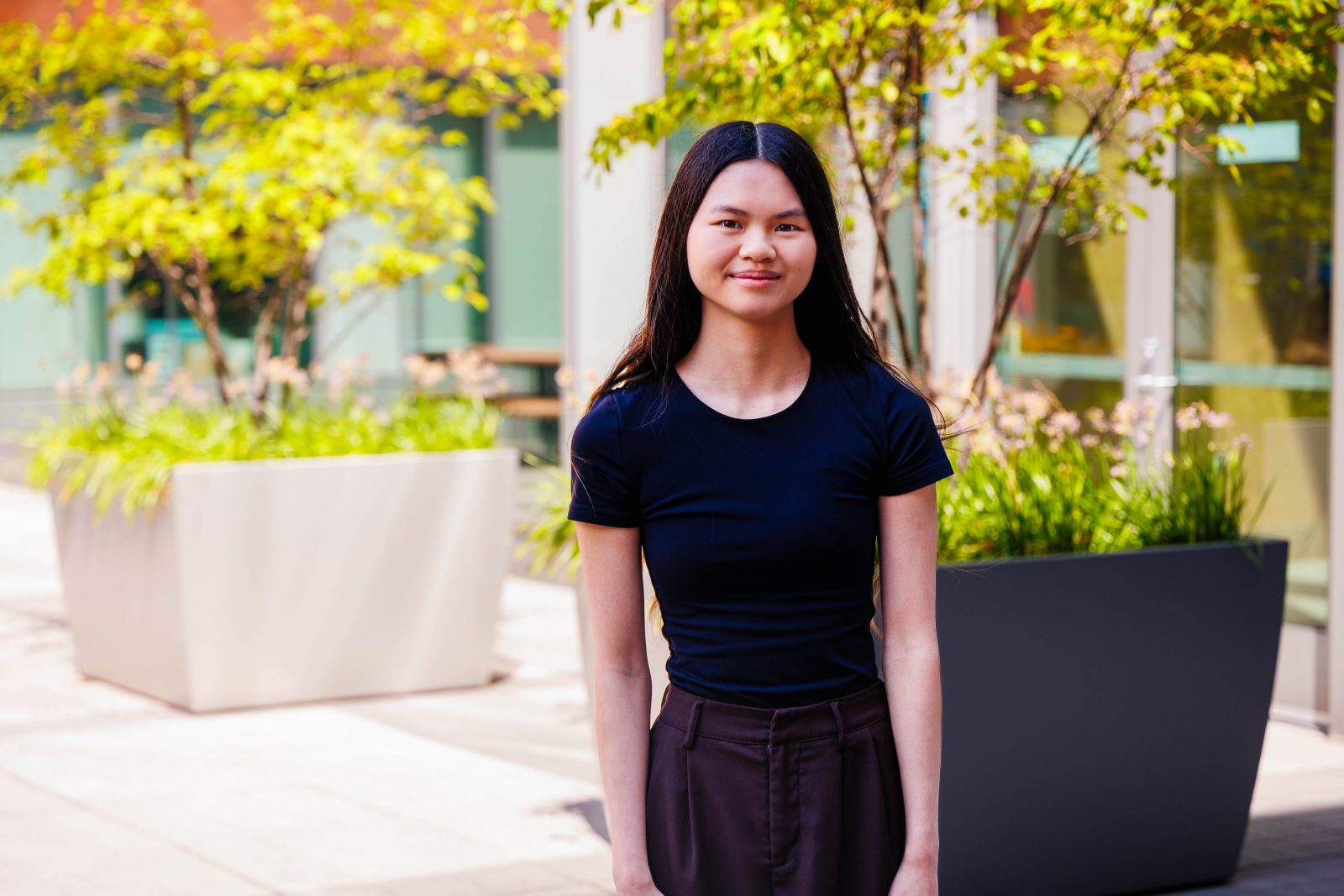
 Grace D’Angelo (BPH ’25), the second Brock recipient of the Niagara Health Knowledge Institute (NHKI)/Brock University Summer Student Research Scholarship, has spent the summer focused on strengthening research capacity in community hospitals.
For Grace D’Angelo (BPH ’25), improving health care starts with tackling big questions about the systems that deliver it and the gaps that leave people behind.
The recent Public Health graduate spent the last few months building research capacity in health systems through the Niagara Health Knowledge Institute (NHKI)/Brock University Summer Student Research Scholarship. She is the second recipient of the competitive 12-week placement, co-funded by the University and valued at $10,000.
Building on her experience at Brock’s Developmental Processes in Health and Well-Being Lab (DPHWB), where she was mentored by Professor of Child and Youth Studies Danielle Sirianni Molnar, D’Angelo undertook two research projects at NHKI.
Working alongside Post-doctoral Fellow Heather O’Grady, her first NHKI project explored what the term “health system capacity” means.
D’Angelo says the way terms are defined in public health shapes how care is planned, funded and delivered.
“Without a clear, consistent definition, planning effective health-care services is like building without a blueprint,” she says.
Deploying a condensed systematic review, she analyzed selected global literature published from May 2015 to May 2025.
For the purposes of her review, a “health system” refers to the people, resources and institutions delivering care within a community.
“Capacity drives effective health systems,” she says. “They must be dynamic, adapt to local contexts, anticipate future needs and prepare for crises such as a global pandemic. Redefining capacity is about shifting the paradigm in how we think about health systems.”
In conjunction with her review, D’Angelo also worked on Building Capacity in Research in Community Hospitals in Canada (RICH-Canada), a national project to strengthen research in community hospitals.
While 90 per cent of the hospitals are community-based, she says most conduct little to no research.
“Research isn’t solely about discovery; it’s about improving care where people actually receive it. When community hospitals lead research, patients benefit directly,” D’Angelo says.
As part of the project, she conducted an environmental scan of community hospitals across Canada, identifying and documenting contact information for those institutions.
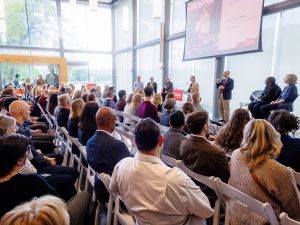
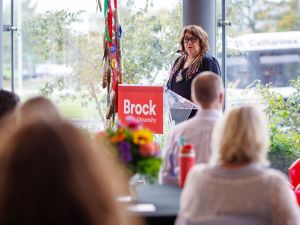
D’Angelo shared her research during a presentation on Aug. 1 at the Marotta Family Hospital, alongside her fellow NHKI scholarship recipients from the University of Niagara Falls, Niagara College and the Thrombosis and Atherosclerosis Research Institute.
“I was delighted to attend the final group meeting to learn from the research projects undertaken by the four summer student scholarship holders from across institutions,” says Associate Vice-President, Research Michelle McGinn. “It was evidently clear that this scholarship program enables high-quality and meaningful experiential learning where students develop research skills and forge professional networks that can shape their future careers.”
The scholarship is one of several initiatives made possible through Brock University’s Memorandum of Understanding (MOU) with Niagara Health. This formal partnership exemplifies the power of collaboration in driving innovation, enhancing research capacity and improving health outcomes across the region. By aligning academic expertise with clinical practice, the MOU fosters impactful opportunities, like D’Angelo’s placement, where students contribute to real-world solutions while gaining invaluable experience.
During her time at NHKI, D’Angelo says she gained experience in patient engagement and deepened her appreciation for the value of lived experience. She plans to carry these insights into her upcoming Master of Health Sciences in Health Equity and Sustainability at Western University.
D’Angelo, who was initially pursuing a Medical Sciences degree, was drawn to Brock because of its Med Plus co-curricular program. She pivoted to Public Health in her third year because of its systemic approach to unpacking complex health-care issues.
Beyond the classroom, she further honed her research skills at community health placements and mentored peers in Med Plus — all while volunteering at Niagara Health through the Interprofessional Education for Quality Program (I-EQUIP).
“Brock has facilitated so many opportunities to grow, including in the lab, classroom and in the community,” she said. “Those experiences have prepared me well to succeed in graduate studies and beyond.”