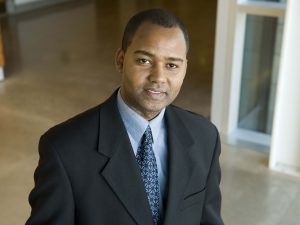
 Rahul Kumar, Assistant Professor of Educational Studies at Brock University, received the 2025 Tracey Bretag Prize for Academic Integrity alongside his colleague Professor Sarah Elaine Eaton from the University of Calgary. The honour recognizes work that advances the understanding of academic best practices and demonstrates the impact of integrity initiatives in education.
 As artificial intelligence (AI) continues to spark renewed conversations around the globe about academic integrity, Rahul Kumar’s award-winning research is calling for a deeper exploration of not just technology, but the very definitions of learning and authorship.
The Assistant Professor of Educational Studies at Brock University and his colleague Professor Sarah Elaine Eaton from the University of Calgary recently received international acclaim for their groundbreaking work that is reshaping how educators think about plagiarism in the AI era.
Kumar and Eaton were the North American winners of Studiosity’s 2025 Tracey Bretag Prize for Academic Integrity, which is awarded for advancing the understanding of best practice and demonstrating the impact of integrity initiatives in education.
Kumar said being recognized for work keeping academic integrity, humanity and learning at the heart of the student experience comes at a pivotal moment in the evolving conversation around AI and post-secondary education.
“We must prepare students for their future, not our past,” he said.

Rahul Kumar, Assistant Professor of Educational Studies at Brock University, received the 2025 Tracey Bretag Prize for Academic Integrity alongside his colleague Professor Sarah Elaine Eaton from the University of Calgary. The honour recognizes work that advances the understanding of academic best practices and demonstrates the impact of integrity initiatives in education.
Kumar’s research focuses on “postplagiarism,” a framework developed by Eaton challenging traditional definitions of academic dishonesty while exploring the ethical integration of AI tools in learning and writing.
“Traditional definitions of plagiarism presume that the person submitting the work is the one who intentionally copied from another source,” Kumar said. “With AI-generated content, authorship and intent become less clear, challenging that presumption.”
Attribution, and how people cite where they got ideas from, will have to be reformed, he added.
“As a consequence, our previous understandings of what constituted academic integrity will have to evolve, change and alter; we must adapt beyond the conventional definition of plagiarism.”
Eaton and Kumar launched a public-facing website featuring their research studies on how students and faculty at post-secondary institutions in Canada perceive AI-assisted writing.
Kumar said one of their key findings showed students are already embracing AI far more than educators.
“In a survey of post-secondary students, 94 per cent admitted to using generative AI, while only 17 per cent of faculty had even tried it, according to a recent study,” he said.
The postplagiarism framework proposes that human creativity can be enhanced — not replaced — by AI, maintaining that responsibility for content remains with the human author.
According to Rajiv Jhangiani, Vice-Provost, Teaching and Learning with Brock’s Centre for Pedagogical Innovation (CPI), the advent of generative AI doesn’t only involve technological change, but also necessitates a reenvisioning of pedagogies to serve students in a world where human-AI hybrid authorship is increasingly common.
“This is both challenging and exciting, and we are fortunate at Brock to benefit from Dr. Kumar’s leading expertise in helping navigate this new era,” he said.
Kumar’s research continues to expand with recent publications on AI authorship and student perceptions of AI, ongoing studies and a forthcoming report on AI encounters in the classroom, including responses from more than 400 Ontario high school educators.
For Kumar, receiving the Studiosity award emphasizes the urgency of the work.
“This tells me we’re moving in the right direction, raising questions that need to be addressed,” he said. “No one has the perfect answer yet, but we’re all searching.”