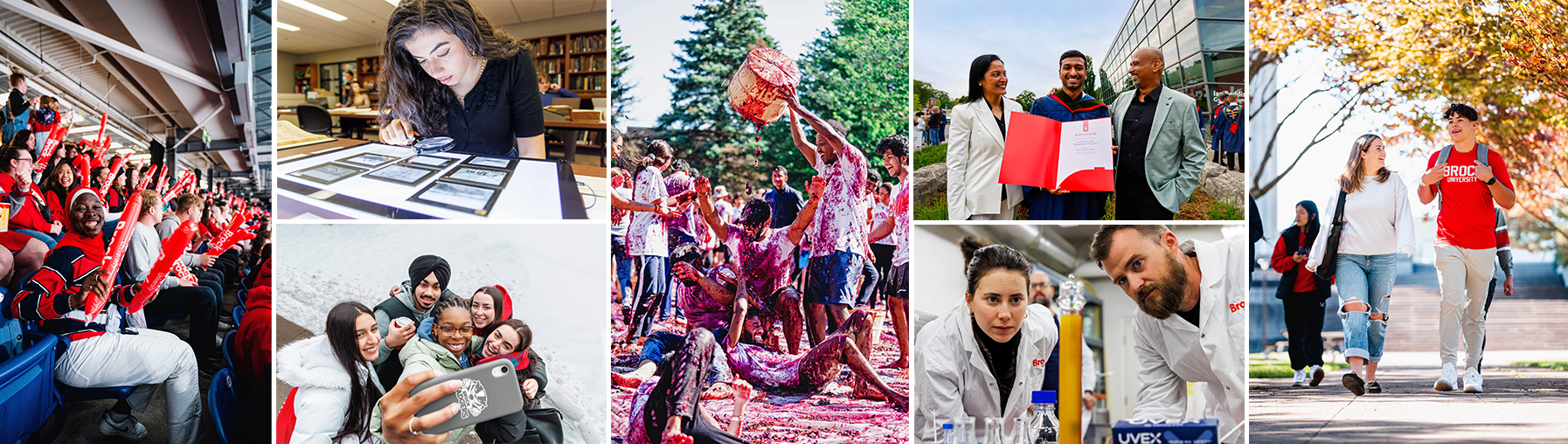
It’s commonly understood that a picture is worth a thousand words. Brock places great emphasis on our visual presence, and the imagery used to portray the University. Impactful images can make an incredible difference in how materials are received and accepted.
Brock photography…
- Is bright, colourful, authentic, dynamic, impactful and striking
- Is true to ourselves
- Expresses the diversity and uniqueness of campus
- Reflects Brock’s roots in Niagara
Photography standards and guidelines
- Use Brock students, faculty and staff
- Include Brock-branded gear/colours/buildings whenever possible and appropriate
- Ensure proper representation of the Brock community is reflected in all respects
- Imagery should tell a story, be “in the moment” and compositionally engaging
Coming soon.
- A photograph must never be changed from how it was originally shot aside from standard toning or cropping of the image, which improves its overall appearance.
- Removal of items from a photograph via “clone stamp,” “healing brush” or any other photo editing software or tool that alters an image from its original state should be avoided. (Permissible exceptions are limited to removal of blemishes, etc. in an official headshot OR dust spots on the lens or sensor)
- Use of special filters that alter the colour or contrast of an image so that it looks radically different from the original should be avoided unless the photo is being used in a way that necessitates the altering of those attributes. (e.g. a stylized photo layout in a magazine, layouts used in any other print/online publication, advertisements and promotional pieces where use of artistic license makes sense)
- Do not use filters found in social media platforms/apps like Instagram, Twitter, Facebook or similar social media platforms.
- Photo illustrations allow more leeway in terms of editing, composition and posing than a journalistic-style photo. Photo illustrations should be obvious to the viewer and do not need much explanation. If, before publication, the question of a photo’s authenticity arises, efforts should be made to clarify that it is an illustration.
In the event that original photography does not exist or cannot be used or created to help tell a specific story, stock photography can be used. Always abide by usage rights from the stock photography provider.
Avoid using AI-generated photography.
All photos and images used on University materials must be in compliance with all legal requirements and University policies. If you’re unsure whether you have the appropriate rights to use a photo or video in your project, contact the Legal, Compliance and Privacy office.
If you would like to organize a shoot to fill a need in the University’s photo library, or have an opportunity for updated photos to be taken, please contact us to discuss your project.
For Brock News or media coverage, please contact our Communications team.
Professional headshots can be taken using the CareerZone headshot booth.
Kindly note that University Marketing and Communications is not able to provide full event coverage with photography and videography support. Instead, we have a roster of photographers that we work closely with who understand the visual identity of the University, and can cover your event based on availability and your budget.
Ahead of your shoot, print the necessary form & signage (see below) and be sure to go through the photoshoot checklist.
The use of drones for photography or videography on Brock University property must comply with all applicable Transport Canada regulations, municipal by-laws, and University guidelines. Drone operation may only take place with prior approval from the University.
Individuals or departments intending to operate a drone on campus must:
- Obtain all required Transport Canada certifications, registrations and flight authorizations required for the drone they intend to fly.
- Follow current Canadian Aviation Regulations and Transport Canada drone safety requirements.
- Ensure that appropriate liability insurance coverage is in place.
- Coordinate drone activity in advance with Campus Safety Services, Marketing and Communications, and other units if required.
- Conduct flights only in approved locations and during approved times.
Drone operators are responsible for ensuring flights are conducted safely and respectfully. They must:
- Maintain visual line-of-sight with the drone at all times.
- Avoid flying over large gatherings, events, emergency operations or high-traffic pedestrian areas.
- Respect the privacy of students, faculty & staff, visitors and neighbouring properties.
- Avoid capturing identifiable individuals without appropriate consent where required.
- Immediately comply with directions from Campus Safety Services, Marketing and Communications, or emergency personnel.
The University reserves the right to deny or suspend drone activity that may pose safety, operational, legal, or privacy concerns.
Use this checklist to help ensure that everything runs smoothly and efficiently during a shoot. Go through the list ahead of your scheduled shoot, and don’t hesitate to get in touch with us if you have any questions.
| Task | Notes |
|---|---|
| Pre Production Meeting with Marcom | Brainstorm/Review needs Formats needed/Platforms |
| Secure Shoot Date/Time | |
| Location Scouting | Be mindful of traffic/crowds, lines of sight, etc. |
| Confirm shot list | List actions, situations and elements to capture during the shoot: Students interacting Students walking Groups of 2, 3, 4… Props Establishing shots Etc. |
| Casting Call/Confirm Talent | Ensure proper representation of Brock Community Confirm call time (call time should be 5-10 minutes before shoot) |
| Discuss Clothing/Swag with crew | Clean and ironed Brock branded clothing is preferred Red or white tops is prefered Avoid large logos Avoid pinstripes, or distracting patterns |
| Reminder email to staff/talent | Outline date/time, location and clothing |
Requesting photography or videography services
Capturing professional, impactful visuals that effectively support Brock’s brand storytelling and reputation is a critical part of what we do. As capturing everything that takes place on or off our busy campus would be impossible, the following criteria are used to help us allocate these resources effectively.
Institutional priorities
Coverage should effectively contribute to one or more of the following:
- Recruitment and enrollment goals
- Reputation-building and brand visibility
- Student success stories and experiential learning
- Research excellence and innovation
- Major institutional events, announcements, or milestones
- Fundraising, alumni engagement, or community partnerships
Audience & impact
- Clear external or high-impact internal audience
- Assets will be used broadly (web/Brock News, social, marketing campaigns)
- Potential for long-term or multi-purpose use
Storytelling value
- Human-interest narratives (e.g. student profiles)
- Visual storytelling opportunities
- Emotionally impactful or photogenic environments
- Unique milestones, experiences, or moments
- Major events (Convocation, Open House, research announcements, major ceremonies, high-profile visits or speakers)
- Key academic or research activities
- Student experience highlights
- Media-worthy or reputationally significant moments
- Marketing campaign content needs
- High-quality interviews with Brock leaders, researchers, students, alumni, or community partners
- Content with clearly defined deliverables and distribution strategy
- Routine meetings, classes, or events without a compelling visual component
- Low-attendance or informal gatherings
- Events with limited audience reach and no marketing or storytelling need
- Requests without a clear use case, marketing plan, or deliverables
- Shoots with heavy logistical constraints or poor photo/video conditions (unless strategically essential)
- “Just in case” documentation that will not be used
- Internal events or activities without a clear marketing or communications need
- Strategic purpose (why?)
- Intended audiences & primary messages
- Planned uses for final assets and deliverables (e.g., social, Brock News visuals, website, print piece)
- Timeline and feasibility — is it realistic?
- Assets already exists — photo/video assets from past event or activity are still in use
- Access (logistics) or approvals required
- Shot list or key moments (see the request brief below for more details)
Requests will be evaluated based on:
- Strategic importance
- Expected audience size and reach
- Visual quality potential
- Timeliness (e.g., relevance to recruitment/awareness campaigns or institutional messaging)
- Resource availability
- Opportunity cost relative to other requests
If full coverage isn’t possible, we may suggest alternatives:
- Brock stock imagery that already exists (Canto)
- Stock image recommendations (GettyImages)
- Guidance for more casual, smartphone photography
- Limited coverage (e.g., short b-roll capture only, a few photos during a portion of an event vs. full event coverage)
- Rescheduling support if timing isn’t practical
Coverage brief
If not included in your initial request, please share the below details with us as soon as possible. This information will help our team plan our support effectively and ensure deliverables align with your goals, audience, and key messaging.
- Project brief / event description
- Date, time & location
- Start / end time
- Primary contact
- Coverage requested (photo, video or both)
- What is the goal or purpose of this coverage? (e.g., marketing/promotional, research piece, Brock News, internal use)
- Who is the intended audience?
- How does it align with the University Strategic Plan?
- Who is the point-person? The primary contact will need to coordinate and facilitate this project with our team.
- Any location details we should know (parking and travel time if off-site, etc.)?
- If working with a third-party, are they aware of our shoot? Do they have a point person?
- Has the location been booked/approved for photography or videography (if required)?
- Have participants been informed there will be a photographer/videographer present? (Any sensitive areas or subjects that should NOT be filmed or photographed?)
- Be prepared to obtain a signed release form for all students / third-parties involved.
- What are the key moments or activities to capture (ribbon cutting, using lab equipment, etc.)?
- Do we need to capture stand up/remarks with individual speakers, researcher(s), Brock executive, etc.?
- Individuals will have to be pulled aside before/during/after the event to shoot stand-up. They must be informed that they will be asked to provide comments for video ahead of time, by your point person.
- Consider Brock branded backdrop requirements if the setting isn’t suitable.
- Prepare questions or prompts based on the desired project outcomes.
- Are there any accessibility or inclusion considerations we should be aware of? (representation, language, etc.)
- Please provide a list of specific shots or subjects required:
- Specific people to include;
- Group photo, candids, branding, lab equipment, etc.
- Any restrictions or other things to know?
- What final assets will you need?
- Highlight video/sizzle reel, social media clips, headshots, event photos, b-roll, etc.
- Timelines & due dates for all assets.
- Where will assets be used? (e.g., website, social media, print, general Marcom library, other)
Resources for photo & video shoots
Release forms should be kept for 10 years after the event (or if the person is a minor, 10 years after they turn 18). See the full retention schedule on SharePoint for more information.