March 6, 2026 | 10:30 am – 1:30 pm EST
BSIA Room 142, Balsillie School of International Affairs
REGISTER HERE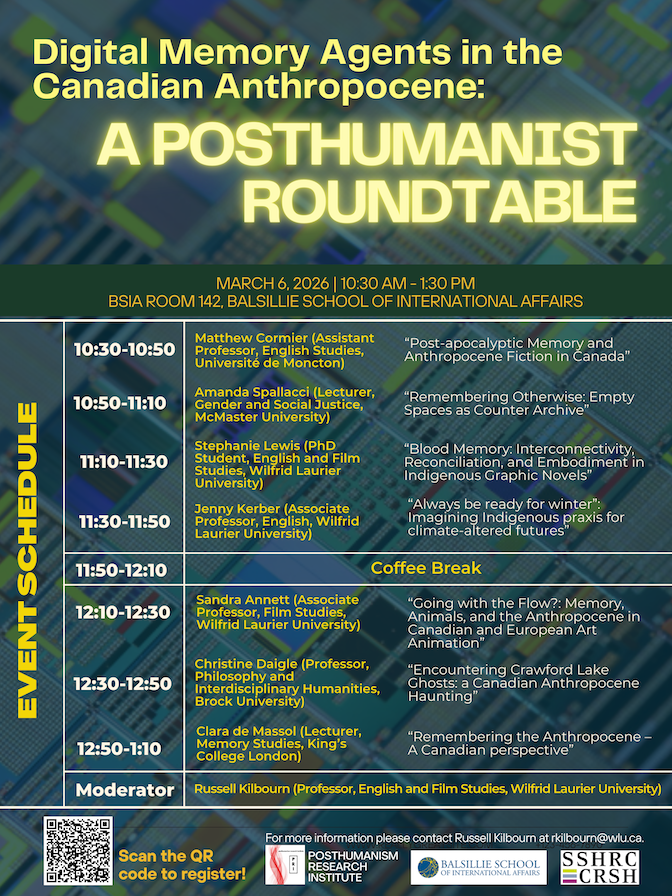
This roundtable proposes to put two recent publications—Amanda Spallacci and Matthew Cormier’s Digital Memory Agents in Canada: Performance, Representation, and Culture (2024) and Clara de Massol’s Remembering the Anthropocene: Memorials Beyond the Human (2024)—into dialogue, inviting a diverse group of scholars to explore specific issues, questions, or problems arising from the juxtaposition of the two texts and their respective interventions into debates at the intersection of the Anthropocene, climate change, memory, and posthumanism.
According to Spallacci and Cormier, in the introduction to their collection, “the digital era marks an irremovable and ongoing shift in terms of how and where memory takes shape not only due to the fact that virtuality collapses space and medium, but also because this new vessel for memory possesses its own intelligence and agency.” Therefore, “in transcending physical space and extending into this burgeoning virtual realm, memory becomes embedded in growing networks that have the potential to move beyond the political economies of place to account for more complex systems of ideas, social positions, and temporal processes.” (viii). “Canada remains a fascinating case study for work in memory studies,” they continue, “because many deem it one of the most multicultural countries in the Western world—meaning that, in the context of collective memory, citizens are not necessarily connected through a common culture, religion, ideology or even language, complicating a collective remembering. […] Scholars tend to agree that Canada has no monolithic collective memory; instead, it encompasses a multiplicity of collective memories, some of which conflict at various intersections of socio-historical power. […] But now activists, artists, and scholars are initiating innovative, persistent, and effective new discourses that challenge national memories, and they use digital media and the internet to instantaneously circulate numerous counter-memories in resistant forms to wide audiences. […]The also simultaneously enact and extend the agency and resistance of marginalized peoples; they encourage the [Canadian] public to remember differently…” (xii-xiv)
As De Massol reminds us, “[i]n the Anthropocene (from the Greek Anthropos, human, and from the suffix -cene, current geologic period), human activity on the planet has become the main geological force. This anthropogenic terraforming of Earth implies that humans, as a species, have the collective potency to irreversibly transform the physicality of the planet along with its atmosphere and ecosystems (Chakrabarty 2012). […] [T]he term Anthropocene signals to a holistic conceptualisation of the deep impact of humans on the planet.” (3-4)
De Massol exposes ‘Anthropocene’ “as both a generative and contested term,” putting it “into tension with, and in relation to, memory, as the past accessible in the present.” Exploring “the juncture between the fields of memory studies and environmental humanities,” De Massol examines the Anthropocene “from a memory studies perspective to reflect on memory as a tool, or apparatus, helping us to grasp the deep paradigm shifts inferred by the new epoch.” She assesses memory, in turn, “from an environmental humanities point of view, to consider how the Anthropocene—as a geological reality and heuristic method—can bring about new ways of examining or conceptualising cultural and collective memory, beyond the human” (1-2).
This roundtable proposes to extend and expand the work on Canadian digital memory agents begun by Spallacci and Cormier and their volume’s contributors, bringing it into dialogue with Clara de Massol’s work on memory in the Anthropocene by inviting presenters to offer brief (15-minutes max.) investigations of or meditations on any of the following topics, in a Canadian cultural-historical context:
Performative vs. reproductive memory
Collective vs. Connective memory (Van Dijk, et al.)
Multidirectional memory (Rothberg)
Memory activism and modes of resistance (Caygill, et al.)
Collective memory vs. counter-memories
Counter-memories and resistance
Political economies of virtual place
Posthumanism and Indigeneity
Indigeneity and Digitality
Memory in the Anthropocene
Posthumanist memory in Canada
AI and the Canadian Anthropocene
Anthropocene, Anthropocentrism, Anthropomorphism
Schedule
10:30-10:50 Matthew Cormier (Assistant Professor, Department of English Studies, Chair, MA Program in Canadian Comparative Literature, Université de Moncton): “Post-apocalyptic Memory and Anthropocene Fiction in Canada”
10:50-11:10 Amanda Spallacci (Lecturer, Gender and Social Justice Department, McMaster University): “Remembering Otherwise: Empty Spaces as Counter Archive”
11:10-11:30 Stephanie Lewis (PhD Student, English and Film Studies, Wilfrid Laurier University): “Blood Memory: Interconnectivity, Reconciliation, and Embodiment in Indigenous Graphic Novels”
11:30 – 11:50 Jenny Kerber (Associate Professor, English, Wilfrid Laurier University): “Always be ready for winter”: Imagining Indigenous praxis for climate-altered futures”
11:50 – 12:10 Coffee Break
12:10-12:30 Sandra Annett (Associate Professor, Film Studies, Wilfrid Laurier University): “Going with the Flow?: Memory, Animals, and the Anthropocene in Canadian and European Art Animation”
12:30-12:50 Christine Daigle (Professor, Philosophy and Interdisciplinary Humanities, Brock University): “Encountering Crawford Lake Ghosts: a Canadian Anthropocene Haunting”
12:50-1:10 Clara de Massol (Lecturer, Memory Studies, King’s College London): “Remembering the Anthropocene – A Canadian perspective”
Moderator
Russell Kilbourn (Professor, English and Film Studies, Wilfrid Laurier University)
Presenter Bios
Sandra Annett is Associate Professor of Film Studies at Wilfrid Laurier University, where she teaches contemporary film theory, digital and new media studies, and animation. She is the author of Anime Fan Communities: Transcultural Flows and Frictions (Palgrave Macmillan, 2014) and The Flesh of Animation: Bodily Sensations in Film and Digital Media (University of Minnesota Press, 2024). She has also published in The Journal of Postcolonial Writing, The Journal of Adaptation in Film and Performance, and Mechademia. With Frenchy Lunning she is Editor-in-Chief of Mechademia: Second Arc, a journal on East Asian popular cultures. She is a member of the Posthumanism Research Institute, among other scholarly organizations.
Matthew Cormier is Assistant Professor in the Department of English Studies at the Université de Moncton and Chair of its MA Program in Canadian Comparative Literature. Dr. Cormier’s research include literatures in Canada, affect theory, memory studies, and the digital humanities, with a recent focus on the apocalyptic genre. He is also co-editor (with Amanda Spallacci) of Digital Memory Agents in Canada: Performance, Representation, and Culture (University of Alberta Press, 2024), which was nominated for the Canadian Studies Network’s Prize for Best Edited Collection.
Christine Daigle is Professor of philosophy and interdisciplinary humanities at Brock University. She is the author of Posthumanist Vulnerability: An Affirmative Ethics (Bloomsbury 2023). She is co-editor of the Posthumanism in Practice series at Bloomsbury and editor of Interconnections. Journal of Posthumanism/Interconnexions. Revue de posthumanisme. Her forthcoming monograph, Joyful Extinction: Opening Posthumanist Futures, explores the Anthropocene, extinction, and futurity from a posthumanist perspective.
Clara de Massol is Lecturer in Memory Studies at King’s College London. Drawing from a background in cultural and literary studies, she examines and interrogates the intersections of the interdisciplinary fields of memory studies and environmental humanities. She is the author of Remembering the Anthropocene: Memorials Beyond the Human (Palgrave Macmillan, 2024), shortlisted for the Memory Studies Association (MSA) First Book Award and a recipient of the MSA Best Paper Award (2019).
Jenny Kerber is Associate Professor of English at Wilfrid Laurier University, where she works in the areas of Canadian, Indigenous and Environmental Literatures. Some of her recent publications include essays on petro-memoir, the rhetorics of Arctic cruise tourism, and consent in Indigenous writing.
Stephanie Lewis is a PhD student in the department of English and Film Studies at Wilfrid Laurier University, with a dissertation on posthuman folklore. She received a BA in Film and Media Production at Humber College and an MA in European Studies at University of Guelph, with a research focus on myths and fairytales.
Amanda Spallacci is a Lecturer in the Gender and Social Justice Department at McMaster University. She received her Ph.D. (’21) from the University of Alberta, where she was a SSHRC doctoral fellow and Killam Laureate. Her research and publications centre on survivor/victim representations of sexual assault across various media, including memoir, television, film, and social media, viewed through memory studies, affect theory, feminist print culture studies, and other frameworks. She is also co-editor (with Matthew Cormier) of Digital Memory Agents in Canada: Performance, Representation, and Culture (University of Alberta Press, 2024), which was nominated for the Canadian Studies Network’s Prize for Best Edited Collection.
Thanks to:
The Posthumanism Research Institute, the Balsillie School of International Affairs, and Social Sciences and Humanities Research Council (SSHRC) / Conseil de recherches en sciences humaines (CRSH).
