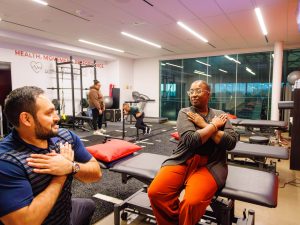
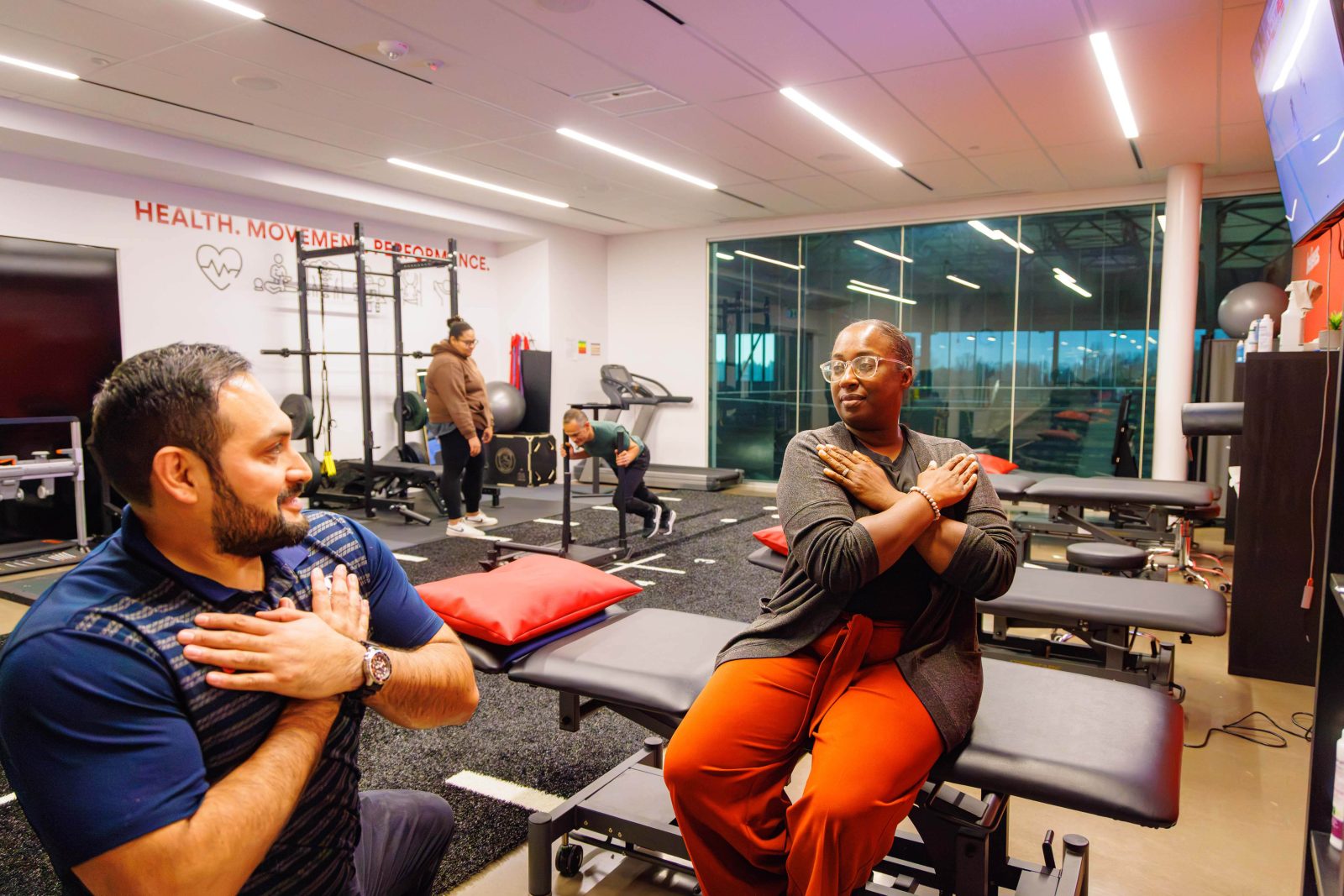
 Physiotherapist David Albines (left) guides a client through a T-spine rotation mobility drill at the Brock Sports Medicine Clinic at Canada Games Park.
One year after opening its doors, the Brock Sport Medicine Clinic had already outgrown its original space.
A recent expansion brought more room, more practitioners and more training opportunities for graduate students, allowing more people to receive care — from varsity athletes to community members who have never played a sport at Brock.
Located in Canada Games Park, adjacent to the University’s main campus, the clinic welcomed its first patients in May 2025 and held its grand opening that September. It opened with four treatment beds, four private treatment rooms, a smaller exercise space and just one physiotherapist.
This spring, another 1,000 square feet was added, bringing the clinic to 3,500 square feet. The expansion made room for six more treatment tables, a full turf area, a larger exercise prescription space and more equipment, including a treadmill, force plates and Vald testing technology.
“More space has allowed us to bring in different practitioners and in turn, we’ve been able to attract different patients into these spaces for treatment,” says Steve Lidstone, Associate Director of Sports Performance and Sports Medicine.
The clinic now has six physiotherapists, three massage therapists, two chiropractors, an osteopath, a pedorthist for orthotics and braces and its newest addition, a mental performance coach.
“It’s a community clinic focused on serving not only our undergraduate student body, our graduate student body and faculty and staff, but the wider community as well,” says Lidstone. “It’s a full-blown community-based clinic.”
Of the roughly 700 members of the Brock Functional Inclusive Training (Bfit) Centre, also located in Canada Games Park, upwards of 200 also visit the clinic for treatment.
“We want to mimic the service level provided to varsity athletes and offer it to the community as well,” says Lidstone.
The expansion also supports student learning. Brock’s Master of Athletic Therapy (MAT) program launched in May 2026 with 26 students in its first cohort. Through the clinic, athletic therapy students see first-hand the work being done by physiotherapists to help athletes return to sport.
“Typically, when someone goes for physiotherapy, the goal is to return them to whatever their normal activities of daily living are, and if it’s someone who is active in sport, that means taking it to the next level so they can return to sport,” says Nicole Chimera, Program Director and Associate Professor in Athletic Therapy. “That piece is really critical for our MAT student clinical reasoning and knowledge-based development.”
Brock Sport Medicine accepted 12 MAT students for placements with varsity teams, where they work under certified therapists to earn clinical and field hours. Those hours are essential for preparation for the Canadian Athletic Therapists Association National Certification Examination. Students from the Master of Professional Kinesiology program can also complete placements in the Brock Sport Medicine Clinic.
Brock also recently launched a paid one-year Sport Physiotherapy Fellowship program designed for physiotherapists seeking high-performance sport hours and mentorship. The two newly appointed fellows will gain experience in the clinic working under a mentor. Fully registered, they can treat community patients.
“The expansion really mattered because it was operating at maximum capacity before. Now, it’s really opened up more space,” says David Albines, Sport Physiotherapy Fellowship Lead. “To be more sport physio and sport medicine focused, we needed more space to have a gym and space for patients to move. Now there’s a turf area, more squat racks and just more areas to move, jump and really test whether they can return to sport.”
No referral is needed to see any practitioner at the clinic, though a doctor’s note may be required to claim massage therapy benefits.
To book an appointment, visit the online booking site.