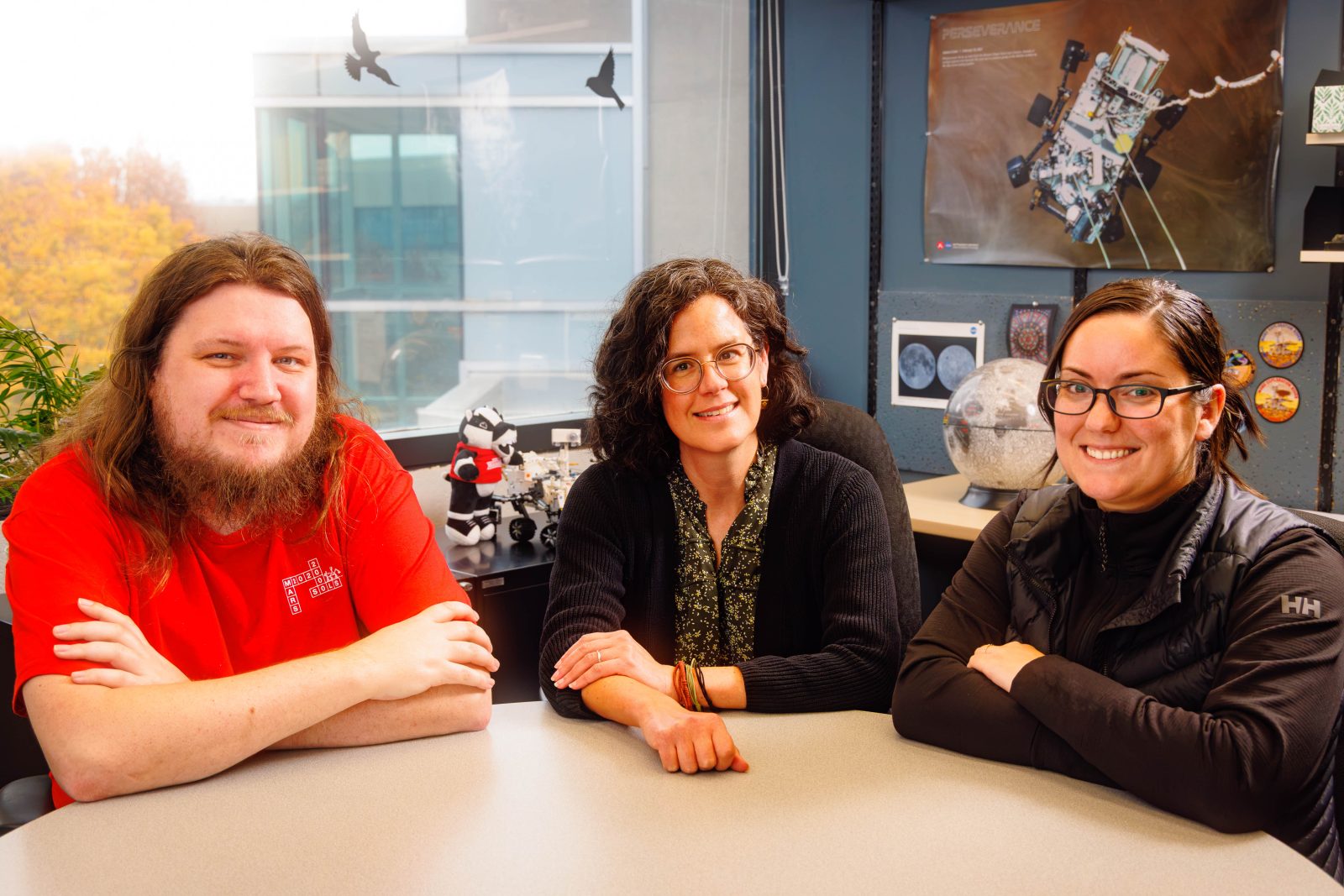
 Brock University master’s student George White (left) and Assistant Professor of Earth Sciences Tanya Kizovski (right) are members of the international Mars 2020 PIXL Instrument Science Team, on which Professor of Earth Sciences Mariek Schmidt (centre) is a Co-Investigator.
Brock researchers are making their mark as they uncover the geological history of Mars.
During a science operations meeting for the Mars Perseverance rover, Earth Sciences master’s student George White (BSc ’23) realized a rock target in images of the Red Planet was still unnamed.
Researchers working on the Mars2020 mission assign names to geological features on Mars’ surface from a list of possibilities.
White noticed an opportunity and scanned the list. When he got to the B section, the answer was obvious.
“Badger Peak was up by the top,” he says. “When I saw the name, I thought, ‘It’s got to be that one. A Brock name for a Brock team!’.”
He immediately requested the name of Badger Peak during the planning meeting and was quickly given the green light.
“I think it’s a fantastic name,” says Assistant Professor of Earth Sciences Tanya Kizovski. “Besides naming the rock target, George has done so much work to understand how the rock originally formed on Mars and what it can tell us about Mars’ geological history.”
White and Kizovski are members of the Mars 2020 PIXL Instrument Science Team, for which Professor of Earth Sciences Mariek Schmidt is a Co-Investigator. The Brock researchers’ work on the team is supported by the Canadian Space Agency.
Scientists and engineers from around the world collaborate on PIXL — the Planetary Instrument for X-Ray Lithochemistry (PIXL) — one of the many scientific instruments found on NASA’s Perseverance Mars rover. Their research involves collecting and analyzing chemical and imaging data gathered by the rover to interpret the geology of Mars.
When the M2020 Perseverance research team noticed that a region along the rover’s traverse contained light-toned rocks, they decided to investigate.
“Those light-toned rocks are of interest because Mars is a planet rich in iron and magnesium which often add colour to rocks,” says Schmidt. “The light-toned minerals could mean that there’s less iron and magnesium in these rocks.”
The team chose a focus on a rock outcrop called Marble Mountain — which is less than a metre high — and instructed the rover to scrape the rock’s outer surface. The rover punched a hole measuring five centimeters by 7.1 millimeters deep to reveal what was inside the rock. That hole, or rock target, is now known as Badger Peak.
White’s role is to help target PIXL scans and analyze data the team received. The light-toned rocks are also a major focus of his research.
Schmidt says there are “exciting things to come” from her team’s ongoing analysis of Martian rocks as the scientists explore Mars.
“Naming rocks can be one of the most fun things when you’re on operations,” she says. “Whenever we’ve seen other rocks that look similar to Badger Peak, George drops in pictures of Brock Badgers into the images just to make it more fun.”