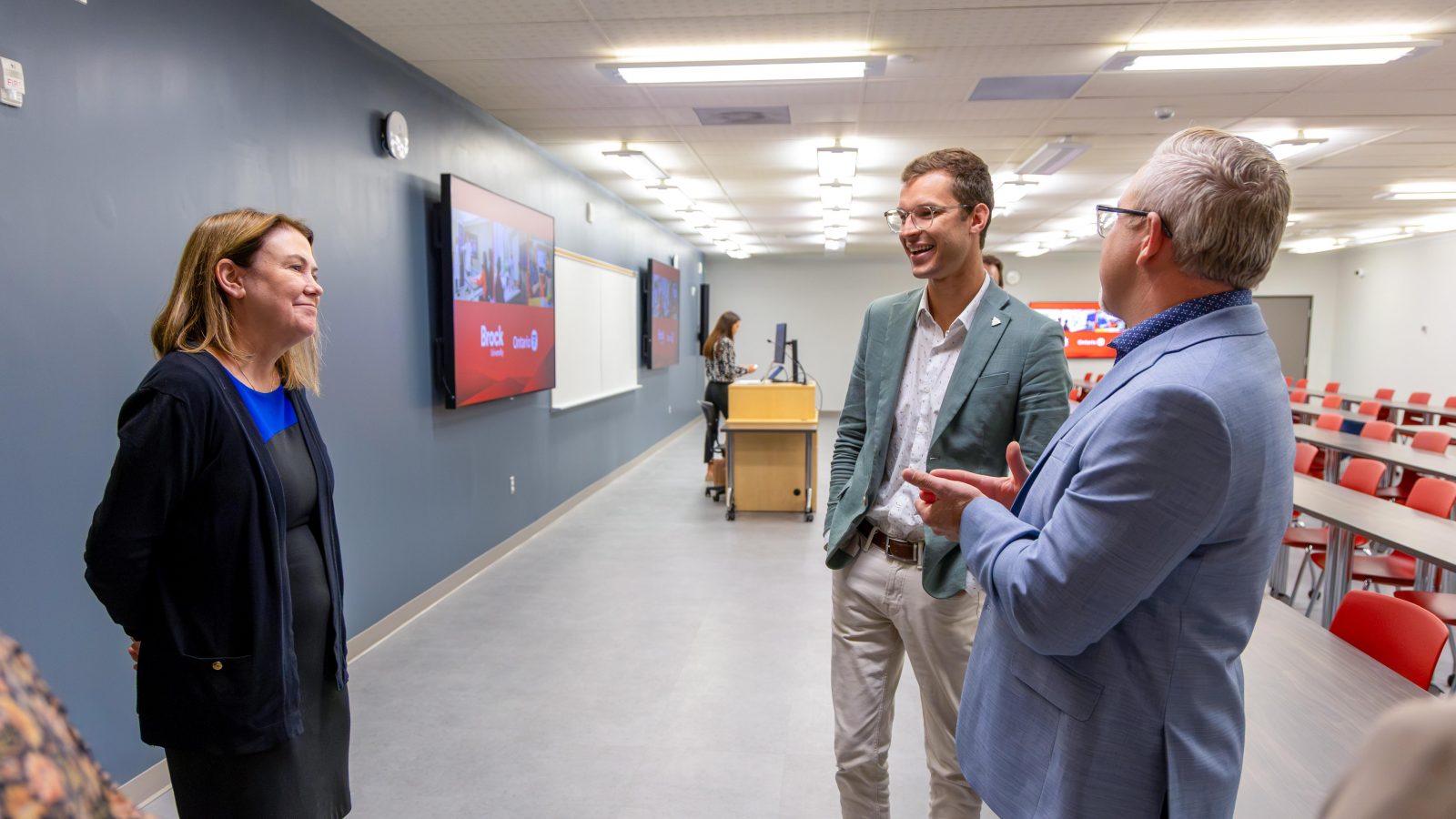
 Member of Provincial Parliament for Niagara West Sam Oosterhoff (centre) visited Brock to see the outcome of the Training, Equipment and Renewal Fund investment. He met with team members in one of the modernized and larger classrooms to learn more about the project, including Vice-President, External Alexandra Lawson (left) and Vice-President, Administration and Services Scott Johnstone (right).
From Welch Hall and the Mackenzie Chown Complex to East Academic, Brock University is transforming and expanding classroom spaces across campus.
Designed to enhance flexibility in teaching and learning, the modernization project focuses on creating larger, more versatile learning spaces that foster collaboration and support technology-enabled learning.
“Aligned with Brock’s Institutional Strategic Plan and the Academic Plan, classroom modernization helps deliver a high-quality and meaningful educational experience,” says Scott Johnstone, Vice-President, Administration and Services.
Through the project, six new teaching and learning environments have been created that can each accommodate 36 to 100 seats. East Academic 104, Mackenize Chown Complex D Block 403 and Welch Hall (WH) 222 and 223 are ready, with WH 8G and 205 to be completed in January 2027.
Prior to this project, the largest flat floor teaching space available on campus could accommodate 77 students, says Associate Director, Enrolment Operations and Policy Hannah Dillon. Larger spaces like the 100-student space in Welch Hall, she says, are a welcome addition that will help accommodate a variety of room booking requests.
Project Manager Alita Jones in Facilities Management began the projects with research and consultation to learn how the spaces will be used. Accessibility, health and safety, and technology needs have been key considerations throughout the design and installation process.
Renovations have included removing walls, installing new flooring, updating finishes and refreshing furnishings to create welcoming, highly flexible spaces.
“Every decision made throughout this project has been guided by the needs of students and faculty,” says Jones. “We’ve heard clearly that there is value in providing a range of classroom sizes, including additional larger capacity teaching spaces, while creating efficiencies that better support both learners and instructors.”
The Brock Information Technology Services team has helped to improve audibility with new sound systems and visibility with strategically placed displays to provide clear sightlines for students. Standardized technology across classrooms is also creating a more consistent experience.
The upgrades are being made with the future in mind, enabling emerging teaching methods and providing the infrastructure needed to support evolving technologies.
Spaces have been designed to meet or exceed the Brock Facility Accessibility Design Standards and current applicable code requirements such as the Accessibility for Ontarians with Disabilities Act (AODA). Considerations include the width of doors and movement paths, furniture that is easy to move or adjust and, for classrooms of a certain size, automated door openers. Attention has also been paid to door handle heights, types and surfaces.
To support the University’s sustainability objectives, existing materials are being repurposed where possible, such as light fixtures updated with efficient LED bulbs as part of the SPARK (sustainability, performance, adaptation, renewal and knowledge) initiative. Low-VOC (volatile organic compounds) paint and Greenguard-rated flooring with 39 per cent recycled content have also been used.
“Spaces that increase flexibility and support inclusion help create exceptional learning experiences,” says Vice-Provost, Teaching and Learning Rajiv Jhangiani. “These investments reflect our ongoing commitment to fostering learning environments that serve diverse pedagogical needs and where everyone has the opportunity to succeed.”
The Government of Ontario supported the project through the Facilities Renewal Program, as well as a Training, Equipment and Renewal Fund (TERF) grant of $286,446. TERF is an annual funding program established by the Ontario Ministries of Colleges, Universities, Research Excellence and Security to help publicly assisted universities purchase modern, state-of-the-art equipment.
“Our government is proud to support post-secondary education in Niagara. This provincial investment through the Training Equipment and Renewal Fund for upgraded classrooms at Brock University will enhance the learning experience for students and ensure the next generation of graduates develop the skills they need to succeed in the workforce,” says Sam Oosterhoff, Member of Provincial Parliament for Niagara West.
Nolan Quinn, Minister of Colleges and Universities, Research Excellence and Security, says the Ontario government is “building the workforce of tomorrow — one that is adaptable, cutting-edge and innovative.”
“By investing in state-of-the-art buildings and learning equipment, we are ensuring Ontario’s students are equipped to thrive as leaders in the modern economy,” he says.
Associate Vice-President, Facilities Management Mary Quintana highlights that the strength of these projects is the partnerships that drive them. From the Government of Ontario, the Office of the Registrar, Information Technology Services, Office of People and Culture, Facilities Management and building occupants, everyone involved plays an important role.
“This collaborative approach ensures that decisions are informed by diverse perspectives and that solutions meet the needs of the entire University community,” says Quintana.