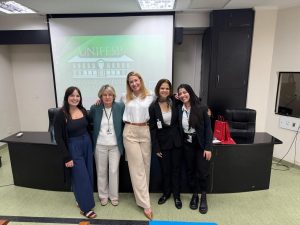
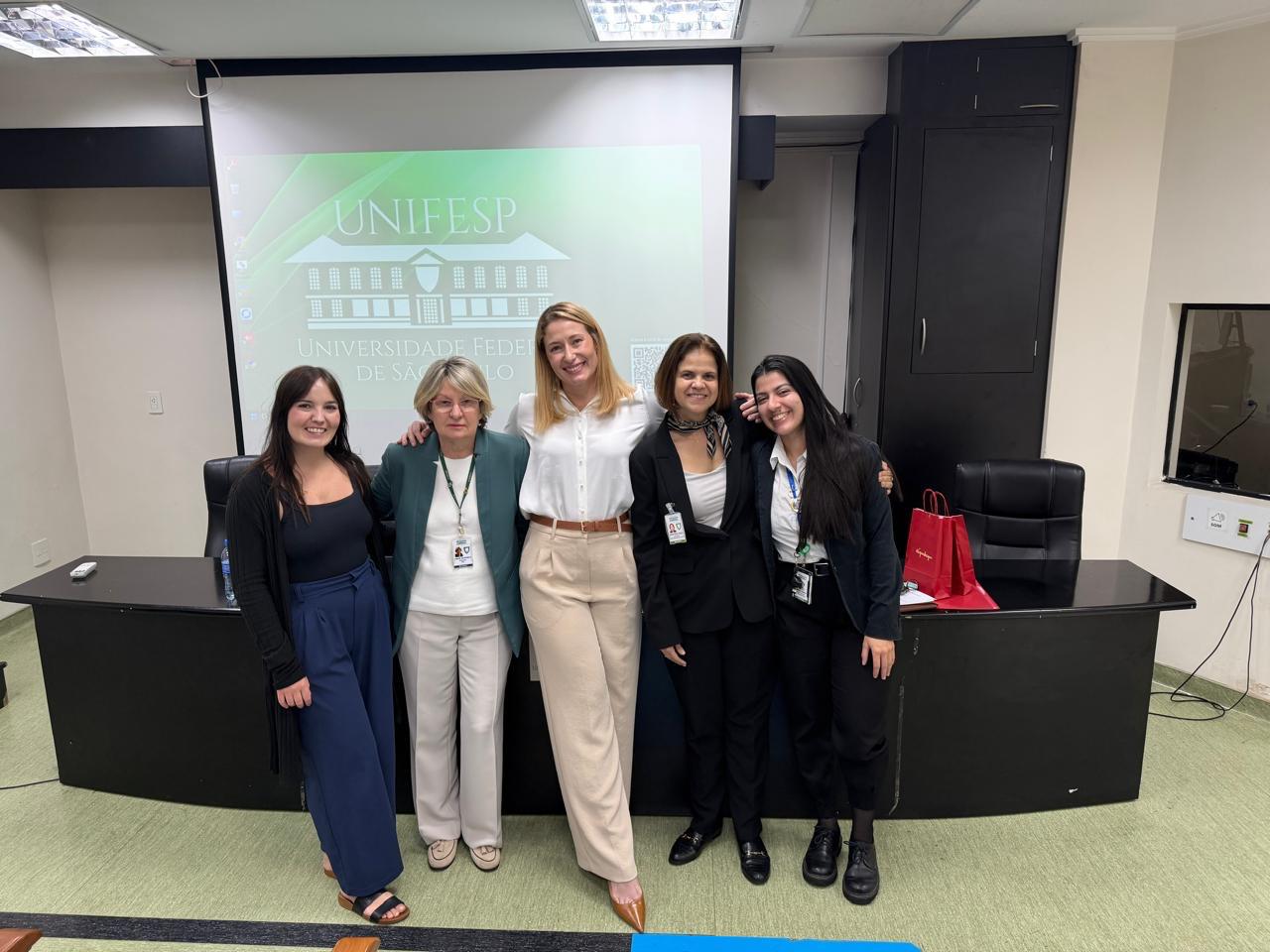
 Vanessa Silva e Silva (centre), Associate Professor in Brock University’s School of Nursing, co-ordinated the International Workshop on Advanced Nursing Leadership and Research Innovation at the Federal University of São Paulo in Brazil earlier this year while visiting the country through the Government of Canada’s Faculty Mobility for Partnership Building Program. From left are Kendra-Lee Dupuis, Nursing PhD student at Brock; Janine Schirmer, Dean of the School of Nursing at the Federal University of São Paulo; Silva e Silva; Bartira Roza, coordinator of the multiprofessional fellowship program at the School of Nursing at Federal University of São Paulo; and Deborah Nunes, master student at the Federal University of São Paulo’s School of Nursing and an Emerging Leaders in the Americas Program student at Brock.
For Vanessa Silva e Silva, international collaboration has opened up a world of opportunities to grow as a researcher and educator.
Through the Government of Canada’s Faculty Mobility for Partnership Building Program, the Brock Associate Professor in the School of Nursing traveled to Brazil from July 14 to Aug. 28 to share her expertise and learn from global health-care practitioners and educators.
Silva e Silva delivered lectures on topics such as organ donation and transplantation, collaborated with research groups at the Federal University of São Paulo and the Albert Einstein Hospital, and co-ordinated a five-day international workshop featuring speakers from Canada, the United States and Brazil.
Silva e Silva, who says internationalization is an important component of her research program, was already building relationships with Brazilian institutions through student mobility and discussions about formal partnerships.
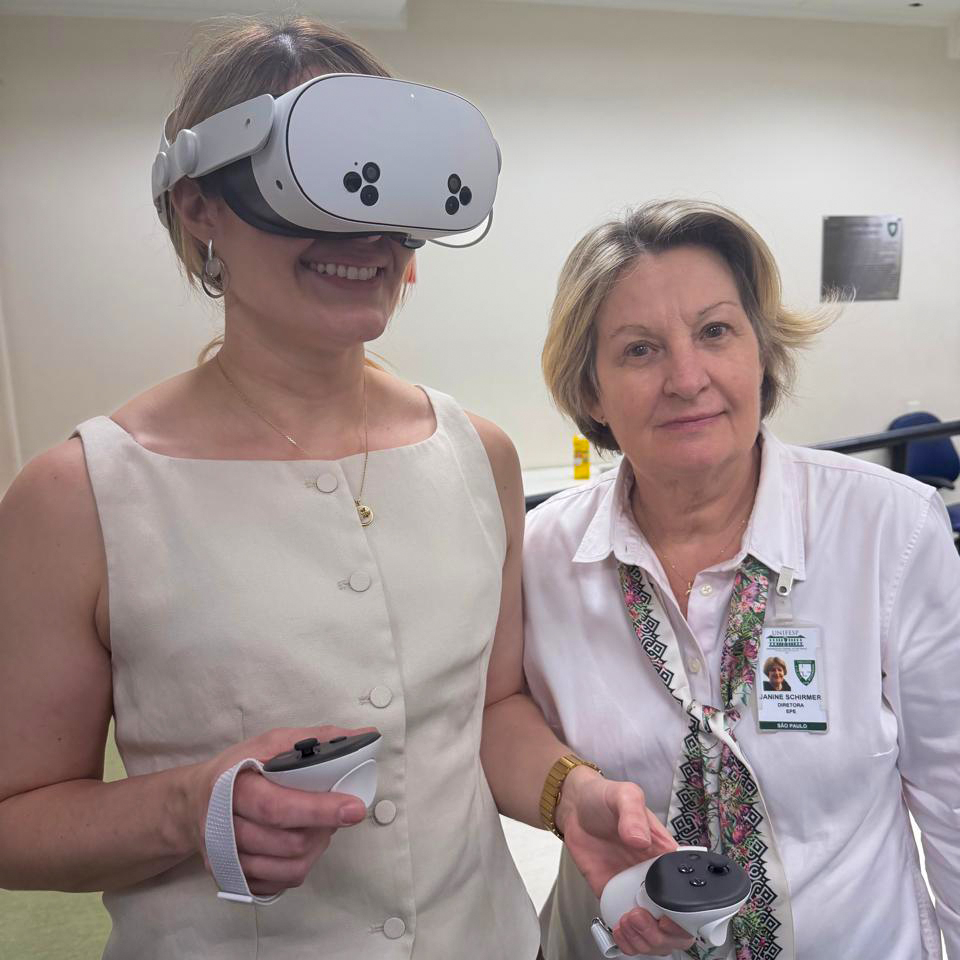
Vanessa Silva e Silva (left), Associate Professor in Brock University’s School of Nursing, demonstrated the code orange 360-degree simulation developed at Brock University to Janine Schirmer, Dean of the School of Nursing at Federal University of São Paulo, during a visit to Brazil from July 14 to Aug. 28.
“The Faculty Mobility for Partnership Building Program was the perfect opportunity to strengthen those relationships in person, advance our planned collaborations and create new opportunities for research, education and student exchange. It also strongly aligns with Brock’s commitment to expanding its global partnerships and international engagement,” she says.
The international exchange also allowed her to share Brock’s emerging use of simulation technology to support student learning in her native country as well as gain valuable insight into the professional master’s curriculum at the Albert Einstein School of Nursing.
During her trip, Silva e Silva demonstrated an immersive disaster simulation that she designed as an innovative approach to nursing education. Assistant Professor of the School of Nursing Amina Silva led the technical development of the simulation, using artificial intelligence (AI) tools to translate the concept into an extended reality application and deploy it to a Meta Quest headset.
“I had an opportunity to share our innovative Code Orange disaster simulation exercise, which has been successfully transformed into an immersive 360-degree virtual reality simulation experience designed by nurses, for nurses,” Silva e Silva says. “To our knowledge, it is the first Canadian initiative of its kind that focus on immersing nursing learners in the complexity of a large-scale mass-casualty response.”
The simulation is part of a broader effort led by Silva and Silva e Silva to reimagine how students learn in health-care environments.
Programs at Brock’s School of Nursing are also implementing other simulation technologies that allow students to assess patients and practice communication strategies.
“My research is increasingly focused on innovation and the responsible integration of AI and emerging technologies into nursing education, research and health care,” says Silva e Silva. “I’m particularly interested in how these technologies can be used meaningfully to improve education, support health-care professionals and ultimately improve patient care.”
Silva e Silva is currently developing an AI tool to support organ donation co-ordinators, who may be called upon repeatedly to answer clinical and process-related questions while simultaneously managing complex time-sensitive responsibilities.
The tool will be tested at Hamilton Health Sciences, with outcomes compared across Kingston General Hospital and Niagara Health, to evaluate its feasibility and whether the technology improves communication flow during organ transplant cases.
Silva and Silva e Silva have also developed a new Leading AI Integration in Nursing Education micro-credential, which will be offered by Brock Professional and Continuing Studies, to help nursing educators effectively implement these emerging technologies.
“AI is already in our classrooms and clinical settings. The course gives educators a way to use it responsibly, and because it teaches judgement rather than one institution’s rules, it works whether you’re in a large university or small college, in Canada or abroad,” said Silva e Silva.
Faculty members interested in learning more about international mobility opportunities can contact Brock International at [email protected]