 Research network partners with local communities for physical activity in newcomer youth.
Taylor Rowe recently saw perseverance play out on the sports field.
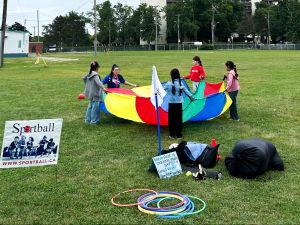
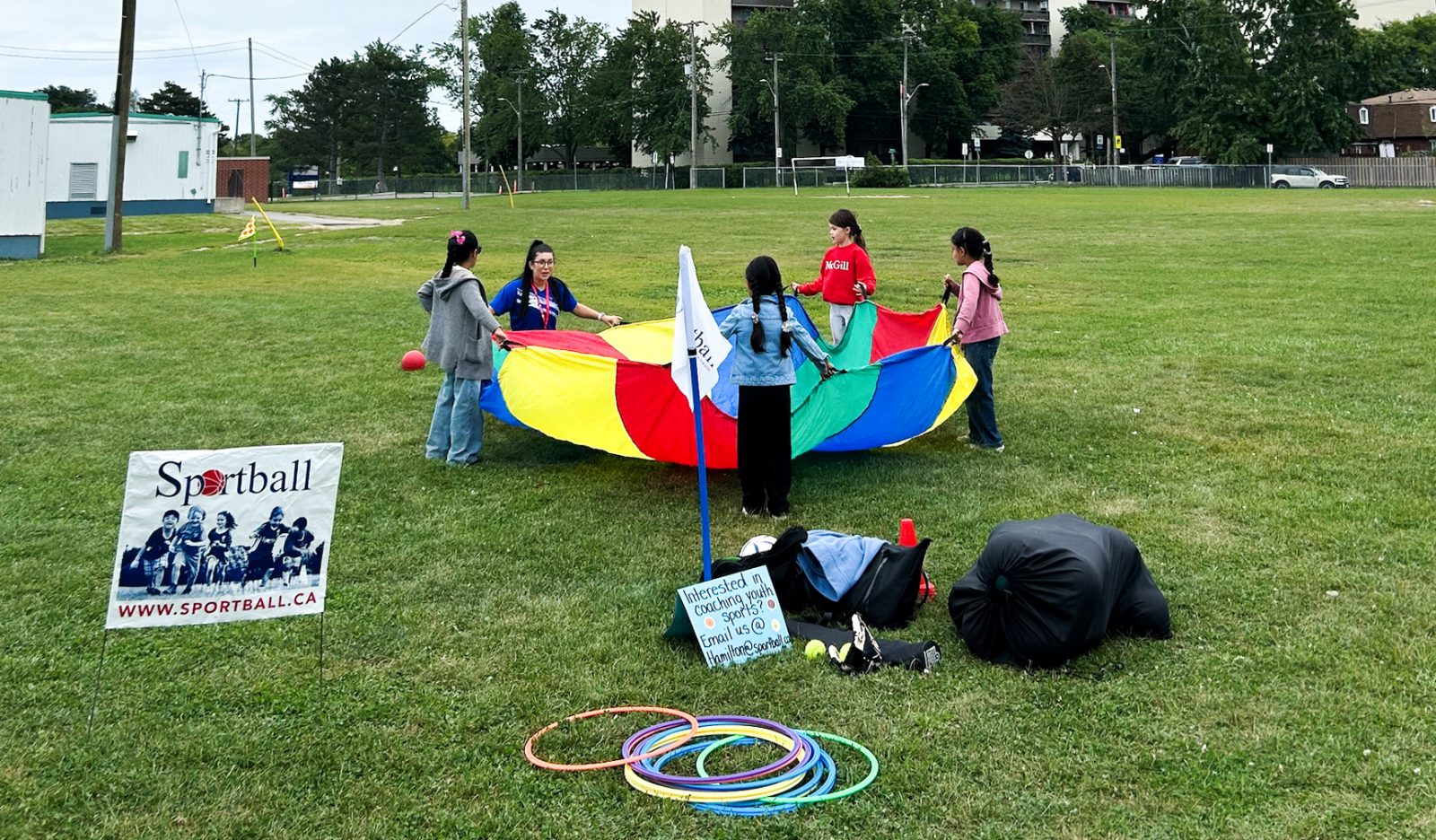
The Applied Health Sciences PhD candidate heads up the Youth Advisory Council of CO-PLAY, a Brock-led national research network to boost physical activity in newcomer children and youth. Last month, CO-PLAY held a community event that allowed almost 100 newcomer girls and their families in the Riverdale neighbourhood to participate in local sport and recreation activities offered by the City of Hamilton, Sport Ball and SCORE!Club.
Within the crowd was Maria Hayder, a 15-year-old IWC volunteer. Rowe and Hayder quickly formed a bond, with Rowe encouraging the teen to try kicking a soccer ball around for the first time.
“Maria was able to do amazing tricks with the soccer ball, and we were all absolutely shocked,” says Rowe. “She had never played soccer. We told her, ‘You’re so good. You can sign up for programs. You’re way better than us.’ Maria even started coaching us when we played soccer.”
For her part, Hayder says her “amazing” experience at Try It taught her communication skills and how to help her peers in a relaxed environment.
“I had a great time playing soccer — it was very fun and exciting. I also played volleyball, which was amazing,” she says.
Try It was hosted in partnership with Hamilton’s Immigrant Working Centre (IWC), where Rowe is conducting her doctoral research on how newcomer adolescent girls experience sport and physical activity.
Events such as these help break down barriers that may hinder newcomer families and their children from participating in community sports and activities, says IWC Director of Settlement Services Wasan Mohamad.
She says parents from IWC and Riverdale Community Centre who attended Try It were pleasantly surprised such activities were available locally.
“Newcomers receive an overwhelming amount of information when they arrive in Canada,” says Mohamad. “Even when information is available through flyers or community centres, families may not notice it, understand what is available or feel confident taking that first step.”
Building trust with those offering sport and recreation programs is another important consideration, says Mohamad.
“Newcomer families are often more comfortable exploring an unfamiliar opportunity when the information comes through an organization they already know and trust,” she says.
That is a view shared by Associate Professor of Child and Youth Studies Matthew Kwan, Project Director of CO-PLAY, which aims to build more equitable opportunities for newcomer children and youth to thrive through sport and recreation.
“By offering welcoming, accessible opportunities like Try It, we hope to foster greater confidence, belonging and lifelong engagement in physical activity,” says Kwan, who is Canada Research Chair in Youth Mental Health and Performance.
Funded through his $2.5 million Social Sciences and Humanities Research Council Partnership Grant, supported by the Government of Canada, the CO-PLAY Network brings together more than 110 community organizations and researchers from across the country.
In addition to Hamilton, there are regional hubs in Victoria, Calgary, Sherbrooke and Halifax where researchers from 15 academic institutions work alongside community partners to co-design and evaluate initiatives that address local priorities while generating evidence to improve practice and policy.
“At its heart, CO-PLAY is about creating communities where every young person feels they belong,” says Kwan. “As we continue to grow our network across Canada, our hope is to turn these individual moments of opportunity into lasting change for generations of newcomer children and youth.”