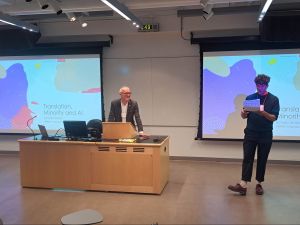
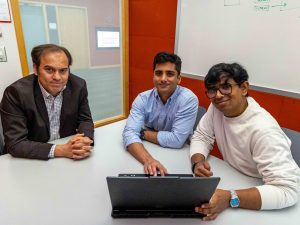
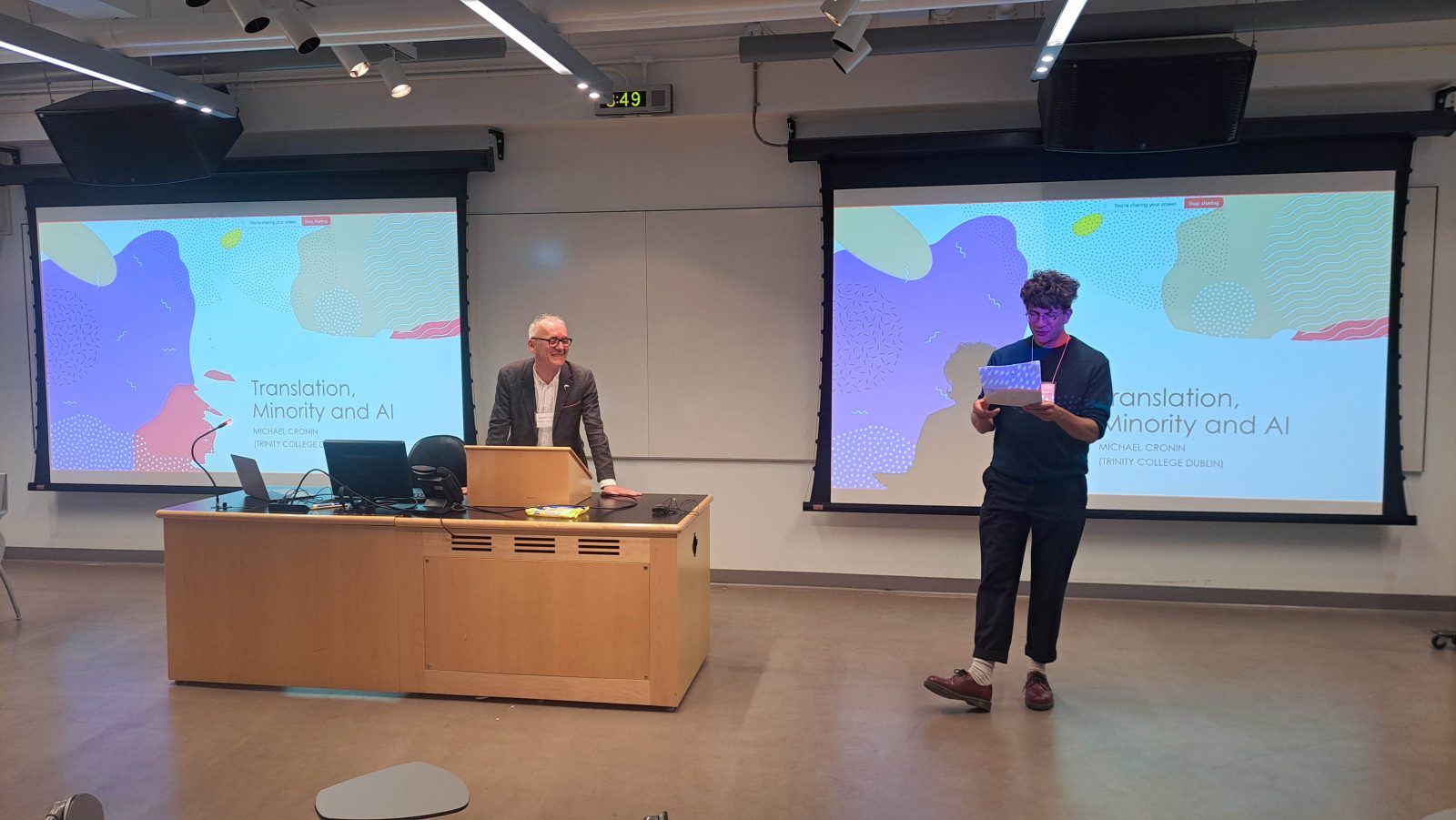
 Associate Professor of Modern Languages, Literatures and Cultures Nicholas Hauck (right) is researching experimental forms of translation and writing in the age of generative artificial intelligence. During a recent conference at Brock University, Hauck gathered international experts in the field including Michael Cronin (right), Professor of French at Trinity College Dublin.
Nicholas Hauck is sparking dialogue around experimental forms of translation and writing in the age of generative artificial intelligence (AI).
The Associate Professor of Modern Languages, Literatures and Cultures’ (MLLC) explores translation as more than a method of transferring meaning from one language to another. For him, the process about exploring new ways to communicate ideas and understanding cross-cultural contexts.
Hauck, who specializes in French, focuses his research focuses on translation as an interconnected creative practice between text, body, mind and the environment.
“With the advancement of technology and AI, it is more important than ever to consider the ways in which the task of language translation can, or can’t, be done by a computer,” he says.
While AI might be successful at translating instructions for everyday activities, Hauck says it falls short when it comes to translating nuances and meaning found in creative texts such as poetry, one of his research interests.
Hauck says that gap also applies to conversational contexts and the subtleties of local dialects, colloquialisms and expressions that don’t translate easily.
“Translation does not always have to produce an exact equivalent. It can involve emotions, sounds or movement. Translation can also be multimodal and what AI cannot yet do is engage in the playfulness and experimental nature of the practice,” he says.
A poem might be best translated through movement, dance or another visual medium, Hauck says, using creative practices to enrichen the experience of understanding the language.
To move beyond conventional notions of translation, it’s essential to understand how the process has evolved over time, says Dante Ognibene, who works alongside Hauck as a research assistant.
“Considering the premise of writing and translation is intriguing, especially when thinking beyond traditional definitions of both practices. Our research explores how meanings are translated through multimodal ways, including in the media, for example,” says the fifth-year Concurrent Teacher Education and French Studies student.
Motivated to add more perspectives to the conversation, Hauck and Ognibene recently gathered scholars, writers and translation experts from across Canada as well as the United Kingdom and United States at Brock to further explore the practice of experimental translation.
Presented by MLLC, the New (and Old) Experiments in Translation (and Writing) Conference took place at Brock’s main campus and the Marilyn I. Walker School of Fine and Performing Arts from Oct. 22 to 24.
Themes explored included non-conventional forms of writing and translation, multimodal methods of translation, eco-translation and non-human writing.
A key theme discussed was transcreation, a portmanteau of “translation” and “creation” that refers to the process of reimagining texts in different languages and cultures instead of translating word for word and focusing solely on meaning.
“Our goal is to foster dialogue that shifts away from the framework of translation as a transactional model between languages towards recognizing and attempting to account for the multidimensional, multimodal negotiations that occur in and through translation,” Hauck says.
It’s clear, Hauck notes, that the conversation surrounding translation and AI is here to stay — but translation encompasses so much more.
“Translation is really about care and hospitality for others, for our environment and for all the living worlds we cohabitate. If we want to keep living in and with these worlds respectfully, ethically, then we’re going to need translation to develop relationships.”