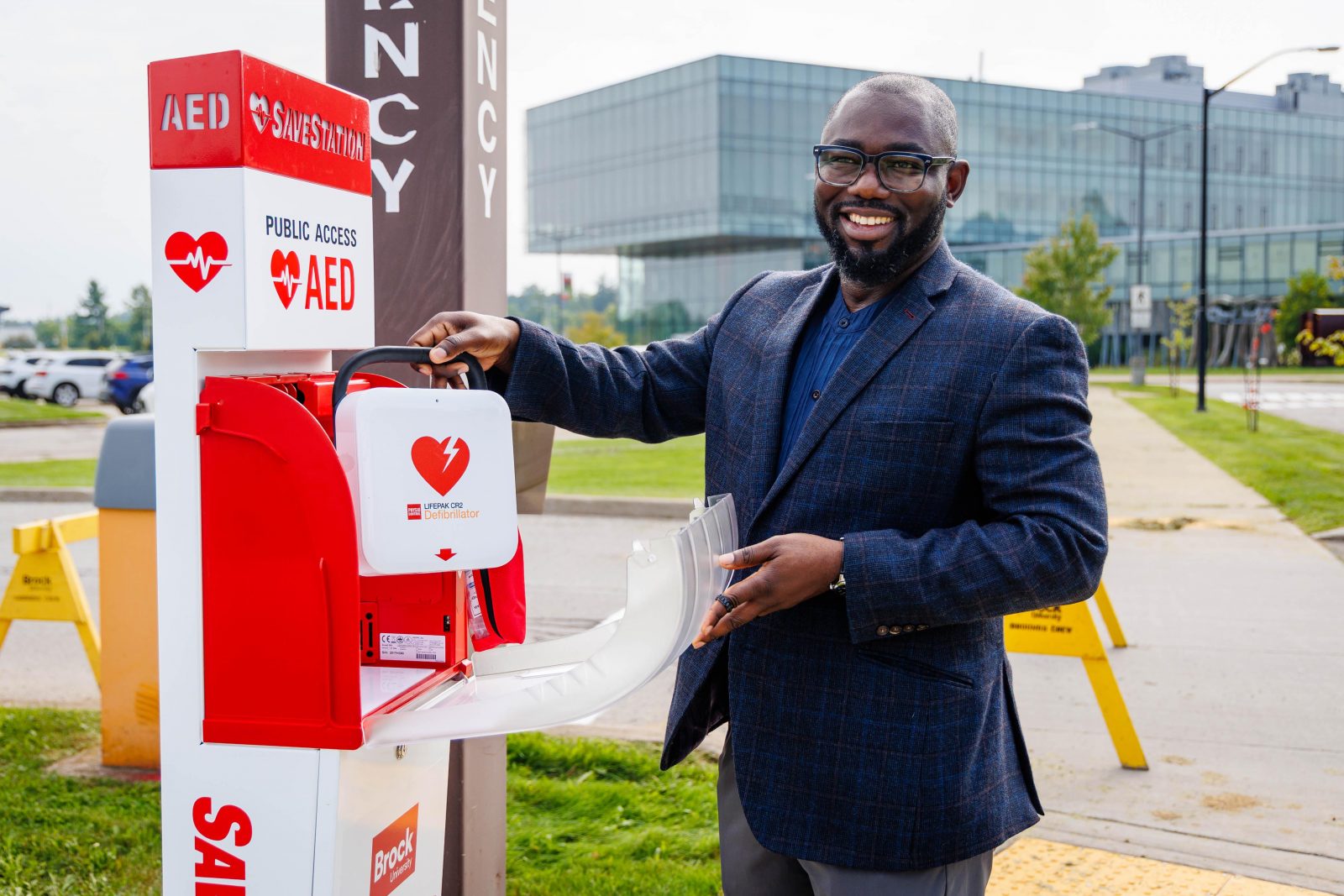
 Director of Health, Safety and Wellness James Iseghayan examines one of the three new outdoor automated external defibrillator (AED) stations on Brock’s main campus. The AED stations are designed to provide quick access to life-saving equipment in the event of a cardiac emergency.
Brock University has expanded its network of lifesaving automated external defibrillators (AEDs) by adding three new SaveStations on main campus.
The University’s first outdoor AEDs are located beside Lot E near Mackenzie Chown Complex J Block, in Lot 2 and beside Alumni Field.
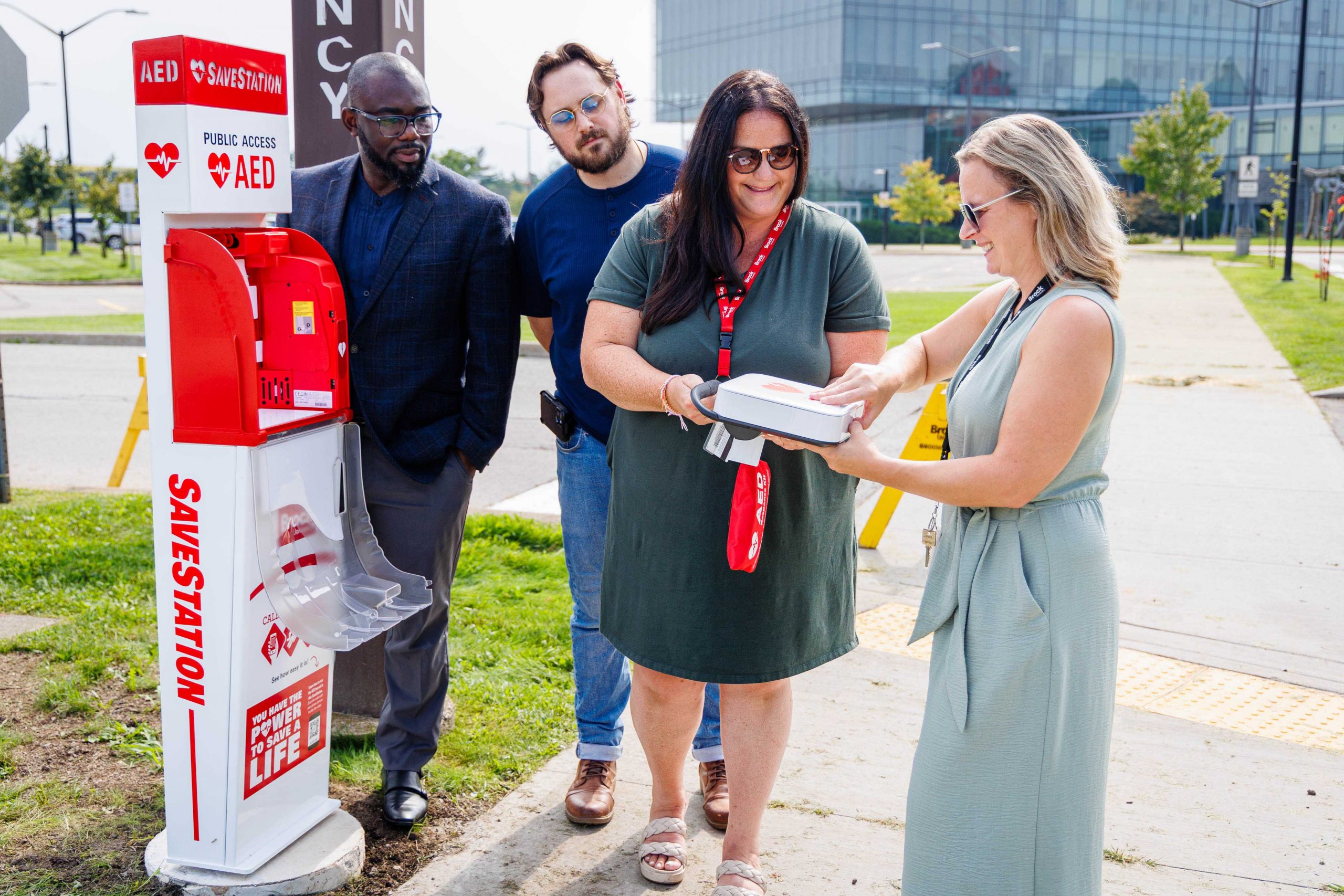
Members of the health, safety and wellness team take a look at one of the new three outdoor AED stations on Brock’s main campus. From left are Director of Health, Safety and Wellness James Iseghayan, Asset and Project Coordinator Evan Schipper, Environmental Health and Safety Advisor Elizabeth Todd and Occupational Health and Safety Specialist Britton Sheppard.
Brock now has a total of 34 AEDs across the main campus and Marilyn I. Walker School of Fine and Performing Arts. The Robert Bateman Community Centre, the location of Brock’s Burlington Campus, also has three.
While most AEDs in Canada are located indoors, sudden cardiac arrest can happen anywhere. According to Heart & Stroke, an estimated 60,000 cardiac arrests occur outside Canadian hospitals each year or roughly one every nine minutes.
A person’s chance of survival can double if someone takes fast action by performing cardiopulmonary resuscitation (CPR) and uses an AED.
“We’re proud to be among the group of Ontario universities with outdoor AEDs on campus,” says Director of Health, Safety and Wellness James Iseghayan. “Making AEDs more accessible is an important investment in the safety and care of our students, faculty, staff and visitors, and reflects our ongoing commitment to strengthening emergency preparedness across campus.”
Sudden cardiac arrest can affect people of all ages, including children, teens and adults who appear to be healthy.
“The installation of these new AEDs provides an opportunity to raise awareness with our Brock community about sudden cardiac arrest and the importance of acting quickly,” says Environmental Health and Safety Advisor Elizabeth Todd.
Signs of cardiac arrest include sudden collapse, loss of consciousness, unresponsiveness to touch or sound, and not breathing or not breathing normally.
What to do if someone appears to be experiencing cardiac arrest:
- Call 911 and ask someone to bring an AED.
- Begin CPR right away.
- Use an AED as soon as available.
The AEDs at Brock are available 24 hours a day and the climate-controlled SaveStation cabinets help keep outdoor devices protected year-round.
To access an AED in an emergency:
- Open the cabinet, remove the AED and open the lid.
- Follow the voice prompts and illustrations — the device will provide guidance every step of the way.
- The AED will assess the person’s heart rhythm and deliver a shock only if needed. If no shock is advised, continue CPR until emergency medical services arrive or the person starts to respond.
“AEDs don’t save lives on their own. They support the people who step in during an emergency,” says Todd. “By increasing access to these devices across campus, we’re helping members of the Brock community feel more confident, prepared and equipped to respond.”