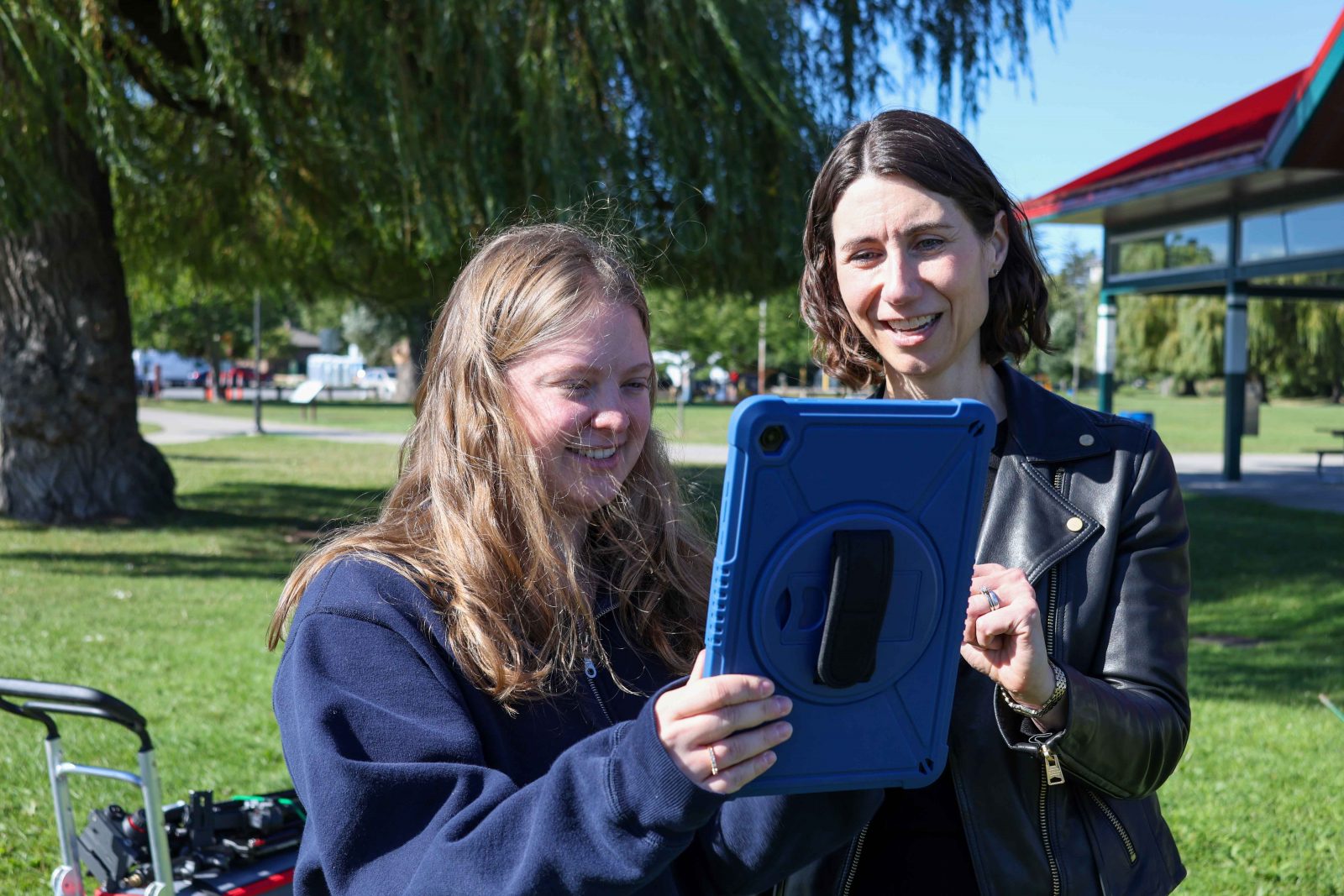
 Professor Julia Baird (right) shows Hannah Sharp, Realty and Legal Services Co-ordinator at Niagara Parks, the augmented reality scenario of future flooding in Lakeside Park that is part of an ongoing research study.
 Visitors to St. Catharines’ Lakeside Park are getting a glimpse of possible climate futures thanks to the fieldwork of Julia Baird’s Empathy for Sustainability research team.
Anyone over the age of 18 is invited to participate in data collection for Virtual Water Futures, a 15-minute experience that allows viewers to observe the park as it is today and then, using augmented reality (AR), see what the area might look like in the future as climate change causes rising lake levels and more frequent storm surges.
Baird, Professor and Director of Brock University’s Environmental Sustainability Research Centre (ESRC), says the goal is to understand whether AR can encourage climate action now by “bringing the future to the present.”
“Climate impacts happen in the future, but we need to take action now, and that’s a really challenging space for people to be in psychologically. Most of us know things are going to happen that will be deeply unpleasant and really challenge the places we love in ways that are not desirable,” she says. “We focused this AR work on Lakeside Park specifically because it’s such an iconic place in St. Catharines, on the shore of Lake Ontario.”
In addition to ESRC researchers, students and affiliates, the team also includes hydroclimatologist Scott Steinschneider from Cornell University and collaborators from several community partners, including the City of St. Catharines.
Olivia Groff, Climate Change Adaptation Co-ordinator with the City of St. Catharines, is among those working with the team and says she is eager to see the results of the study.
“The use of augmented reality to help demonstrate possible climate scenarios and associated impacts to our own Lakeside Park here in St. Catharines is quite unique,” Groff says. “Flooding events have occurred in the park before, which may be familiar to survey participants, while the added layers and highlighted features of the AR future scenarios hopefully resonate with them.”
Master of Sustainability student Alicia Rauth (BA ’25) will be using the data to support her thesis research into how people recognize changes in their local environment and whether those insights inspire them to become more involved in community-based natural resource management.
She says research participants acknowledged that their perspectives on flooding scenarios had likely changed following the severe storms and significant flooding that led the City of St. Catharines to declare a State of Emergency in August.
“We had already been out collecting data about a month prior to the flooding,” Rauth says. “We had a lot of participants verbally express that had they answered our survey before the flooding, their answers would not be the same.”
While the AR scenarios developed for the study are more focused on the longer-term impacts of repeated flooding events from lake storm surge than on extreme rainfall events like those of the past summer, Baird says it will be interesting to analyze the data collected before and after the events that had such a serious impact on participants, as well as their friends and neighbours.
Baird, who holds a Canada Research Chair in Human Dimensions of Water Resources and Water Resilience, also looks forward to seeing AR’s potential as a tool in support of sustainability measures.
“We’re hoping that this is a starting point for something much larger,” she says. “And we hope that augmented reality, if we show that it’s effective, can be implemented in other situations and applied more broadly for the same purpose in various locations.”
People are invited to visit Lakeside Park before the end of September to take part in the research.
The project is supported by the Social Sciences and Humanities Research Council, which is funded by the Government of Canada, as part of Baird’s 2025 Insight Grant “Building Empathy for Sustainable Water Futures.”