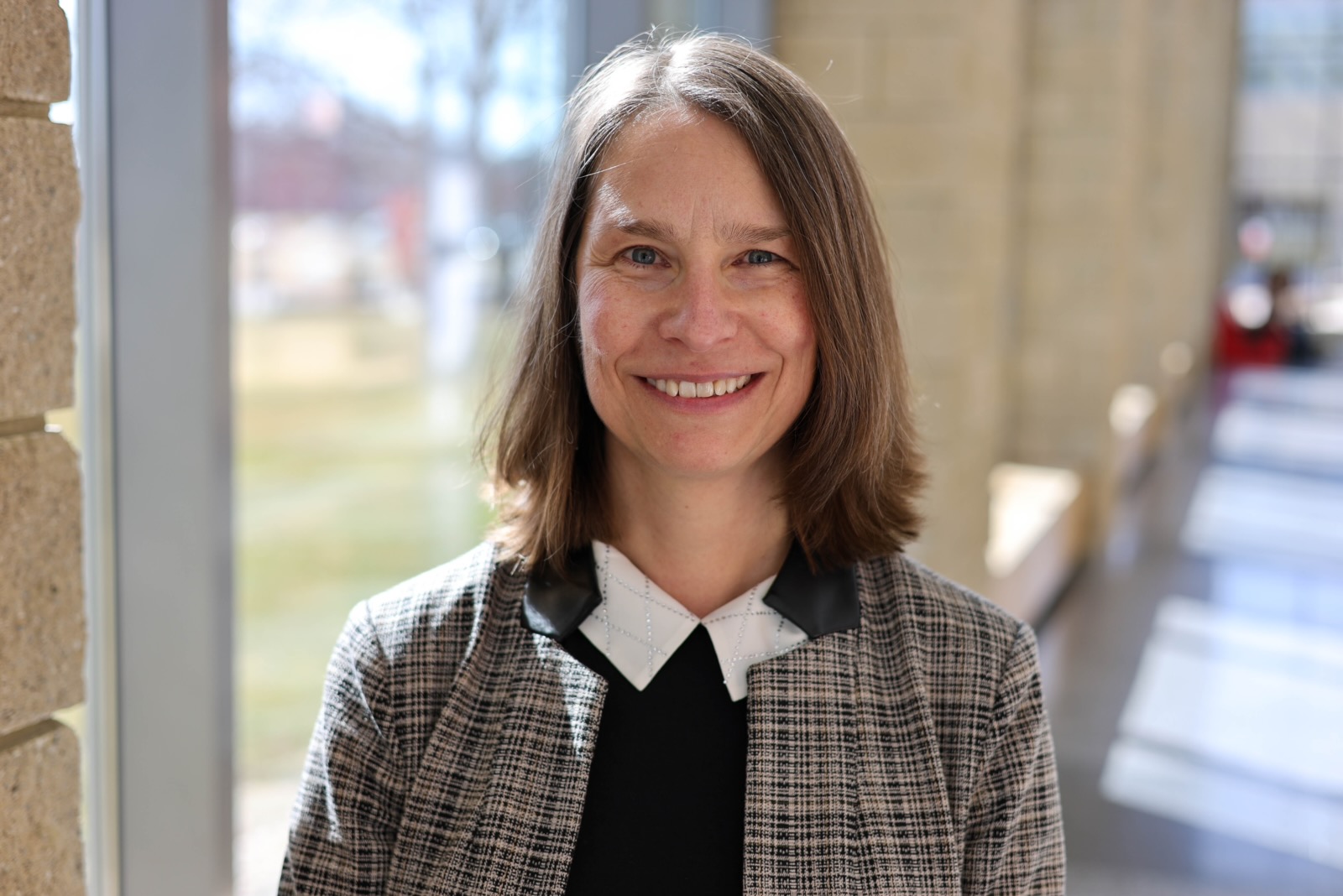
 Professor of Educational Studies Nancy Taber has been appointed as the inaugural International Visiting Professor with the Centre of Excellence for Equity in Uniformed Public Services in the Faculty of Health, Medicine and Social Care at Anglia Ruskin University in the United Kingdom.
Nancy Taber is determined to help military veterans process their lived experiences in public service, one story at a time.
The Professor of Educational Studies and fiction author was recently appointed the inaugural International Visiting Professor with the Centre of Excellence for Equity in Uniformed Public Services (CEEUPS) in the Faculty of Health, Medicine and Social Care at Anglia Ruskin University (ARU) in the United Kingdom.
Effective through August 2029, the appointment will allow Taber to contribute her expertise in military studies — particularly women’s experiences in the Canadian Armed Forces — to innovative international research.
As a CEEUPS International Visiting Professor, Taber will continue collaborating with ARU’s Social Science Research Lab to learn about issues in other militaries and uniformed public services. While these can be quite similar in Western societies, Taber says their contexts vary.
“As researchers coming together, we are different yet interconnected, and I am bringing practices and research from Brock University in Canada to CEEUPS,” she says. “In turn I am bringing their international insights back to Brock. Together, we are helping each other develop our own creative practices so we can effect real change in military organizations and culture.”
While statistics and journal articles are hugely important in effecting wide-scale change in military culture, Taber believes using creative research methodologies can assist with sparking that transformation.
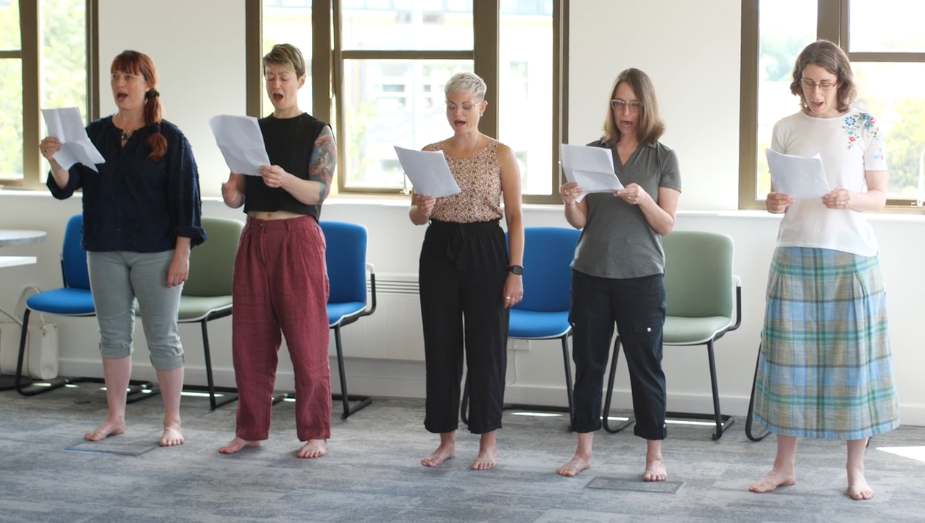
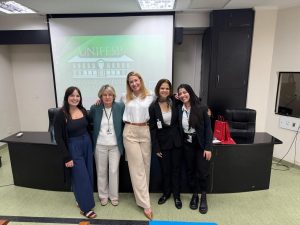
Professor of Educational Studies Nancy Taber (second from right) has been appointed the inaugural International Visiting Professor with the Centre of Excellence for Equity in Uniformed Public Services (CEEUPS) in the Faculty of Health, Medicine and Social Care at Anglia Ruskin University in the United Kingdom. At a recent CEEUPS voice workshop, Taber collaborated with researchers and participants to explore the experiences of retired women military veterans. Pictured from left are workshop facilitator Mary Jane Wells with military veterans and researchers Annie Geisow, Ashleigh Percival-Borley, Taber and Hannah West.
“In order for cultural shifts towards gender equity to occur, people need to understand the need for that change. If issues can be understood from the viewpoint of a story and protagonist, people will be more immersed in the mindset of others and more willing to imagine themselves in their situations,” she says.
Supported by a Social Sciences and Humanities Research Council of Canada Insight Grant, Taber will continue conducting workshops that use expressive writing as a transformative learning practice to explore Canadian military women’s gendered experiences.
Her storytelling research engages with different modalities of expression, such as in a recent multi-day workshop for women military veterans that explored voice and sound work that she facilitated in collaboration with CEEUPS.
“Women veterans bravely shared their stories, resulting in not only a powerful opportunity for reflection, but also the chance to build a trusted community,” she says.
Taber’s work holds a critical duality that lies in helping people use their unique voices to share their stories while also making their lived experiences available to others to learn from in an accessible way.
What strikes Taber most about her work is the emotion participants pour into their writing.
“Essentially, we are guiding women to look at their military service in different ways through the process of creative writing,” she says.
Whether through expressive writing, voice work or participatory filmmaking, Taber says the throughline is that people learn from stories.
“We often think of a story as something that is mere entertainment, or fun, but stories are also much more — everything someone writes down is in some way connected to who are they are and what it is to be human, which has powerful learning potential,” she says.
This belief underpins her fiction-based research, a form of qualitative research that can take the form of short stories, novellas or novel.
Taber is set to release her new fiction-based research work A Cove of Witches this fall. A follow up novel to her fiction writing debut A Sea of Spectres, her newest work is a fast-paced adventure steeped in Prince Edward Island folklore and history.