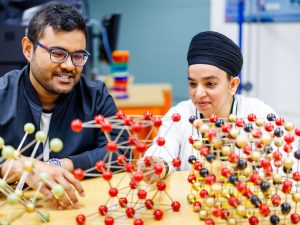
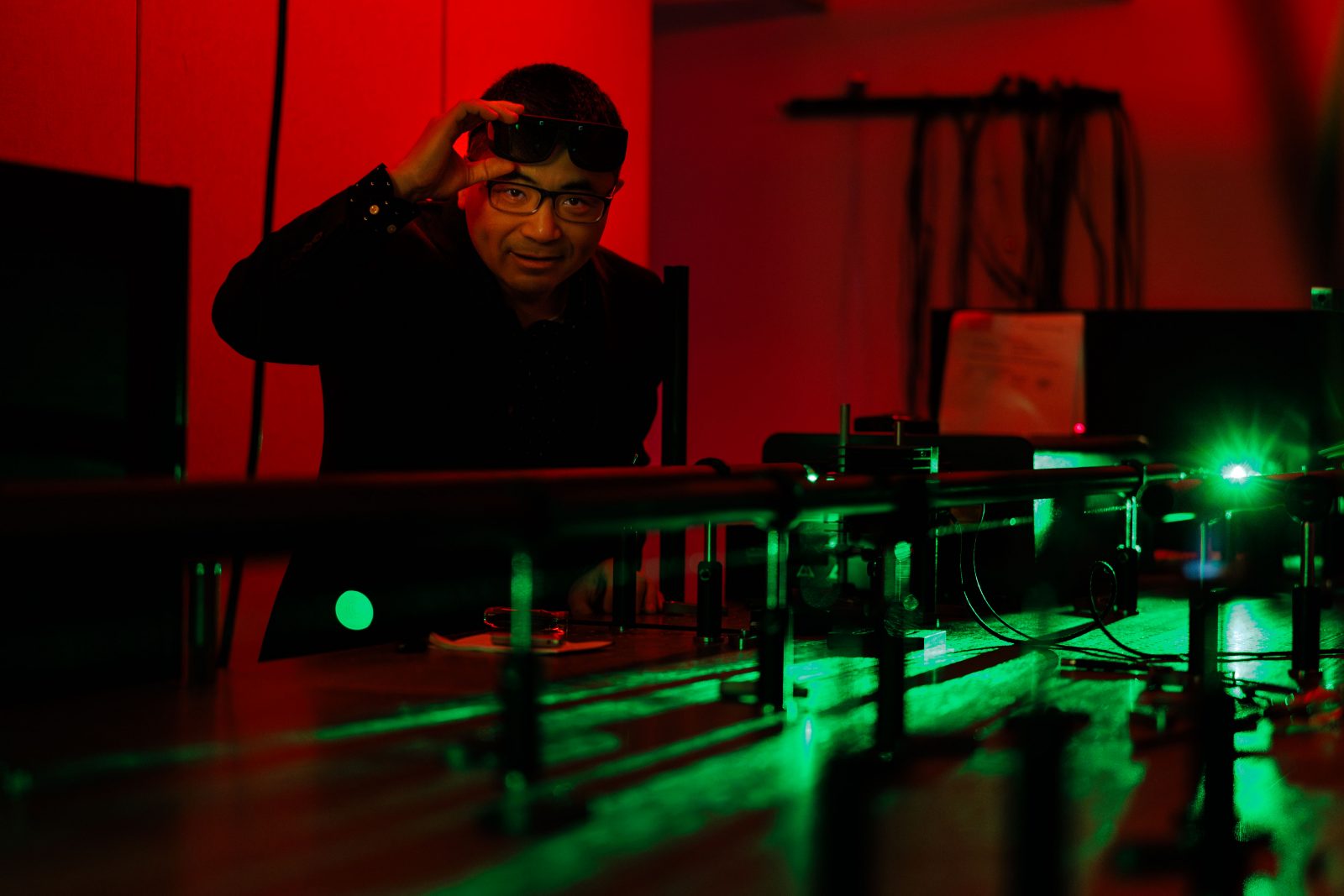
 Professor of Chemistry Jianbo Gao has worked with Brock LINC to commercialize his photosensing chip, which can be integrated into fibre optic cables to detect hacking and eavesdropping attempts as they happen.
Every day, the world’s most sensitive information — from medical records to government communications — travels through fibre optic cables. Jianbo Gao has invented a way to catch the people trying to listen in.
Using advanced nanotechnologies, the Associate Professor of Chemistry and his team have created a photosensing chip that integrates into fibre optic cables and detects hacking and eavesdropping attempts as they happen.
But inventing the chip was only half the journey. Between a laboratory breakthrough and marketplace success stands a process few researchers are equipped to navigate alone: assessing a technology’s commercial potential, protecting it, funding its development and finding the right industry partners.
So Gao turned to Brock LINC, a research innovation office that provides research commercialization, entrepreneurship and industry partnership supports to the University and Niagara communities.
“Brock LINC has unique programs and services to help faculty bring their research to market,” says Gao. “Its staff are extremely knowledgeable, supportive and a pleasure to work with.”
Farzana Crocco, Brock LINC’s Executive Director, says Gao did the right thing by reaching out before he made decisions that could have limited his options.
“That gave us the full runway: protection, proof of concept and the right industry conversations in the right order,” she says. “Early engagement is often the difference between a technology that reaches market and one that stays a published paper.”
Patenting and commercializing technology demands expertise, time and financial resources that few individual researchers can marshal on their own, Crocco says.
Gao chose to assign his intellectual property (IP) to the University, with Brock LINC leading the commercialization effort on his behalf.
The team filed for patent protection to secure exclusive rights to the technology, supported Gao in developing his proof of concept (small-scale testing to verify the invention works outside the lab), identified funding opportunities, shaped the commercialization strategy, and connected Gao and his colleagues with industry partners to explore validation and commercialization opportunities.
Gao says the innovation and commercialization journey with Brock LINC was seamless from the start.
“Most remarkably, the LINC has invested extraordinary effort in helping us secure funding and transform our vision into a concrete opportunity by working alongside me to develop a highly competitive proposal,” he says. “Together, we secured Brock University’s first Idea to Innovation (I2I) grant from the Natural Sciences and Engineering Research Council (NSERC) in more than a decade — an achievement that reflects the strength of our collaboration and the LINC’s unwavering commitment to innovation.”
With this and other NSERC funding from the Government of Canada, Gao is developing validated photodetector prototypes and a roadmap for further development toward industry co-development or licensing.
Gao’s chip joins a growing pipeline of Brock innovations moving toward market: researchers currently have 13 technologies available for licensing through Brock’s IP and technology portfolio.
Brock LINC is actively seeking industry partners interested in co-developing, piloting or licensing technology. Crocco is also encouraging researchers from all disciplines to reach out to Brock LINC for help protecting and promoting their projects and ideas.
“There’s research that doesn’t always translate to a traditional commercial outcome, like a product,” she says. “The value of the work may be to change processes, public policies or practices that impact real-life situations.”