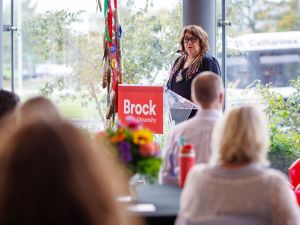
Sherri Vansickle, Assistant Professor of Educational Studies, and Margot Francis, Associate Professor in the Centre for Women’s and Gender Studies, used the play “You People” in their research exploring the use of participatory theatre to eliminate anti-Indigenous discrimination in the delivery of health-care services.
 NOTE: Brock University announced the creation of its Indigenous Research Grant in 2021. This is the last in a series of articles profiling the research of the 2025 recipients of this yearly internal award. Read more on the series on The Brock News.
Edna, an older Indigenous woman portrayed in the play You People, has fallen and is in great pain at the hospital.
During intake process, she’s asked repeatedly about drug and alcohol use, even though she’s stated she doesn’t drink or take drugs.
After Edna is admitted, her daughter requests a blanket and sandwich for her but is told by the floor nurse the hospital is out of both. A patient in a nearby bed, however, soon receives those same items from the same nurse.
When an audience at Fort Erie Native Friendship Center saw the 10-minute play, “every single person watching saw themselves in that scene,” says Assistant Professor of Education Sherri Vansickle.
“Was it being denied a blanket? Was it constant referencing about being an alcoholic or just looking for drugs? Was it not getting medication in a timely manner or the assumption that we can endure more pain than the person beside us? We all experience bias after bias,” she says.
Vansickle — who is from the Onondaga Nation, Six Nations of the Grand River Territory — partnered with Margot Francis, Associate Professor in the Centre for Women’s and Gender Studies, on a project exploring the use of participatory theatre to eliminate discrimination in the delivery of health-care services.
The pair recruited Métis actor and writer Michaela Washburn as artistic director and Naomi Tessler, founder of Branch Out Theatre in Toronto, to create a play titled You People in the style of forum theatre.
Invented by Brazilian dramatist Augusto Boal, forum theatre is an interactive performance in which actors portray an event involving oppression. Facilitators stop the scene at certain points so audience members can provide feedback and discuss alternative ways of approaching the situation.
Laying the groundwork for the play’s content was research assistant Bailey Amos, who reviewed qualitative literature reporting cases of racism, bias and discrimination Indigenous people experience in Canada’s health-care system.
“The play is based on this person’s story from that piece of literature and this person’s story from another piece of literature and the team’s experiences as well,” says Vansickle. “It’s all very, very real.”
Roles in the play were portrayed by professionals including Niagara-based Cree actor Nicole Joy-Fraser and performers from Mirror Theatre, a participatory theatre company founded by retired Brock Professor of Drama in Education and Applied Theatre Joe Norris.
The play was performed at Fort Erie Native Friendship Center and in two Brock classes related to health care. When audience members saw an instance of racism or bias, they yelled “stop” and someone stepped in to replace one of the actors.
“The whole idea is to interrupt the conflict and the negativity and the bias and replace these with a better and more just way of handling interactions in the health-care system that really benefit Indigenous people,” says Vansickle.
In addition to challenging racism, the performance also enabled participants to develop skills in successfully navigating discrimination by building alliances with others who can meet the patient’s needs, says Francis.
The play has been “transformational,” enabling both Indigenous and non-Indigenous audiences to learn and “find their voice” in accessing and delivering health care, Vansickle says.
The researchers aim to publish their findings over the summer, and Francis says the team is hoping to expand their work to explore if and how this type of play can be incorporated into medical education programs and workplace training.
The project builds on research supported by the Government of Canada’s New Frontiers in Research Fund that uses theatrical vignettes to model how people from equity deserving groups experience many forms of injustice when they access the health-care system.
The results of that work, co-led by Associate Professor of Health Sciences Valerie Michaelson and Associate Professor of Nursing Sheila O’Keefe-McCarthy, were presented at a May 28 symposium.