 Working with the Royal Ontario Museum and an international research team, Brock Assistant Professor of Earth Sciences Tanya Kizovski has discovered the presence of garnet on Mars.
An international research team led by a Brock University professor in collaboration with the Royal Ontario Museum (ROM) has given stargazers another reason to call Mars the “Red Planet.”
On Earth, garnet — a dark-red gem popular with Ancient Egyptians, Romans and the Victorian elite alike — is January’s birthstone.
On Mars, garnet’s presence is a potential new opening to a deeper understanding of the planet’s 4.5-billion-year history, says Tanya Kizovski.
“This discovery is going to expand our knowledge of the geologic processes that are possible on this planet,” says the Brock Assistant Professor of Earth Sciences. “This new garnet-bearing rock type could give us clues to how Mars has changed throughout its history and new insights into the ancient environments that could have formed the garnet and related minerals.”
Kizovski and colleagues at the ROM came to know of the garnet’s presence while analyzing a fragment of a Martian meteorite known as NWA 8171 within the ROM’s collections.
Kizovski sought to identify the fragment’s minerals and chemical composition.
“This little section of the meteorite looked really interesting, and the chemistry was a bit odd,” she says. “At first, we assumed it was a mineral called pyroxene, which is very common, but then we decided to take a second look.”
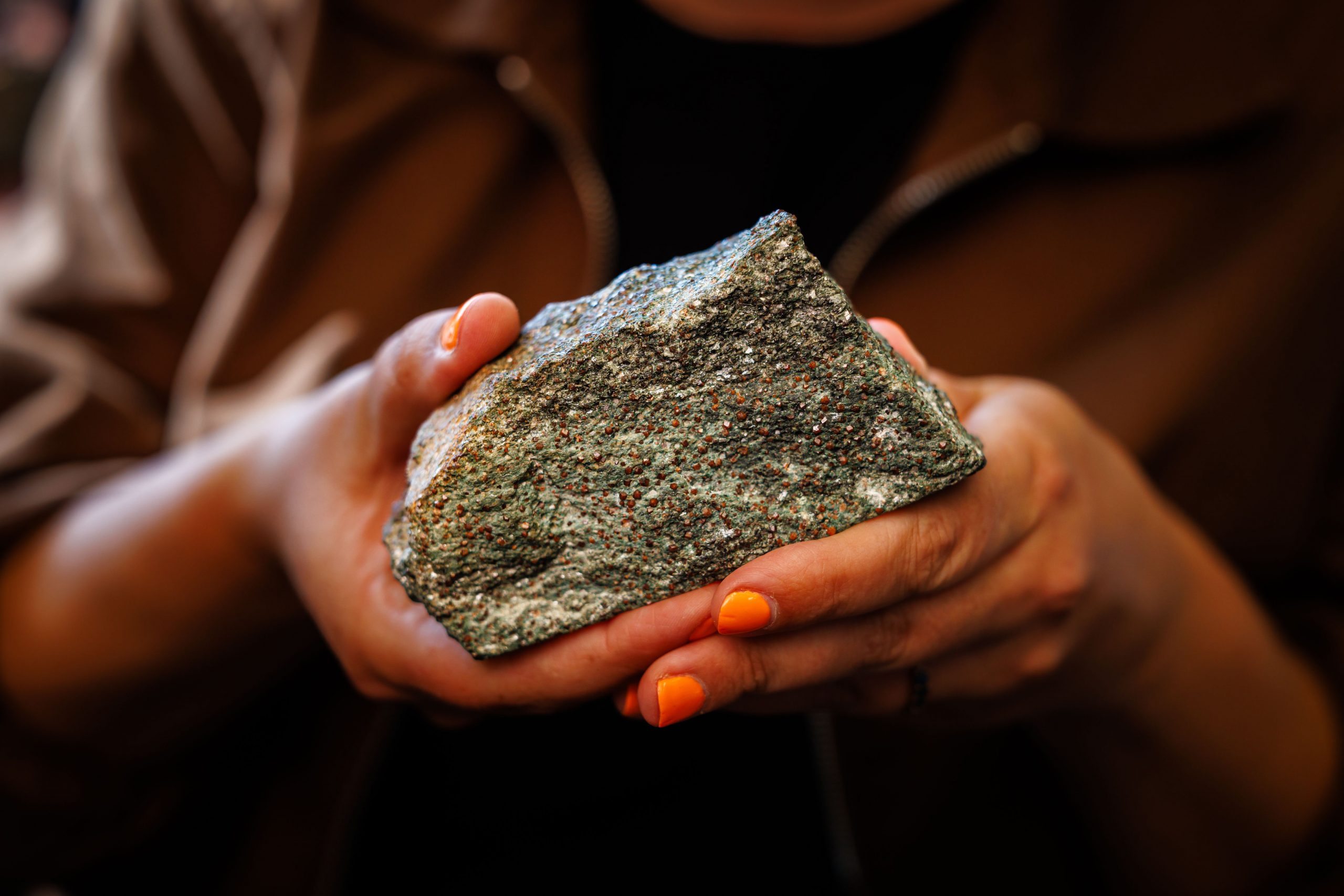
Assistant Professor of Earth Sciences Tanya Kizovski holds up a rock called an Eclogite, a garnet-bearing rock from Earth that contains red garnets and green pyroxene.
Using the ROM’s specialized laser equipment, the team — which in addition to Brock includes researchers from the ROM, University of Toronto, University of Portsmouth in the U.K., Universita di Trieste in Italy and Open University in the U.K. — were surprised to discover garnet, a mineral that had not been identified on Mars until now.
The team analyzed the fragment’s chemistry and mineralogy and speculated on the garnet’s origin.
Garnet is a “classic example” of a mineral often found in metamorphic rocks on Earth, says Kizovski. The process of metamorphism transforms igneous or sedimentary rocks into a new form through exposure to extreme heat, high pressure or hot fluids.
On Mars, the heat and pressure needed to produce garnet through metamorphism could have come from the impact of a meteorite hitting the surface of Mars, magma rising up into the Martian crust or both, she says.
Kizovski is quick to caution that the research doesn’t definitively indicate whether the garnet-bearing rock formed on Mars or was delivered to the Red Planet and incorporated into its surface in a meteorite landing, leaving the possibility for an “extra-Martian” origin.
Scientists need to now study the garnet’s isotopic signatures to verify if it was originally produced on Mars or on another planetary body.
Measuring oxygen isotopes from the garnet-bearing rock type itself would help to confirm if it is Martian in origin or from an exotic meteorite impactor, Kizovski says. Isotopes are a collection of atoms with equal numbers of protons and electrons, but different numbers of neutrons.
However, that process would entail destroying some of the sample, “which was avoided thus far due to its rarity, as it may be the only garnet-bearing Martian rock we have for study,” she says.
ROM curator Kim Tait and Research Assistant Jessica Tomacic are continuing to study the sample. “With their work and more comparisons to rover and orbital data, I’m hopeful that we will be able to learn more about the origin and history of garnet on Mars,” Kizovski says.
The team’s study “Expanding Mars’ lithologic diversity: discovery of a garnet-bearing clast in NWA 8171,” was published Tuesday, June 16 in Geochemical Perspectives Letters.
This research project is funded in part by the Government of Canada’s Natural Sciences and Engineering Research Council (NSERC) and the Killam Trusts Dorothy Killam fellowship.