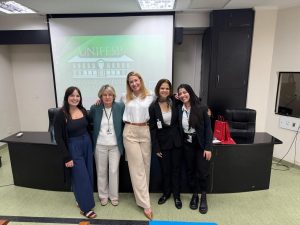
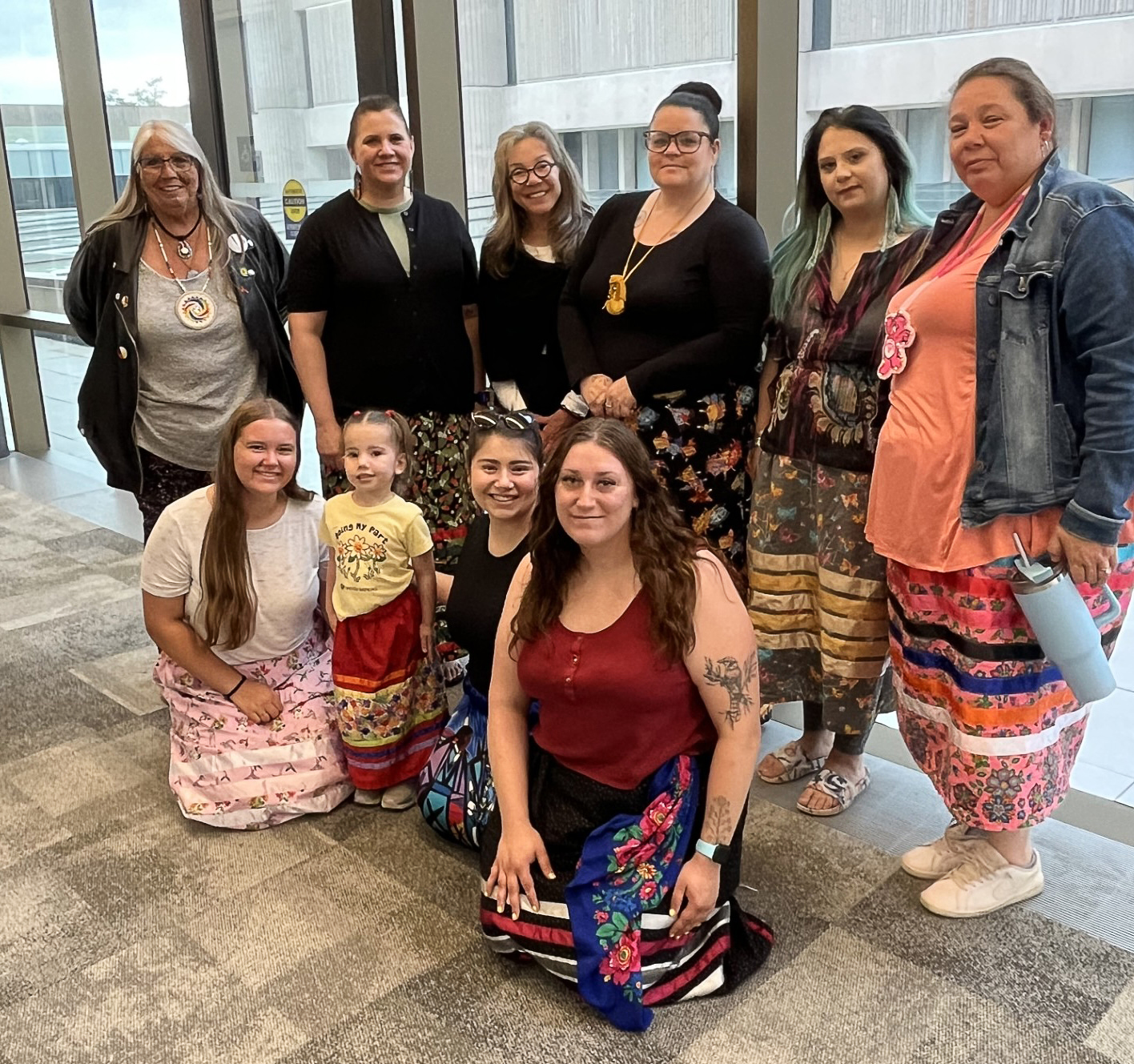
 The Strong Water Singers, an Indigenous women's drumming collective based at the Fort Erie Native Friendship Centre, participated in a sharing circle at Brock University as part of a research project exploring access to housing for Indigenous peoples in the Niagara. The group was on campus to perform at the University's Convocation ceremonies in June 2024.
NOTE: Brock University announced the creation of its Indigenous Research Grant in 2021. This is one in a series of articles profiling the research of the 2025 recipients of this yearly internal award. Read more on the series on The Brock News.
Mary Ellen Simon can’t help but reflect on the bitter irony of what she encounters across Niagara’s urban areas.
“I’ve seen Indigenous men sitting homeless out on the streets,” says the Housing Programs Director at the Niagara Regional Native Centre. “I always say to myself, ‘Why are we homeless on our own land?’ This doesn’t make sense. Our resources have been extracted and yet there are no resources to house our people.”
Simon and her colleagues in the Indigenous Housing Advisory Circle (IHAC), which consists of a half-dozen Indigenous organizations in Niagara, have been co-researching access to housing for Indigenous peoples in the region with Brock University Adjunct Professor of Political Science Joanne Heritz and Associate Professor of Political Science Liam Midzain-Gobin.
The group recently released their policy brief, “Indigenous Visions of Making Home in Niagara,” through Brock’s Niagara Community Observatory (NCO).
The brief gives an overview of land rights and treaties, outlines principles guiding the research, and highlights two case studies of Indigenous housing projects in British Columbia and Manitoba.
Over the course of two years, the researchers held extensive conversations and sharing circles with 90 Indigenous community members to gather information on the challenges of, and potential solutions for, access to adequate housing.
“We need to listen to their stories,” says Heritz. “Indigenous community members are disproportionately affected by the housing crisis and they experience racism and discrimination in housing more so than non-Indigenous people.”
The brief’s findings include:
- Only eight of the 90 research participants own their own home, a rate that is significantly less than the general population.
- Indigenous Peoples were more likely than the non-Indigenous population to be living in a dwelling that needed major repairs (16.4 per cent versus 5.7 per cent) or live in crowded housing (17.1 per cent versus 9.4 per cent) in 2021.
- According to the most recent 2021 Point-in-Time count including Indigenous data, approximately 22 per cent of the 665 people experiencing homeless identified as Indigenous despite making up only three per cent of Niagara’s total population.
- Research participants reported that the possibility of being unhoused has led many to experience, or re-experience, trauma.
The brief also responds to the Niagara Region’s Housing and Homelessness Action Plan (HHAP) and makes recommendations to the regional, provincial and national governments. These include:
- Constructing “tiny home” Indigenous communities that include access to nature and space for community needs.
- Developing partnerships between municipalities, Indigenous communities and the federal government’s Rapid Housing Initiative to create housing on vacant and/or underused government-owned lands.
- Creating 22,000 Indigenous-led subsidized housing units in urban spaces across Ontario over the next 10 years.
- Fostering collaboration between the provincial and federal government to develop a new Urban Indigenous Housing Strategy.
- Retaining and training Indigenous staff to build housing and increase the capacity of communities to build and maintain their own housing.
The NCO policy brief is part of a larger study — supported by a Brock Indigenous Research Grants awarded in 2023 and 2025 as well as the Niagara Community Foundation — examining Indigenous housing in Niagara.
The research group is aiming to present reports arising from the larger study to Niagara policy-makers, organizations and others in Niagara later this year, says Midzain-Gobin.
“When Indigenous communities are wanting to work through their own self-determination, they’re finding a lot of barriers and blockages, especially at the local and provincial levels,” he says.
Simon says she is pleased with how the research has been carried out so far and the awareness it will raise when the reports are distributed widely.
“Our policy research is a great advocacy tool for all Niagara communities to utilize in their roles of helping to end homelessness,” she says. “These are not just individual struggles; there are systemic barriers in place that need to be addressed.”