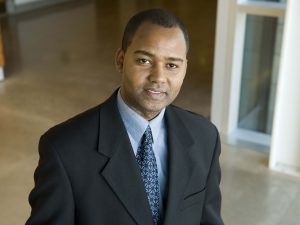
 Associate Professor Duncan Koerber in the Department of Communication, Popular Culture and Film explores an unusual new aspect of the crisis communications field — social media posts that spark a crisis in the real world.
Crisis communications expert Duncan Koerber has spent a decade examining how a single social media post can become a full-blown disaster.
The Brock University Associate Professor of Communication recently published his findings in Crisis in a Tweet: The Rise of the Social Media Crisis, a detailed study of how social media platforms have become a site for creation of digital disasters — often with serious, real-world consequences.
“I started working on this book when I noticed that crises with almost the same level of significance, powerful enough to have outcomes affecting people’s careers and organizational reputations, were also developing solely on social media,” he says.
While crisis management and crisis communication usually relate to crises happening in physical spaces, such as natural disasters, product failures or political scandals, Koerber says online crises are “always about language and meaning.”
“Social media has pushed aside the gatekeepers of mass media,” he says. “Anybody can post anything, so that means anybody can get into a crisis now. You could post something tomorrow and a crisis forms as a result, whether for someone else or for you.”
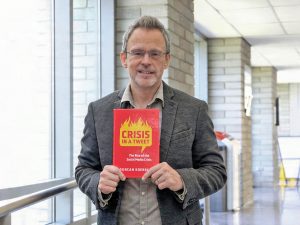
Associate Professor Duncan Koerber’s book on social media crises was published in March 2026.
Koerber also digs into what he calls “tweet archaeology,” a scenario in which old posts can be searched and reshared to stoke public interest — or outrage — in a new context.
In these cases, he says, an individual’s employer often faces pressure to take action in the real world, which can have serious consequences.
In recent weeks, for example, a finance executive sued her firm for wrongful termination after online activists combed through social media sites following the death of political podcaster Charlie Kirk. The senior vice-president had privately posted about Kirk on Instagram before he was shot and killed, but the firm dismissed her anyway.
In cases like this, Koerber says organizations can become “complicit” in the crisis by complying with the demands of online critics because this appears to be the fastest and easiest way to deal with negative attention.
He hopes his research helps everyone from organizational decision-makers to casual social media users look at social media posts and their consequences from a more realistic perspective.
“On one hand, I’m showing why these crises blow up, causing job loss and shame and organizational reputation damage,” he says. “But on the other hand, I’m trying to argue that we shouldn’t see them as such a big deal. Somebody posts something, a mob pops up, the situation goes viral and everyone starts saying the person should be fired or even physically harmed — we need to temper these situations.”
Koerber was already at work on the project when he joined Brock’s Department of Communication, Popular Culture and Film in 2018, where he says working with fourth-year students studying crisis communication helped him identify and map out the ways in which crises develop on social media platforms.
“Students who are constantly online, using Instagram and X and YouTube, would bring cases to class for discussion and get into debates about current topics,” he says.
With funding from Brock’s Council for Research in the Social Sciences, Koerber hired one of his students at the time, Media and Communications major Kim Payne (BA ’19), as a research assistant to track down examples of social media crises for analysis and comparison as the project took shape.
Koerber’s curiosity about this new area of study in the field of crisis communication continues to grow. He is currently at work on an edited volume featuring research by other communication scholars investigating the evolution and impacts of social media crises.