 Brock's spring Chemistry courses aim to equip students from all disciplines with foundational principles and skills.
 Brock University is offering several introductory Chemistry courses this spring that will help students to build fundamental skills in science and grow their confidence in the lab.
Designed for students who do not yet have a solid foundation in chemistry, CHEM 1P00 Introductory Chemistry aims to “even the playing field” for students who had limited exposure to the subject in high school, says Professor and Chair of the Department of Chemistry Paul Zelisko.
The spring offering helps to bridge students into courses such as CHEM 1P91 Chemistry Principles and Properties I and CHEM 1P92 Chemistry Principles and Properties II that are required for certain programs.
Students in non-science programs across the University can also expand their understanding of chemistry in SCIS 1P52 Chemistry in Everyday Life, which is offered in a virtual, asynchronous format that allows learners to work at their own pace.
“SCIS 1P52 explores environmental issues and chemistry as it impacts society, taking a holistic approach to science and chemistry rather than focusing on concepts that require a strong scientific background,” Zelisko says. “The goal is to increase science literacy in non-scientists.”
For students already in the sciences, CHEM 2P20 Principles of Organic Chemistry I and CHEM 2P21 Principles of Organic Chemistry II offer an introduction to organic chemistry, which explores carbon-containing compounds found in natural and human-made materials.
“The aim is to give students an appreciation for the chemistry that’s in their everyday lives and to demonstrate the transdisciplinary nature of science,” Zelisko says.
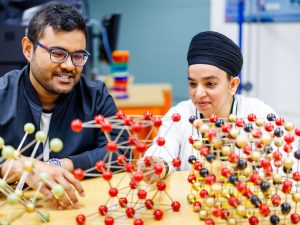
Labs play a critical role in CHEM 1P00, CHEM 1P91, CHEM 1P92, CHEM 2P20 and CHEM 2P21, allowing students to build scientific thinking skills and learn fundamental techniques, such as how to identify unknown compounds.
“Thinking like a scientist means being able to look at a challenge, propose hypotheses, execute experiments and then draw conclusions based on the results,” Zelisko says.
“If you can understand the fundamentals, you always have the basis to approach any problems.”
While the shift in focus from memorizing information to understanding processes can be a challenge for some students, Zelisko says students who are adaptable in how they approach courses tend to be successful.
“To support students across all courses, we take a proactive approach,” he says. “Regular assessments help identify students that are struggling earlier followed by additional supports.”