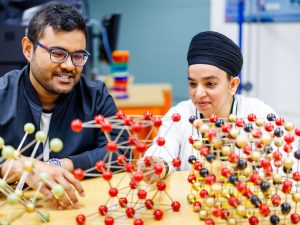
Child and Youth Studies PhD students Rawan El Haj (left) and Aayushi Gandhi have received Brock University’s 2025-26 Horizon Graduate Student Scholarship.
 NOTE: This is one in a series of articles on Brock’s 2025-26 Horizon Graduate Student Scholarship recipients. Read other stories in the series on The Brock News.
Rawan El Haj and Aayushi Gandhi are determined to shape systems that shape the lives of children and youth — particularly those navigating displacement, inequality and deficit-based labelling.
Both Child and Youth Studies PhD students at Brock University, the Horizon Graduate Student Scholarship recipients are using their research to centre lived experience and spark meaningful change in policy and practice.
For El Haj, pursuing a PhD is deeply personal.
An international student from Lebanon and a Palestinian refugee, she says her academic journey has been shaped by displacement, loss and resilience.
After completing undergraduate and master’s studies in pharmacy, she worked in the humanitarian sector with children and youth affected by crises and displacement. That experience broadened her understanding of justice and equity and ultimately led her to doctoral research.
Her work focuses on newcomer children and youth in Canada, examining how access to health care influences social inclusion, belonging, educational outcomes and psychosocial well-being over time.
“I really want to focus on the voices of these children,” she says.
Using a trauma-informed approach, she aims to identify structural barriers affecting newcomer families and influence refugee child policy at both the national and international levels, ensuring that health-care access and integration frameworks align with what children and youth say they need.
El Haj says receiving the Horizon Scholarship has helped her balance academic work and caregiving responsibilities.
“As an international student and as a mother, financial constraints limit so much time and focus,” she says. “This scholarship provided stability.”
Beyond financial support, she says the award reinforced the value of diverse lived experiences in shaping impactful research and strengthened her sense of institutional support.
Like El Haj, Gandhi is also focused on shifting dominant narratives.
Her research examines how perceptions of children and youth labelled “at risk” in policy and school settings can shape the supports they receive.
“What often happens is that the label becomes the loudest thing about them,” she says. “Instead of asking what’s wrong with them, we should ask what happened to them or what’s happening around them.”
With a background in school counselling and clinical settings, Gandhi became interested in what she describes as a gap between policy intentions and lived realities after observing how quickly young people could be reduced to labels, such as “non-compliant” or “aggressive,” that can follow them across settings.
Her doctoral research uses qualitative analysis to explore how risk is understood in policy and practice and to identify strength-based alternatives that centre children’s agency and resilience.
Gandhi says support from her supervisor and family — including her husband, child and extended family members who assist with caregiving — has been foundational throughout her academic journey.
The Horizon Scholarship has helped her invest directly in research tools, conference participation and resources that strengthen both the rigour and reach of her work. It has also allowed her to think intentionally about how she can give back to the schools and communities involved in her research.
“I don’t want to just take something from a community for my project,” she says. “I want to give something back.”