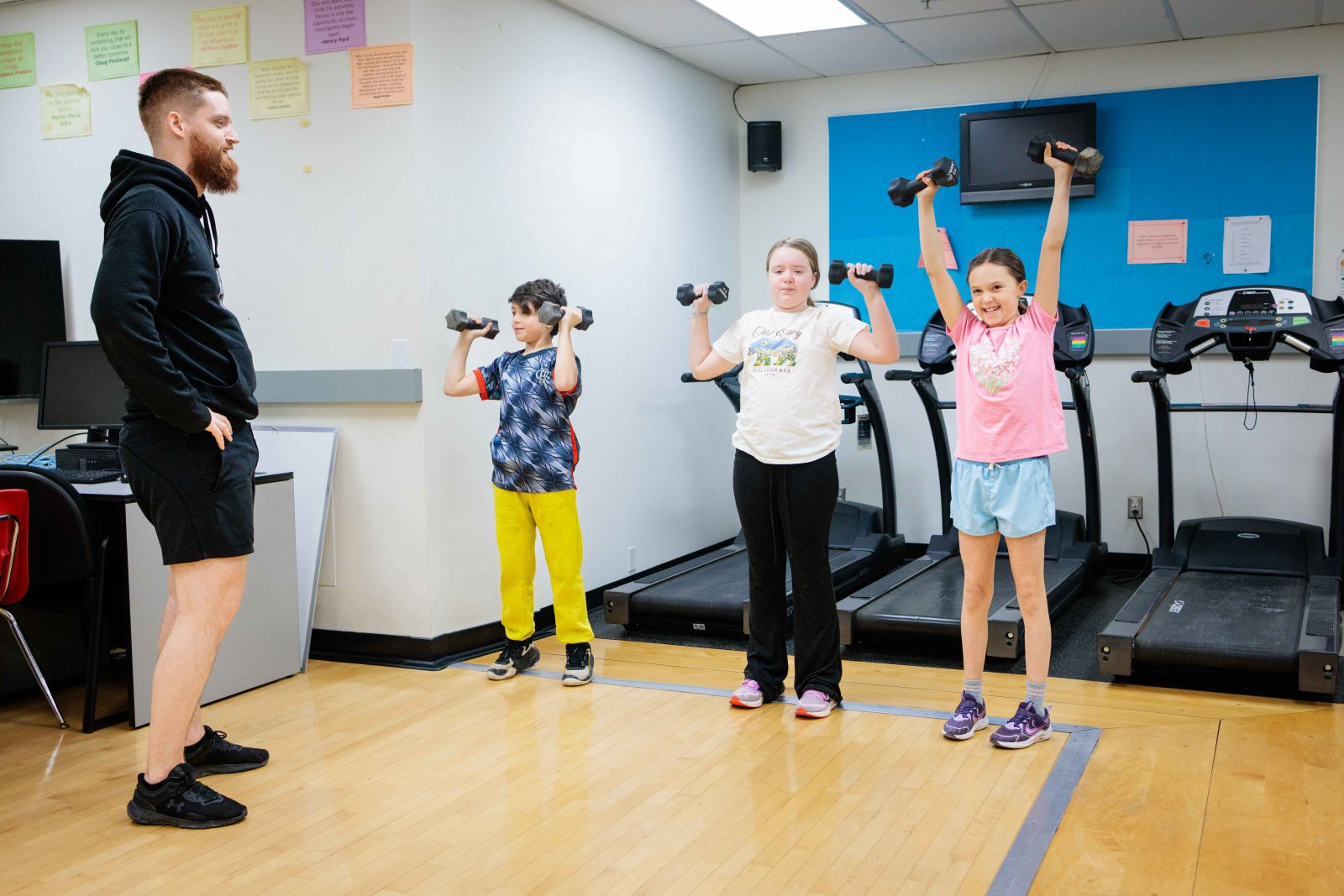
 Brock University PhD student James Maynard (left) looks on as Vince Renno (second from left), Violet Smith (centre) and Amelia Vernon (right) participate in a study on how resistance exercise affects children’s muscles and cardiovascular system.
There’s a common misconception that pumping iron is exclusively for adults.
But research has shown that children also get stronger from lifting weights.
To learn more about the benefits children reap from resistance training, Brock University PhD students Andrew McKiel (MSc ’22) and James Maynard (MSc ’22) are examining the mechanisms of how children’s muscles get stronger and how training impacts other systems of the body. Overseeing McKiel and his team is Professor of Kinesiology Bareket Falk, a Brock University Distinguished Professor and international expert on children’s physiological responses to exercise.
The researchers are looking for children ages eight to 11 years old to participate in the 12–week study, led by McKiel. Some participants will complete two sessions of resistance exercise training a week and all will visit an on-campus laboratory seven times throughout the study period. Details and registration can be found on the Institute for Lifespan Development Research website.
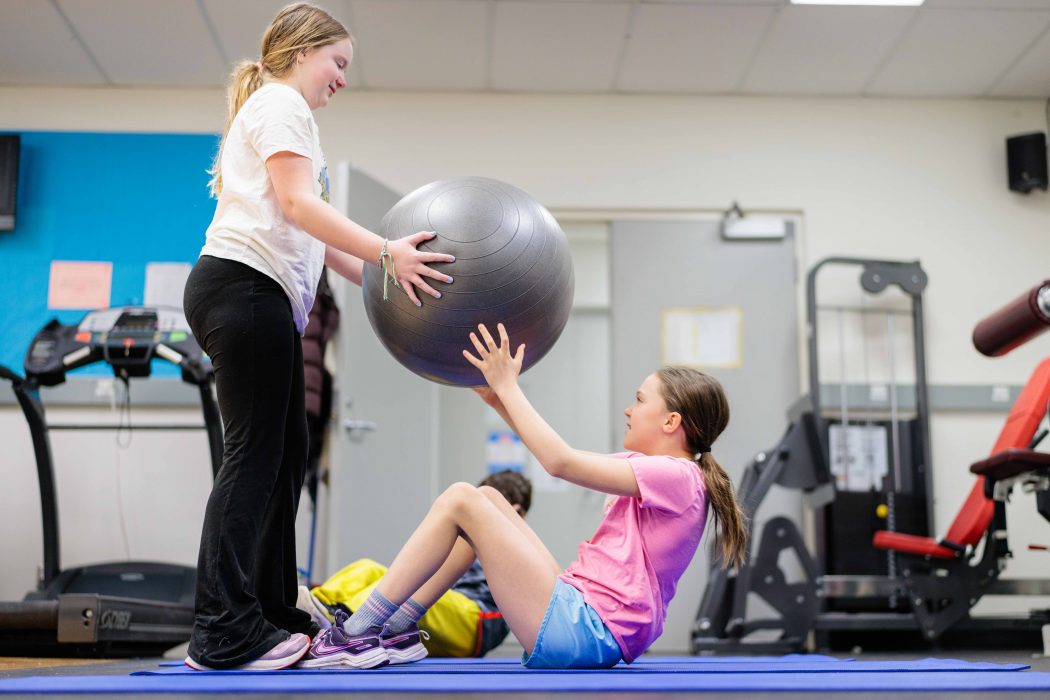
Violet Smith (left) hands an exercise ball to Amelia Vernon (right) during an exercise in a research study examining how resistance exercise affects children’s muscles and cardiovascular system.
Funded by a doctoral scholarship McKiel received from the Government of Canada’s Natural Sciences and Engineering Research Council, the study builds on earlier Department of Kinesiology research examining the effects of exercise and physical training on bone health and neuromuscular function during growth and maturation.
Muscles are activated when the central nervous system (CNS), consisting of the brain and spinal cord, transmits electrical impulses to and from the neuromuscular junction. This junction is a space between cells where electrical signals are converted into chemical signals bringing about muscle contraction.
Muscles working against a heavy load such as dumbbells, bands or even a person’s own weight trigger biological signals instructing the body to build more muscle tissue, resulting in bigger, stronger muscles.
While this mechanism, called hypertrophy, and the CNS neural mechanism have been well studied and understood in adults, less is known about how muscles “turn on” in children — or even if resistance training makes children’s muscles get bigger, says McKiel.
He says recent advances in equipment and technology make this research much easier to conduct, especially with children.
“In the past, we had to rely on an electromyography (EMG) needle to measure when individual groups of muscle fibres turn on during a muscular contraction,” he says. “We couldn’t use that with pediatric populations because it involved sticking a needle into the child’s muscle, which is both psychologically and physically uncomfortable.”
But now Brock University and other labs can utilize new algorithms that break down EMG signals recorded from the skin into groups of muscle fibres, he says.
Maynard is investigating whether resistance training makes children’s arteries more flexible, as is the case when adults and children do aerobic exercises.
Ideally, arteries need to be elastic so that they can easily expand and contract to ensure consistent blood circulation, he says. Stiff arteries can cause cardiovascular disease by making the heart pump blood through less space, which can damage tissue found within arteries and lead to high blood pressure.
Falk, whose research lab is the only one in Canada specializing in the study of children’s neuromuscular functioning, says monitoring changes in children’s muscle size and neuromuscular activation will add deeper insights to past research.
“Currently, there are very few studies that examined either one of these mechanisms in children,” she says. “This is important because it can provide us with the initial basis for designing effective training or rehabilitation programs that are age specific.”
The experimental phase of the study is expected to wrap up by September.