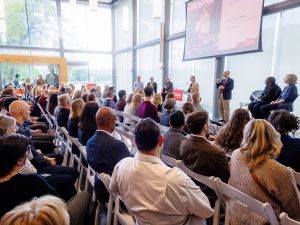
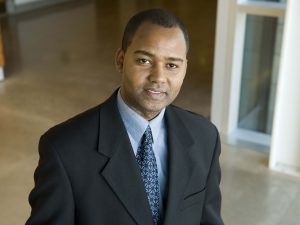
Applied Health Sciences master’s student Anna Nickel (second from right) won first place at Brock University’s Three Minute Thesis (3MT) Finals on Tuesday, March 24. Biological Sciences master’s student Holly Eaton (left) earned second place, Applied Health Science master’s student Jessica Malcolm (second from left) came in third and Critical Sociology master’s student Faith Westman (right) won the People’s Choice award.
 Brock graduate student Anna Nickel knows first-hand how important early diagnosis is when it comes to treating concussions. After sustaining multiple concussions over several years, she experienced significant visual symptoms that required ongoing therapy.
Now an Applied Health Sciences master’s student, Nickel is researching ways to make standard concussion assessment tools — which often depend on visual tracking and spatial awareness — more effective for athletes with visual impairments.
She shared her work at Brock’s Three Minute Thesis competition (3MT) Finals on Tuesday, March 24, where she earned first place and a spot at Ontario Regional Competition. The 3MT competition invites graduate students to present their research to a general audience in three minutes using just one slide.
Biological Sciences master’s student Holly Eaton earned second place, Applied Health Science master’s student Jessica Malcolm came in third and Critical Sociology master’s student Faith Westman won the People’s Choice award.
Nickel’s research introduces practical adaptations to better support athletes who cannot rely on visual cues during assessment in her research, including using light sources in place of visual targets and textured surfaces to guide balance tests.
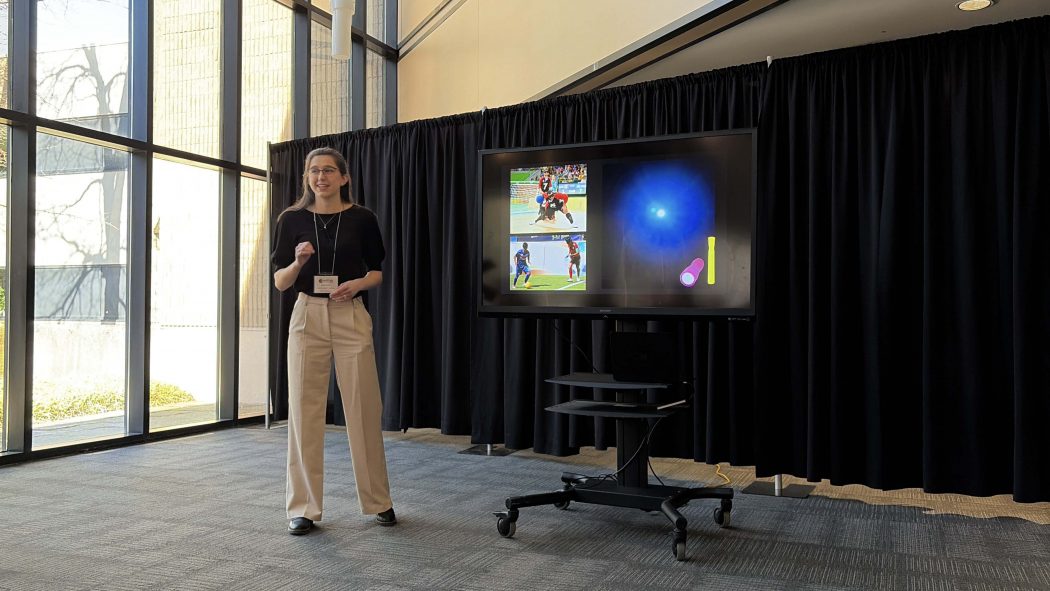
Anna Nickel, an Applied Health Sciences master’s student, presented her research on adapting standard used concussion assessment tools for athletes with visual impairments at Brock University’s Three Minute Thesis (3MT) Finals on Tuesday, March 24.
“Just because someone can’t complete a standard test doesn’t mean we can’t assess them,” she said. “We can adapt the tools so they are accessible and still meaningful.”
The commonly used Sports Concussion Assessment Tool, for example, includes tasks such as walking heel-to-toe along a straight line to assess balance, which can be difficult or inaccessible for athletes with visual impairments. To address this, Nickel and her team created a textured line on the floor, allowing athletes to feel the path underfoot.
“Working directly with athletes and asking what works best for them allows us to adapt tools like the Sports Concussion Assessment Tool so they are accessible,” she said.
Nickel’s goal is to ensure clinicians are better equipped to assess and treat athletes with visual impairments, helping prevent situations where individuals are turned away due to a lack of appropriate tools.
“I’m hoping this research amplifies athletes’ voices and shows clinicians there are ways to adapt assessments and treatment, so care is accessible for everyone,” she said.
As a 3MT competitor, Nickel had to rethink how she communicates her research, shifting from technical language to a format that is accessible to a broad audience.
“Explaining your work to a general audience is very challenging because you have to rethink everything you know,” she said. “You need to break it down, test it with others and be willing to change how you say something until it truly makes sense.”
Nickel leaned on her support network while preparing for 3MT, including practicing weekly with her supervisor, Assistant Professor of Kinesiology Amanda Black; attending the 3MT workshops to refine her presentation; and rehearsing with friends outside her field, using their feedback to clarify complex ideas.
She will compete in the 3MT Ontario Regional Competition, hosted at Brock University, on Wednesday, May 6.
Reflecting on both her research and experience in the competition, Nickel shared a message she hopes resonates beyond the stage.
“When you find yourself saying a group of people can’t do something, ask why that is and whether there’s a way to change it.”