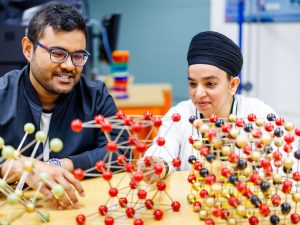
Brock University Master of Applied Gerontology student Anaiah Asif (left) has spent the past few months living in a Niagara Regional Housing apartment building with a community of older adults, including Taza Tusak (right), after receiving the Intergenerational Community — Engaged Residency Award. Tusak and some of the other residents visited an Aging and Communication class with Asif in January.
 Learning hasn’t stopped at the classroom door for Anaiah Asif. For the Brock University Master of Applied Gerontology (MAG) student, that career growth has continued during meals, through quiet conversations and while listening to the stories of her new neighbours.
Asif has spent the past few months living and working alongside older adults in a Niagara Regional Housing (NRH) apartment building after receiving Brock’s Intergenerational Community-Engaged Residency (ICER) Award.
The “once-in-a-lifetime opportunity” has shaped her personal and professional growth, Asif says.
“All the interactions, no matter how big or small, teach me something,” says Asif. “It makes me more confident in myself and the work I want to do in the future with older adults.”
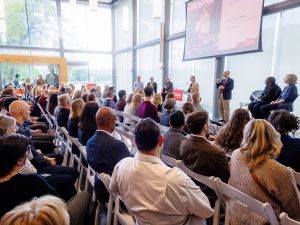
A highlight of the experience has been inviting tenants from the NRH building to visit an Aging and Communication class at Brock.
The class focused on intergenerational communications, stereotypes around aging and how younger people can better communicate with older adults, with small-group discussions also had to create space for meaningful dialogue.
“We can’t really see the value of it until we hear from those lived experiences — those older adults who’ve actually been through what we’re reading about,” Asif says.
For the NRH residents, the experience has affirmed that their knowledge matters.
“One day, they’re going to be in our shoes,” NRH tenant Taza Tusak says of the students. “Older people have lived through many life experiences.That’s why learning effective communication strategies is so important; it helps us connect and understand each other.”
The MAG program — and seeing the strength, humour and intelligence of her NRH neighbours — has challenged Asif’s perceptions of aging.
Visiting Hospice Niagara as part of a course on death and dying, for example, expanded her understanding of palliative care.
“I thought it was where people go to die and lose hope,” she says. “But palliative care is the opposite and actually where people go to live while they’re dying.”
Asif first learned about the MAG program at a graduate fair after completing a degree in kinesiology at McMaster University.
At the time, she was struggling to find a career path that aligned with her passion for working with older adults and was drawn to MAG’s coursework, placement opportunities and one-year structure.
With prior experience volunteering in exercise rehabilitation programs for seniors, cancer survivors, and cardiac and stroke patients, the fit felt natural.
“From the moment I knew about it, I always had my mind set on it,” she says.
Balancing graduate coursework with about 30 hours per month of community programming has come with challenges, especially while settling into a new city. Over time, Asif has learned to manage boundaries, time and self-care and has found a sense of belonging.
Looking ahead, she knows one thing for certain: her future lies working with older adults. The experience has sparked a growing interest in medical school and becoming a geriatrician.
For more information on the MAG program, including Fall 2026 application timelines and details, visit the Brock website.