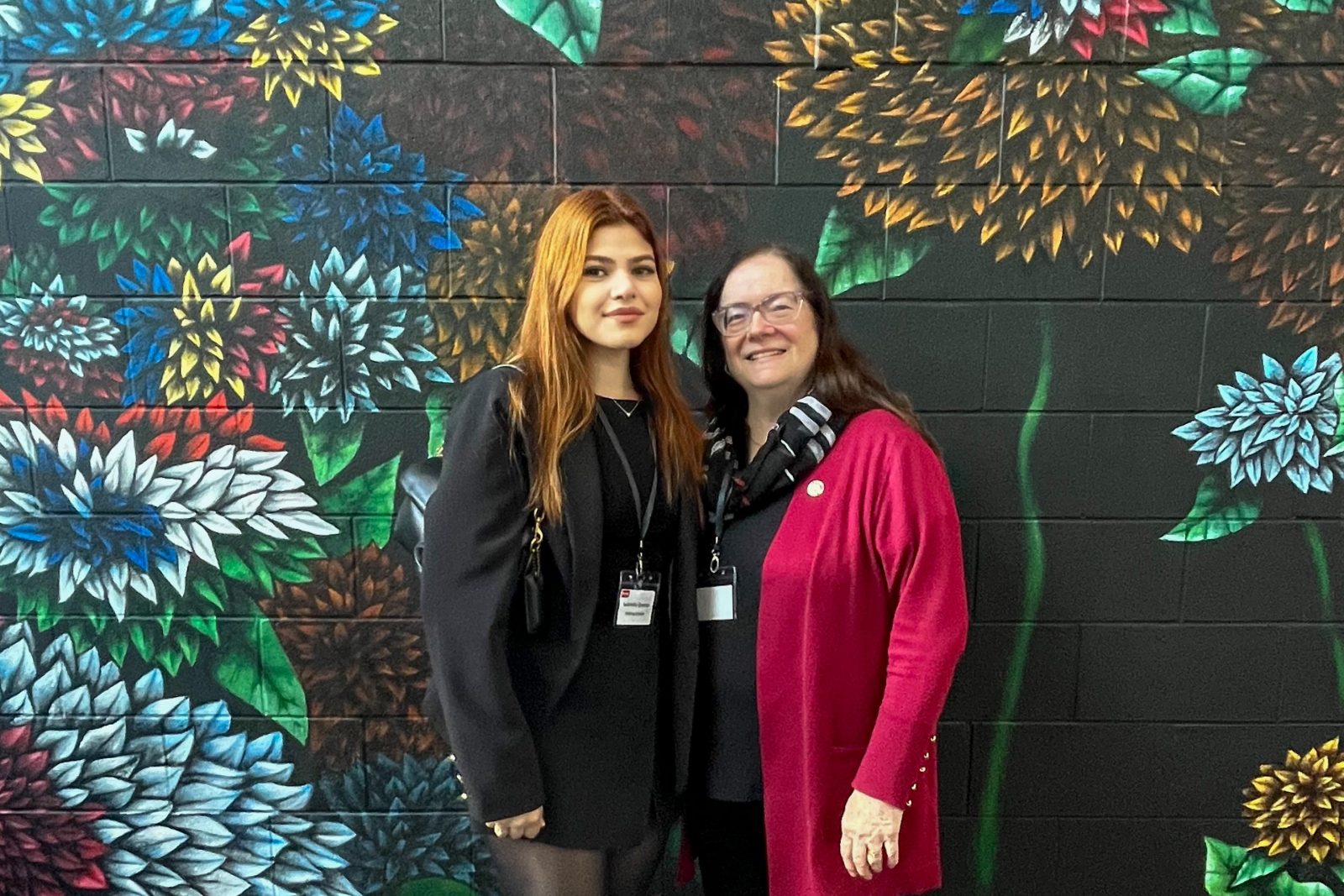
 Associate Professor of Nursing Sheila O’Keefe-McCarthy (right) is mentoring Visiting International Scholar Gabrielle do Nascimento Queiróz (left), an undergraduate Nursing student from São Paulo State University, on digital health tools used for cardiac prehabilitation.
When Brazilian undergraduate student Gabrielle do Nascimento Queiróz arrived at Brock through the Emerging Leaders in the Americas Program (ELAP), she stepped into her first-ever research role — in a new country, language and academic culture.
It was a leap she was ready to take.
“Everything here is new for me. I am learning and applying at the same time,” she said.
Queiróz came to Brock to explore digital health tools used for cardiac prehabilitation, an area that is still gaining ground in Brazil and aligns with her interest in improving patient readiness before heart surgery.
Cardiac prehabilitation involves conditioning a patient’s body before surgery to minimize the risk of complications and improve recovery outcomes.
To apply for ELAP, she secured an invitation from Sheila O’Keefe-McCarthy, Associate Professor of Nursing and leader of Brock’s Heart Innovation Research Program.
While at Brock, Queiróz co-authored an editorial commentary on digital innovations in cardiac prehabilitation with O’Keefe-McCarthy, now under review at the British Journal of Cardiovascular Nursing. Working with O’Keefe-McCarthy and an expert librarian, she has also been conducting a rapid review of global rehabilitation practices.
The research is grounded in global, community-informed perspectives, with clinicians from St. Bartholomew’s Hospital in London, U.K., experts in Brazil, two cardiac patients — from Canada and Brazil — and the spouse of a Canadian patient who underwent cardiac surgery serving as stakeholder-consultants and co-authors.
While some studies explore digital health in rehabilitation, few examine tools designed specifically in partnership with cardiac patients scheduled for surgery, says O’Keefe-McCarthy. Her work spans cardiovascular science, digital health innovation and data mobilization through the Heart Innovation Research Program.
O’Keefe-McCarthy says many digital tools are built primarily from a clinician-first perspective, leaving out patients’ insights, a challenge this project aims to address.
Once the rapid review is completed, the researchers aim to finalize a manuscript for submission in early 2026.
Queiróz will help share findings with clinicians and participants as part of the project’s structure consultation phase and plans to begin developing a prototype for a digital rehabilitation tool as part of her nursing bachelor’s degree capstone project when she returns to Brazil.
Beyond research, Queiróz has immersed herself in Brock’s Nursing community. She has gained experience in conducting arts-base qualitative research, observed clinical and simulation activities and audited second-year courses in ethics and medical-surgical foundations.
O’Keefe-McCarthy believes these experiences reflect the broader value of international exchange, creating opportunities for connection and transferable learning across programs.
“International scholarship programs create a global community of learners,” she said. “Students bring their perspectives and cultures, helping to enrich our understanding of the world.”
Queiróz hopes other students will recognize how accessible international scholarships can be with the right support.
While adjusting to the Canadian post-secondary system has been challenging at times, Queiróz has found community on campus through programming offered by Brock International, even sharing her experience through the Human Library event held during International Education Week.
“At the beginning, I wasn’t used to making the first step to meeting other students, but the International Centre helped me connect through events,” she said.