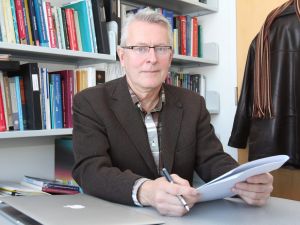
Assistant Professor of Physics Barak Shoshany was part of recent research, along with Brock University PhD student Alessandro Pisana, exploring how wormholes could be created.
 Is it possible to create shortcuts across the universe?
That question is at the center of a theoretical physics study led by Brock University PhD student Alessandro Pisana. His work explores how wormholes — a staple of science fiction — could form within Einstein’s theory of relativity, which describes gravity as the curvature of spacetime caused by mass and energy.
While no wormholes have been observed in nature, they can be described as mathematical solutions of Einstein’s equations and studied from a theoretical perspective. Hypothetically, a wormhole could serve as a short tunnel through space and time that connects two distant locations in the universe, and perhaps even two different points in time.
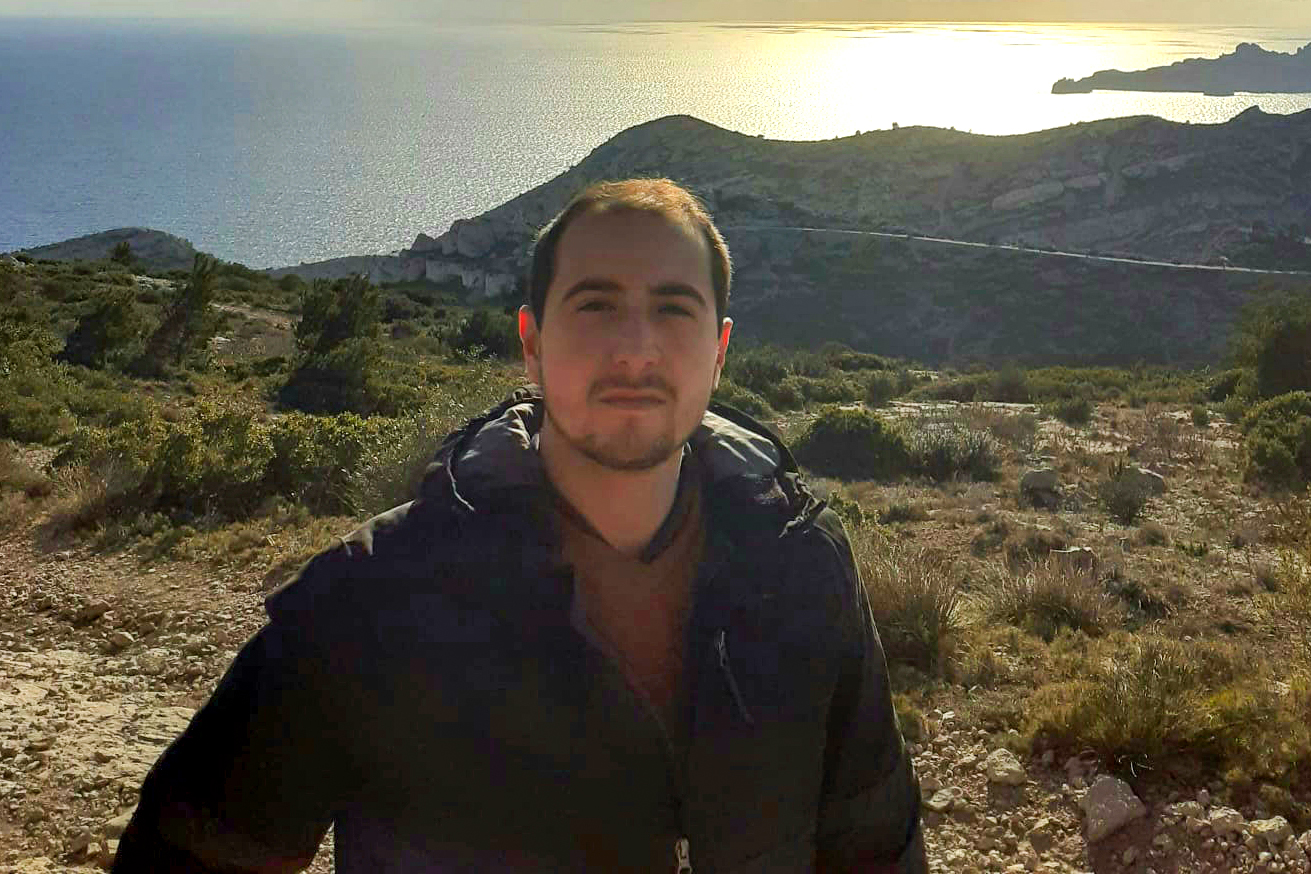
Brock PhD student Alessandro Pisana recently conducted a research project on wormholes.
After arriving at Brock in 2022, Pisana realized that while existing literature has concentrated on studying theoretical models of how wormholes could be maintained, less attention has been paid to how a wormhole could form in the first place.
That gap became the focus of a new research paper, “Wormhole Nucleation via Topological Surgery in Lorentzian Geometry,” published in Physical Review D and freely available on the arXiv.
“Previous research has found that creating a wormhole from empty space would necessarily require creating either singularities or closed timelike curves,” says Pisana. “In our paper, we found a concrete model of wormhole creation without creating a singularity — the first such model in the literature.”
Pisana says a singularity is a region where the rules of physics break down, which should be avoided at all costs, while a closed timelike curve is a path through spacetime that loops back on itself, which may lead to causal paradoxes.
The research team used mathematical tools from topological surgery, a technique for studying how the shape of space can change, to model the moment the wormhole forms. This, combined with a “cut and paste” geometry, avoids the creation of a singularity and introduces the closed timelike curves in a controlled way.
This framework could also help researchers explore other situations where singularities arise due to changes in the shape of space. Even if nature prevents these such scenarios in practice, having a concrete model would help clarify the relationship between singularity resolution and causality as well as what a future theory of quantum gravity may need to explain.
Pisana worked on the research with Assistant Professor of Physics Barak Shoshany, his PhD supervisor, as well as Stathis Antoniou and Professor Sofia Lambropoulou from the National Technical University of Athens and Professor Louis Kauffman from the University of Illinois Chicago.
The opportunity to work with Shoshany, whose research focuses on wormholes, causality and related topics, was one of the reasons Pisana chose to pursue a PhD in Theoretical Physics at Brock.
Originally from Italy, Pisana says the supports available to international students at Brock, and the warm welcome he received from the Department of Physics, made it easier to adjust to a new country and academic environment.
Looking ahead, he plans to tackle larger questions about spacetime and gravity through his research at the intersection of theoretical physics and mathematics.