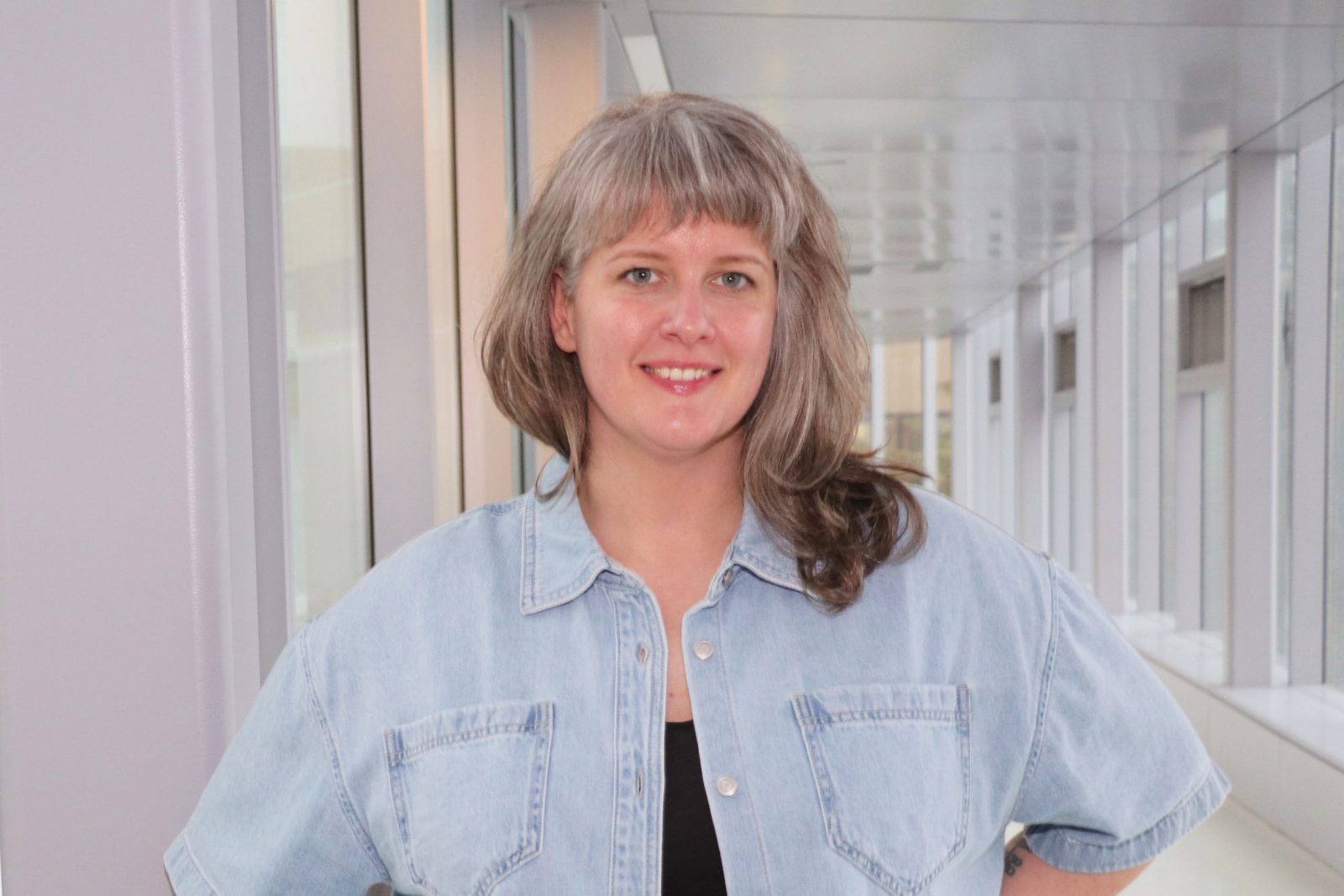
 Associate Professor of Child and Youth Studies Chelsea Jones has been awarded Brock University’s 2025 Chancellor’s Chair for Research Excellence for her project aiming to create an online studio for young digital content creators with disabilities.
Chelsea Jones is trying to change the world, one online space at a time, by building a hub for young content creators with disabilities.
The Access Imaginarium: Crip Futures Studio aims to reconceptualize equity and digital accessibility “as an artful, aesthetic, community-engaged, and youth-led cultural practice,” says the Associate Professor of Child and Youth Studies.
The Studio is one of the initiatives Jones aims to pursue in her research program, “Reshaping Digital Access in Childhood and Disability Media Studies,” as recipient of Brock’s 2025 Chancellor’s Chair for Research Excellence.
“Dr. Jones’s research goes far beyond merely meeting legal requirements to make digital content accessible to everyone,” says Vice-President, Research Tim Kenyon. “By positioning disabled youth as experts of content creation and training, Dr. Jones and her team are transforming the online space into one that emphasizes insight, agency and autonomy over messaging.”
Jones envisions the Studio as a hub where youth and scholars with disabilities from around the world can connect with one another to design accessible media, experiment with immersive arts, provide training, and advocate for policies and education that make online spaces accessible to all.
Steering the process is an advisory committee of youth with disabilities who will give direction on the project’s creation and implementation, especially since these content creators are often not properly acknowledged for their work, she says.
“The relationship building is based on justice and premised on the idea that accessibility is not just a compliance-based kind of afterthought, but an iterative creative process that young disabled people are deeply involved in,” says Jones.
Accessible media refers to movies, television shows, videos, websites and other content that have been modified using measures such as closed captioning, sign language, transcripts and audio descriptions.
Accessibility measures tend to be added on to what’s already been produced so as to comply with the Accessibility for Ontarians with Disabilities Act, says Jones. Her work aims is to make accessibility the foundation of whatever material is being generated.
For example, she refers to the “silent podcast,” a style of broadcasting that incorporates long pauses during the show to allow neurodivergent guests and audiences to process information. Or, instead of subtitles scrolling at the bottom of a screen, text is incorporated through speech or thought bubbles in scenes where a character is sending and receiving texts and the messages are displayed on the screen.
While this type of material is already being produced, these efforts tend to be overlooked, Jones says.
“The question is, how do we support the co-creation of this content that advances and actually surpasses established industry norms around making accessible media?” she says.
Jones’s current research builds on 15 years of research on media production and access to digital technology.
In 2019, she organized a panel at the international Cripping the Arts Symposium, where disabled young creators expressed dissatisfaction about how their content was being manipulated by mainstream media outlets.
That led to research – based largely at Re·Vision: The Center for Art and Social Justice at the University of Guelph – on how to make accessibility tools artistic and aesthetically pleasing to audiences in filmmaking, podcasting, poetry and digital tool production.
Currently, in addition to coordinating the Studio, Jones and her team are providing training and mentorship opportunities for 60 youth worldwide through their “Making Accessible Media with Youth” project, funded by the Government of Ontario’s Early Researcher Award.