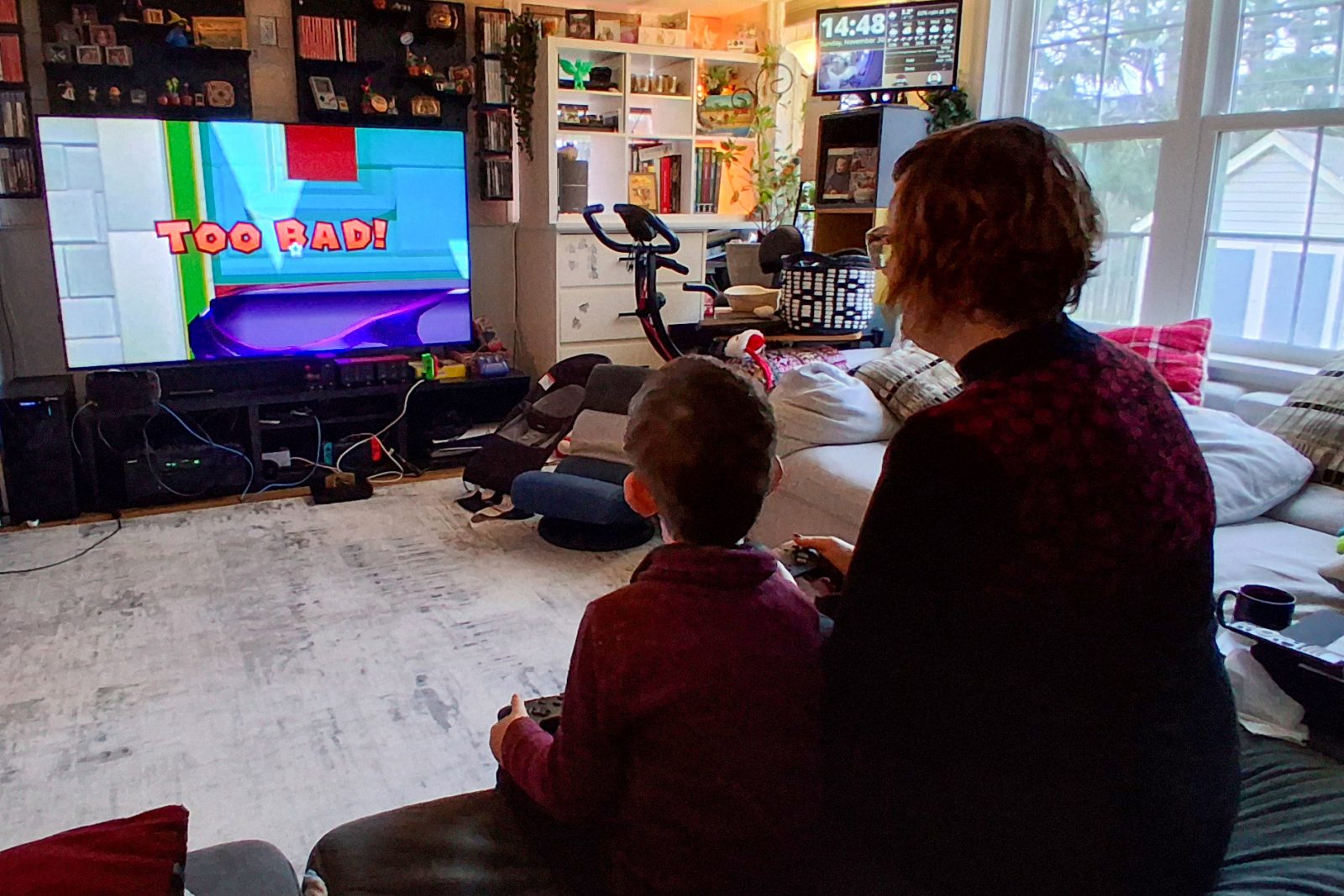
 Associate Professor of Game Studies Sarah Stang (right), a mom herself, is researching how video game players and developers view pregnant and maternal characters in games as well as their experiences in gaming workplaces and communities.
Sarah Stang can still remember the image of a spider-shaped pregnant woman looming large on her screen. The then-PhD candidate was two months away from delivering her first child when she picked up a new video game that involved battling a somewhat monstrous mother figure and her spider offspring.
“When you’re pregnant and you’re forced to fight a screaming pregnant monstrosity, you don’t necessarily want to murder a being you sort-of resonate with,” says the Associate Professor of Game Studies.
That experience stuck with Stang.
Years later, she’s teamed up with Lauren Cruikshank from the University of New Brunswick to explore motherhood in the gaming world, an area that has not been well studied, Stang says.
Their project, “Pregnancy, Motherhood, and Play: The Experiences and Perspectives of Video Game Player and Developer Mothers and Mothers-to-Be,” is supported by the Social Sciences and Humanities Research Council of Canada (SSHRC), which is funded by the Government of Canada.
The research builds on the results of an earlier survey the duo sent to video game developers, players, mothers-to-be, mothers and non-mothers that sought to gather opinions on the representations of motherhood in video games. It also asked game developers who identified as mothers if they were treated differently in the industry compared to their male counterparts and if gamers and streamers still felt welcome in the gaming community during pregnancy and motherhood.
Stang and Cruikshank’s current research involves examining the survey data to assess how players and developers, especially those who identify as mothers, view pregnant and maternal characters in games and their experiences in gaming workplaces and communities.
The duo is also conducting semi-structured, in-depth interviews to gauge how mothers fare in gaming communities and in mainstream and independent game industries.
Stang says her research to date has revealed some troubling trends.
“In video games, most of the time you won’t see a mom at all; they’re totally absent,” she says. “They’re just not part of the story, because the story’s all about adult men and their experiences, or the mothers died before the story began.”
Mothers and motherhood in monster-themed games are often depicted using science fiction, fantasy and “body horror” imagery, Stang says, which can parallel the tremendous bodily changes brought about by pregnancy.
She says a common theme of these games is “male hero slays female monster” and her monstrous children, which can be triggering for expecting players.
Even more problematic is the fate of mothers in the industry, Stang says.
“There’s still this sense that there’s no problem for a dad, that he’ll just go back to work and continue making games,” she says.
“But if you’re a mom, it’s like, ‘don’t bother coming back unless you can meet the same level of expectations we had for you before you became a mother,’ which is impossible for most people now, especially those in the United States who have very short maternity leaves,” she says.
Stang hopes their research will lead to a deeper understanding of the current situation regarding both in-game representation of pregnancy, childbirth and motherhood as well as what it’s like to be a mother in gaming communities and the industry.
Some of the project’s outcomes will be a white paper outlining ways developers can improve maternal representation in games as well as an annotated database of games that feature these kinds of portrayals, both positive and negative, she says.
“Highlighting the troubling trends, giving voice to mom gamers and developers whose opinions are rarely heard, and providing practical advice for creating more positive and nuanced representations will hopefully contribute to creating positive change in this hugely influential and lucrative medium,” Stang says.