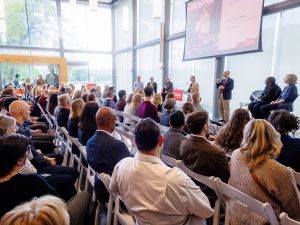
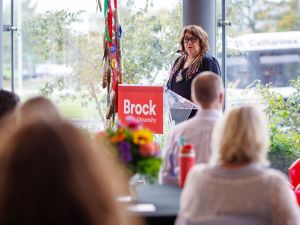
Faculty of Social Sciences Early Career Researcher Charlis Raineki (left) and Distinguished Researcher Julie Ham (right) each presented talks on their findings to a packed house at the Social Sciences Research Colloquium on Friday, Dec. 5. The event was hosted by Acting Dean Dawn Zinga (centre).
Fetal alcohol exposure, technology used to facilitate sexual violence and the hypersexualization of racialized sex workers were among the many subjects explored at the eighth annual Social Sciences Research Colloquium Friday, Dec. 5.
The event featured talks from 2024 Faculty research award winners and a selection of graduate students, as well as a student poster fair.
Social Justice and Equity Studies master’s student Mackenzie Rockbrune (BA ’22) was one of three student speakers, sharing research from her thesis about Brock students’ knowledge of and experiences with deepfakes used for sexual violence.
Rockbrune says the project stems from her deep concern about data privacy risks related to artificial intelligence (AI) and that as “technology evolves faster than policies and public education,” she hopes to highlight the problem and spark conversations.

Twenty students took part in the first-ever Social Sciences Research Colloquium Poster Fair.
“As artificial intelligence continues to advance, students and the Brock community are facing everyday realities of deepfakes and AI-related harms, but they don’t have the public education or terminology to discuss these harms,” she says.
Rockbrune was joined on the student panel by MA candidate Temilade Adesina in Applied Disability Studies, who shared findings on concerns affecting the mental well-being of disabled students who withdraw from post-secondary, and PhD candidate Erika Savage in Child and Youth Studies, who is studying children’s cognitive engagement across their academic and extracurricular activities.
After a break for poster viewing, Faculty of Social Sciences Early Career Researcher Charlis Raineki shared some of his ongoing research into gut microbiota and fetal alcohol spectrum disorder in a talk, “Understanding how early environments shape health and disease: a translational approach using prenatal alcohol exposure.”
The Assistant Professor of Psychology’s work in this area is funded by the National Institutes of Health (NIH) in the U.S., specifically the National Institute on Alcohol Abuse and Alcoholism and the Collaborative Initiative on Fetal Alcohol Spectrum Disorders. Raineki was the first Brock researcher to be directly awarded funding from NIH.
He says his translational approach to this research, which brings together findings about rats, non-human primates and humans, gives the best chance of identifying core biological effects of prenatal alcohol exposure, which could in turn yield multiple benefits.
“Finding a biomarker might help a diagnosis of fetal alcohol spectrum disorder, which will allow for earlier and more targeted interventions,” he says. “If we know biologically what’s happening, we can not only improve the interventions that are available but we can also help guide the development of new treatments.”
Rounding out the program was Distinguished Researcher Julie Ham, who is internationally known for her research on migration and criminality, the experiences of domestic workers and the rights of sex workers. Her work prioritizes the voices of members of those communities and creative expressions of their stories.

PhD student Erika Savage (left) and master’s students Temilade Adesina (centre) and Mackenzie Rockbrune (right) were selected from a pool of applicants to deliver presentations on their research.
Ham, an Associate Professor in the Department of Sociology and Criminology, is the author of Sex Work, Immigration and Social Difference and co-editor of The Routledge Handbook on Crime and International Migration and Ingat: An Anthology of Works by Migrant Domestic Worker Creatives in Hong Kong. Her co-authored paper on sex work and human trafficking won the Radzinowicz Memorial Prize from The British Journal of Criminology , and she has written several reports for organizations such as the Global Alliance Against Traffic in Women and the United Nations.
In her talk, “Hypersexualization and racialized erotic capital in sex work,” Ham tackled the question of how to understand hypersexualization within a sex-worker rights framework.
“We can absolutely talk about the histories of hypersexualization that have emerged in a settler colonial context, and we can also talk about the rights of Asian women sex workers from a sex-worker-rights perspective, and bridge the gap between those two conversations,” she says.
Acting Dean of Social Sciences Dawn Zinga says the event showcased the scope of research being undertaken within the Faculty and highlighted the value of different disciplinary lenses when approaching socially significant topics.
“Hearing from award-winning faculty researchers alongside our graduate students and reading about the projects being carried out by student researchers across our departments and centres was incredibly inspiring,” Zinga says. “The afternoon was a testament to the teaching, mentorship and research training taking place in labs and offices across the Social Sciences every day.”