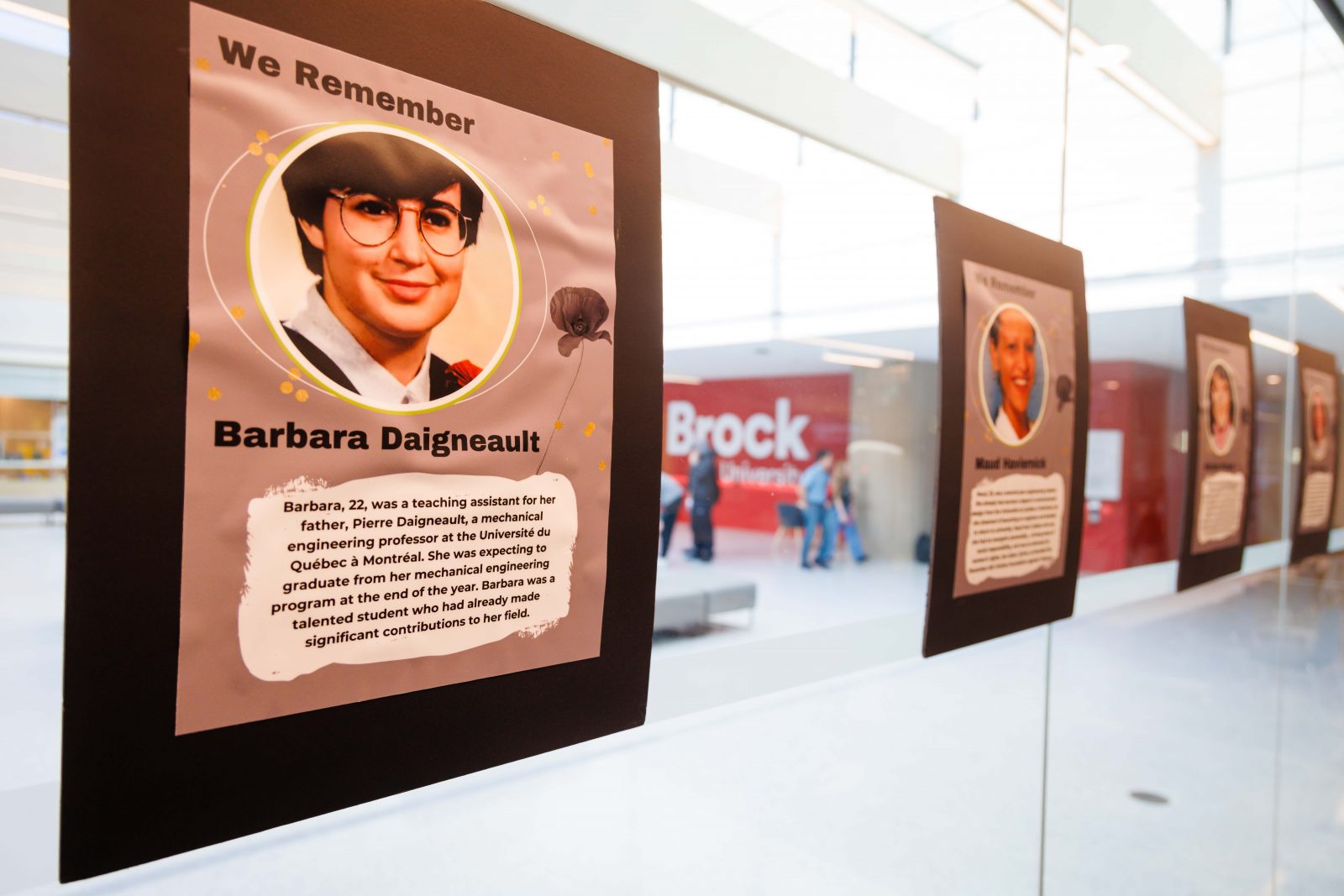
 Brock University marked the National Day of Remembrance and Action on Violence Against Women with a memorial and discussion in Rankin Family Pavilion on Friday, Dec. 5.
On Dec. 6, 1989, 14 women were murdered at l’École Polytechnique de Montréal.
The tragedy that profoundly shocked the nation brought with it a terrifying realization for then 11-year-old Robyn Bourgeois: that she could be killed for being a woman.
Now an Associate Professor of Women’s and Gender Studies and Brock’s Vice-Provost, Indigenous Engagement, Bourgeois reflected on the startling revelation while delivering opening remarks at a gathering at the University on Friday, Dec 5. The event served to mark the National Day of Remembrance and Action on Violence Against Women, observed annually on Dec. 6 in remembrance of those who have experienced and been lost to gender-based violence.
Bourgeois, herself a survivor of gender-based violence, spoke about her decades of work committed to building safer and more equitable communities by dismantling the interlocking structures of social power that underpin violence.
Throughout her career, she has conducted scholarly research in areas such as intimate partner homicide, violence against Indigenous women and girls, and sexual violence, including human trafficking. She also serves as a reviewing member for the Domestic Violence Death Review Committee for the Chief Coroner of Ontario, for which she authored a report on gaps in care for child survivors in the aftermath of intimate partner homicide.

Robyn Bourgeois (left), Associate Professor of Women’s and Gender Studies and Vice-Provost, Indigenous Engagement, spoke about steps needed to eradicate gender-based and sexual violence during Friday’s event.
While gains have been made, Bourgeois said that overwhelming rates of these various intersecting incidents of violence have continued to rise across Canada since the 1980s.
“We have failed to grasp the essential interconnections between heteropatriarchy, white supremacy, colonialism, capitalism, ableism and other forms of systemic oppression that establish and sustain this violence,” she said. “Until we can see the deaths of these 14 women as entwined with the phenomenon of missing and murdered Indigenous women, girls and 2SLGBTQQIA people; transphobia and anti-trans violence; the deaths of Black and other racially marginalized people at the hands of police; or the exploitation of migrants through trafficking — to name but a few examples — we will never make meaningful advances in ending gender-based violence for anyone.”
A screening of Gone for a Run, the new short film by Professor of Kinesiology Cathy van Ingen, also took place at Friday’s event. The film visualizes van Ingen’s decades of research on gender-based violence, focusing on incidents impacting those in the running community.
Attendees also engaged in guided discussions about gender-based and sexual violence and were encouraged to think critically about whose stories are remembered — whose are not — and how to move from remembrance to meaningful action.
“The best way to honour the lives of the 14 women murdered at l’École Polytechnique is to commit to ending all forms of gender-based violence — regardless of whether they impact us directly or not,” Bourgeois said. “Gender-based violence is everyone’s problem, and it will take everyone acting to bring it to an end.”